
Most AI visibility audits would have found an easy story in this data.
Equity and KCB appeared in 28 of 36 answers. Co-operative Bank appeared in 26. NCBA appeared in 22. Put those numbers into a league table, colour the winner green, and send the presentation.
Then we checked what the answers actually told prospective customers. The problems showed up quickly, and they appeared before anyone had optimised a single page.
Ask the same question twice and the list of recommended banks changed. One bank stayed in first place, but the transaction fee quoted for it kept shifting. In one case a sponsored article was among the sources an AI cited. In another, a condition for opening an account appeared in one answer and vanished from the next. And one cited comparison stated the wrong repayment term for the product it named.
The pattern held across platforms. In 36 matched comparisons, ChatGPT, Google AI Overviews, and Perplexity never returned the same full shortlist of banks.
That does not make GEO pointless. It makes shallow GEO measurement dangerous.
A bank does not earn revenue because its name appeared in an answer. The right customer must see a suitable product, understand the material conditions, trust the evidence, and take the next step.
That is the marketing question behind this study:
When AI recommends your bank, does the answer help the right customer make the right next move?
Attention Lasso helps brands understand how customers discover them across search and AI, where the journey breaks, and what to improve next. Explore our SEO, AEO, and GEO work, or bring us one customer journey that matters.
We started where most GEO audits stop looking
The first job was not choosing prompts. It was listening.
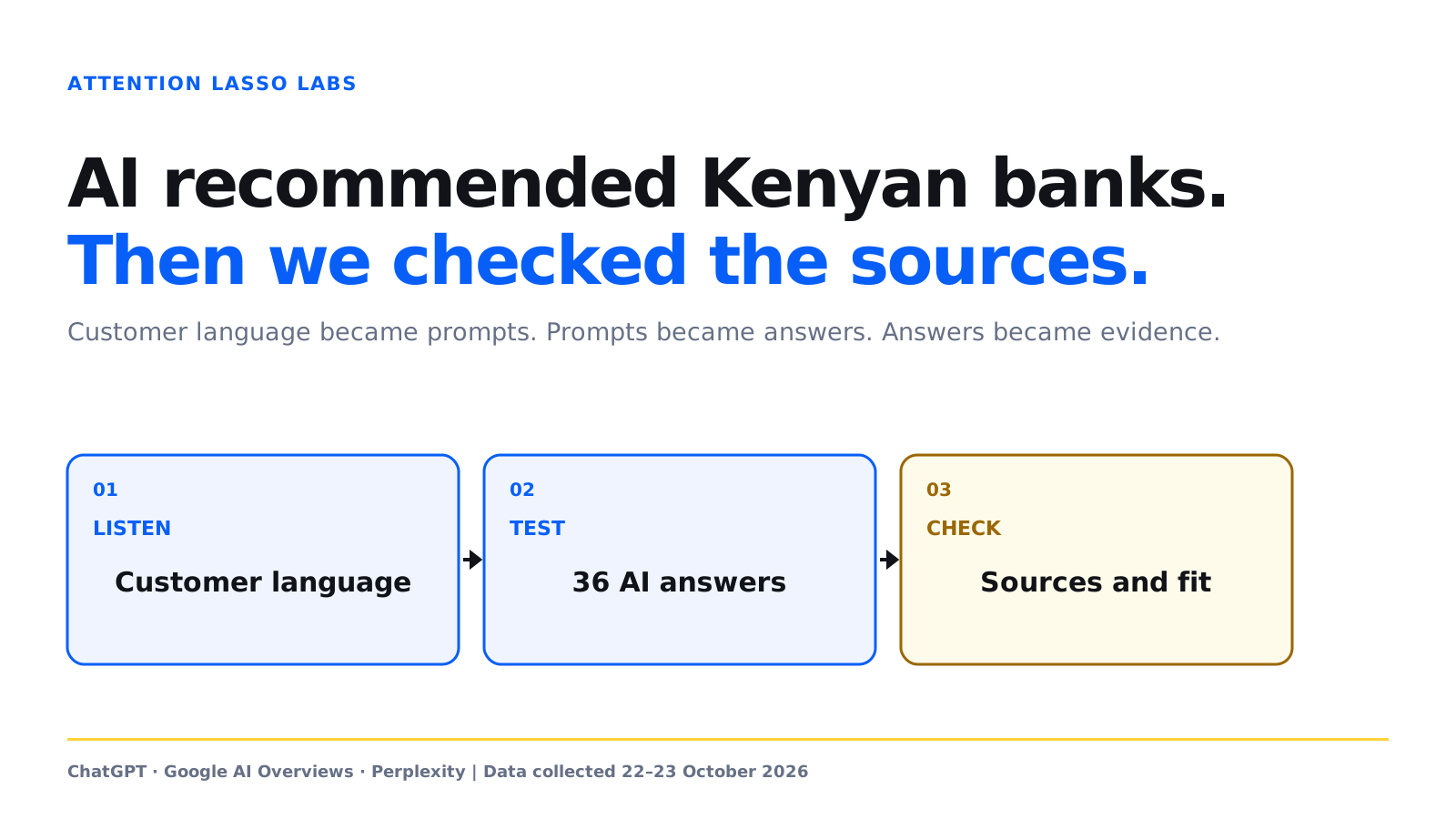
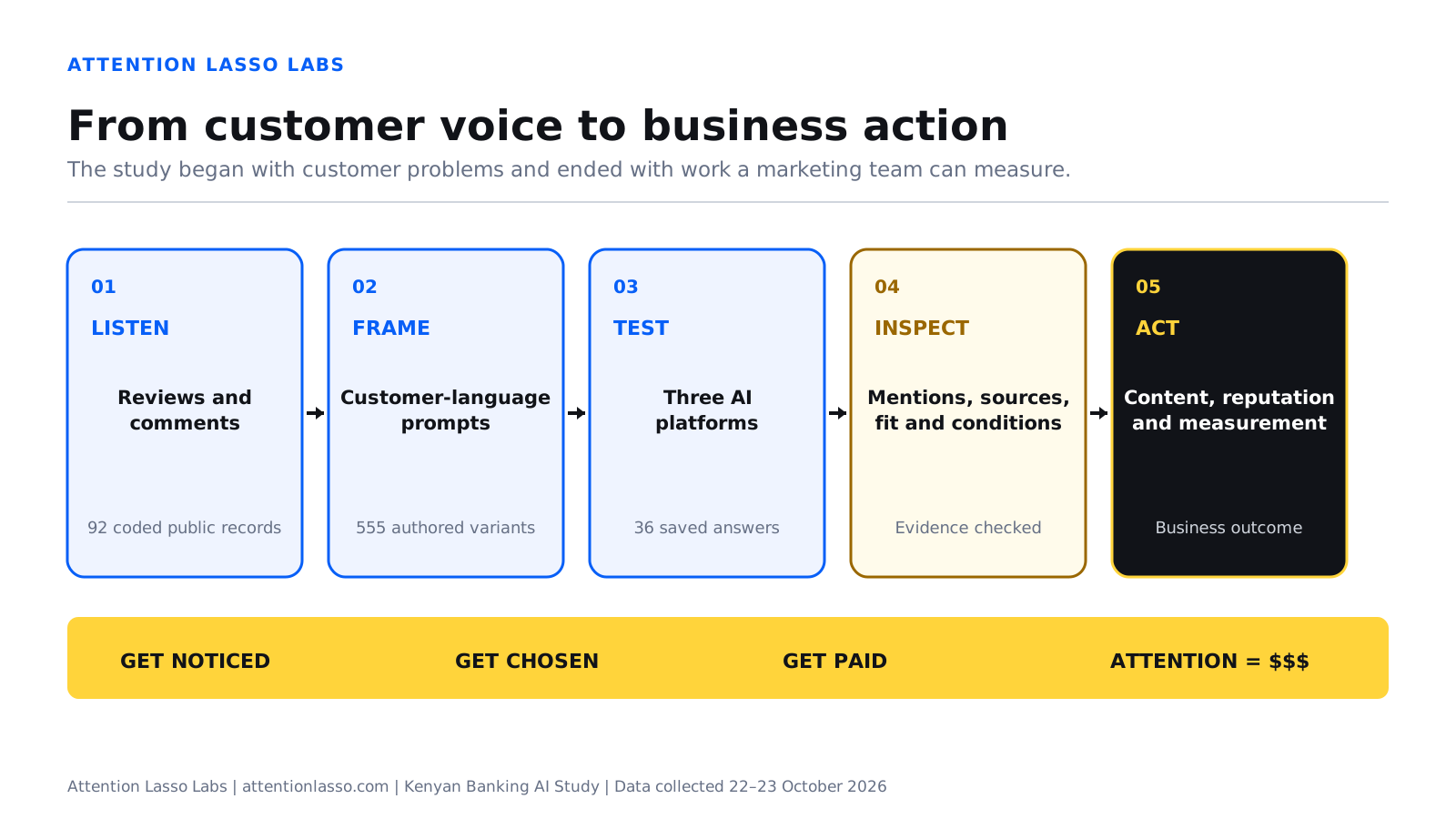
I reviewed public comments and reviews about Kenyan banks, then coded the problems people described: years of account history without loan eligibility, repayment periods that felt punishing, unclear transaction costs, app access after changing phones, and account-opening requirements for people outside Kenya.
The language was rarely tidy. One customer wrote:
Muongeze iwe 6 months , hio ya 3 months hutumalizaaa
Roughly: make it six months because three months finishes us.
That kind of sentence contains more useful research direction than “best bank in Kenya”. It carries a constraint, emotion, desired outcome, and the language a real person might use when asking for help.
From the wider voice-of-customer work, we created 555 authored prompt variants, including English versions, and retained 178 verbatim wording candidates. Those numbers describe the research library. They do not mean 555 people typed those prompts into an AI tool, and they do not enlarge the executed sample.
For this pilot, we chose six commercially useful needs:
- clear loan eligibility;
- longer repayment periods;
- borrowing against business income without a payslip;
- low-cost transfers for small amounts;
- regaining app access from abroad; and
- opening savings without visiting a branch.
The six needs trace back to 92 coded public records. We then wrote two test versions for each and ran them on three platforms, producing 36 saved answers.
This method addresses a weakness Andy Crestodina identified in his review of 100 AI visibility audits: many audits generate prompts from the company website instead of researching the questions buyers actually have.
It also exposed a risk in our own process. Translating or cleaning a comment can alter the problem. A loyalty complaint can become an eligibility question. A request to recover an account can become a general question about using an app abroad.
The prompt must preserve the customer’s decisive constraint. Otherwise, a polished research library can measure the wrong journey with great precision.
The same question moved before any optimisation happened
One prompt appeared twice with exactly the same wording:
Which banks in Kenya explain clearly how you qualify for a loan?
That gave us an identical-input repeat on every platform.
| Platform | What changed between the two captures? | Bank-set overlap | Captured-source overlap |
|---|---|---|---|
| ChatGPT | Bank of Africa left; Equity entered. Co-operative stayed first. | 66.7% | 66.7% |
| Google AI Overviews | National Bank entered. Co-operative stayed first. | 80.0% | 57.1% |
| Perplexity | The same four banks and sources remained, but Stanbic and Co-operative exchanged first and second place. | 100% | 100% |
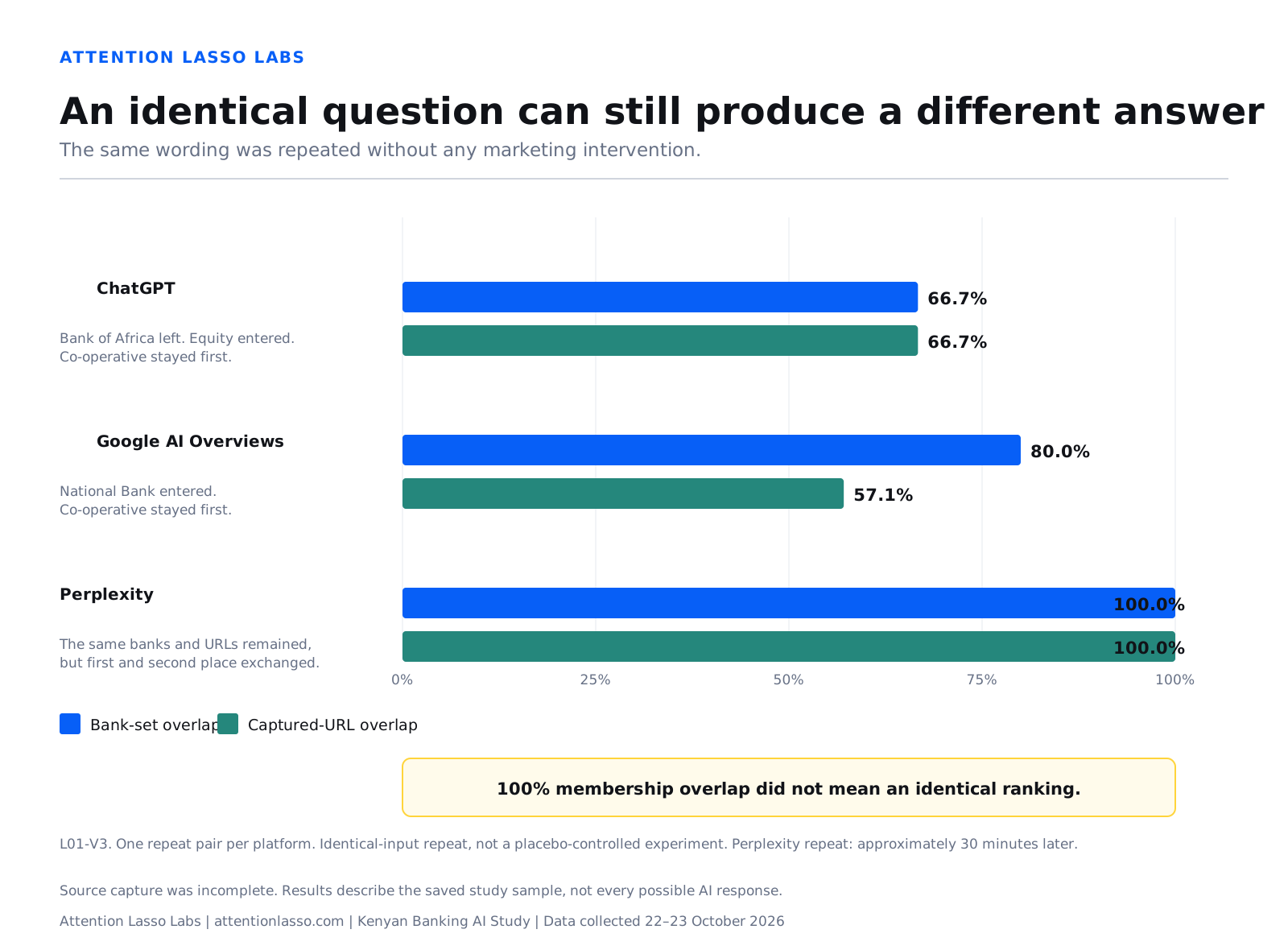
For Google, the nine visible organic-result cards stayed unchanged while the AI shortlist changed. Perplexity retained the same banks and captured sources but changed their order.
This is not a placebo-controlled experiment. There was no treatment, random assignment, or enough repeated collection to estimate each platform’s normal variation. It is an identical-input repeat, or a negative control for wording.
The marketing implication is still serious. If an agency shows one screenshot before a page edit and another afterwards, the change cannot automatically be credited to the optimisation. A useful baseline needs repeated answers under recorded conditions.
The 2026 preprint Don’t Measure Once makes the same broader methodological case. Our small study is consistent with that concern; it is not a replication of the paper’s results.
GEO may influence the probability of accurate inclusion. This experiment changed no bank content, so it cannot measure that effect. It shows why the test design must account for movement that happens without the intervention.
The platforms agreed on familiar names and little else
The same large banks kept returning. Equity and KCB appeared 28 times each, Co-operative 26, NCBA 22, and Absa 21.
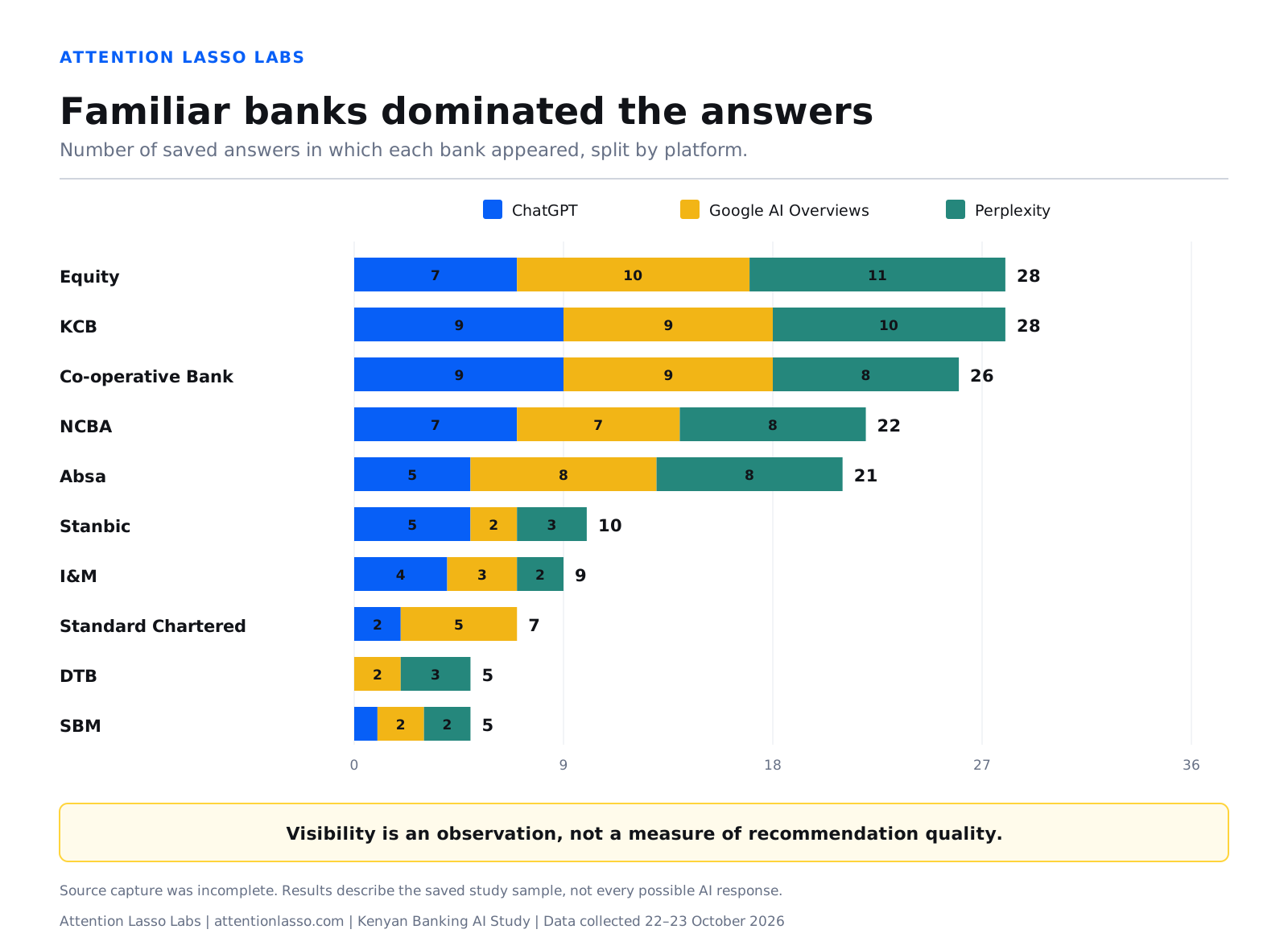
Yet no matched cross-platform comparison produced the same complete shortlist. We compared each of the twelve question slots across all three platform pairs, giving 36 comparisons. Every pair differed.
Google and Perplexity had the highest mean bank-set overlap at 55.0%. ChatGPT and Google averaged 42.2%. ChatGPT and Perplexity averaged 38.1%.
The sources agreed even less. Mean captured-URL overlap was 15.5% for Google and Perplexity, 9.3% for ChatGPT and Google, and 7.5% for ChatGPT and Perplexity.
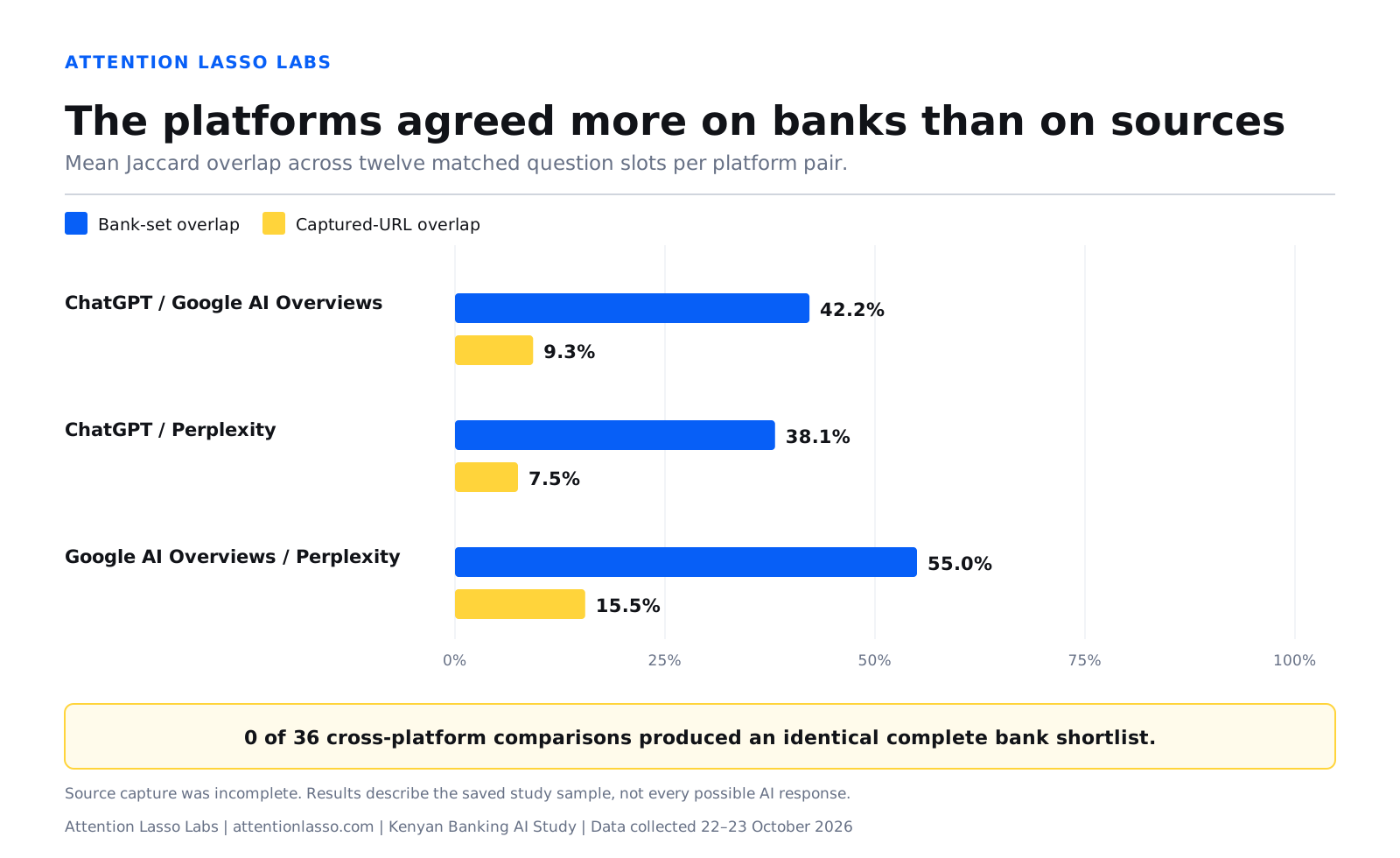
Two platforms could therefore arrive at partly familiar recommendations through mostly different pages.
That matters to marketers because aggregate visibility conceals topic ownership. SBM Bank appeared in only two Perplexity answers, but it was first in both fee answers. Standard Chartered appeared in five Google answers and none of the Perplexity answers.
A single share-of-voice number cannot show which customer need a bank owns, which source supports it, or whether the recommendation is suitable.
A useful audit needs more than a mention column
We found six separate things worth recording:
- Presence: Was the bank included?
- Prominence: Where did it appear in the answer?
- Need fit: Did the recommended product solve the customer’s actual problem?
- Evidence fit: Did the source support the claim, market, and product?
- Condition survival: Did fees, eligibility rules, expiry dates, and branch requirements remain visible?
- Business action: Could an eligible customer complete the next step?
The study produced examples at every layer.
Perplexity recommended KCB M-Pesa as a six-month option. The cited comparison repeated that claim, while the official KCB M-Pesa page specified one month. KCB was visible, prominent, and cited. The named product still failed the customer’s requested term.
Both Perplexity fee answers placed SBM Bank first. One described PesaLink transfers as free up to KES 999,999; the other described a KES 20 charge above KES 1,000. An official SBM Bank article gave a promotion end date of 31 July 2026. Our checks did not settle the exact October tariff. The defensible finding is that the two answers gave different prices without reconciling their dates.
One Perplexity savings answer preserved Absa’s active-current-account prerequisite. The paired answer listed app opening without it. Absa’s official page states the condition.
A TUKO fee comparison entered Google’s English answer and both Perplexity fee answers. The article was attributed to Branded Content and labelled Sponsored. That does not prove the article was inaccurate or that anyone paid an AI platform for placement. It shows that citation is not the same as independent endorsement.
These are targeted checks, not a randomly sampled accuracy audit. We cannot convert them into a platform error rate. They demonstrate why a mention count and a citation count are not enough to assess marketing quality.
Banks owned the eligibility evidence. Publishers owned the fee conversation.
Source patterns changed sharply by customer need.
For loan eligibility, nine of eleven recovered Google source records and all eight Perplexity records were bank-owned. For transaction fees, one of fourteen Google records and none of twelve Perplexity records were bank-owned.
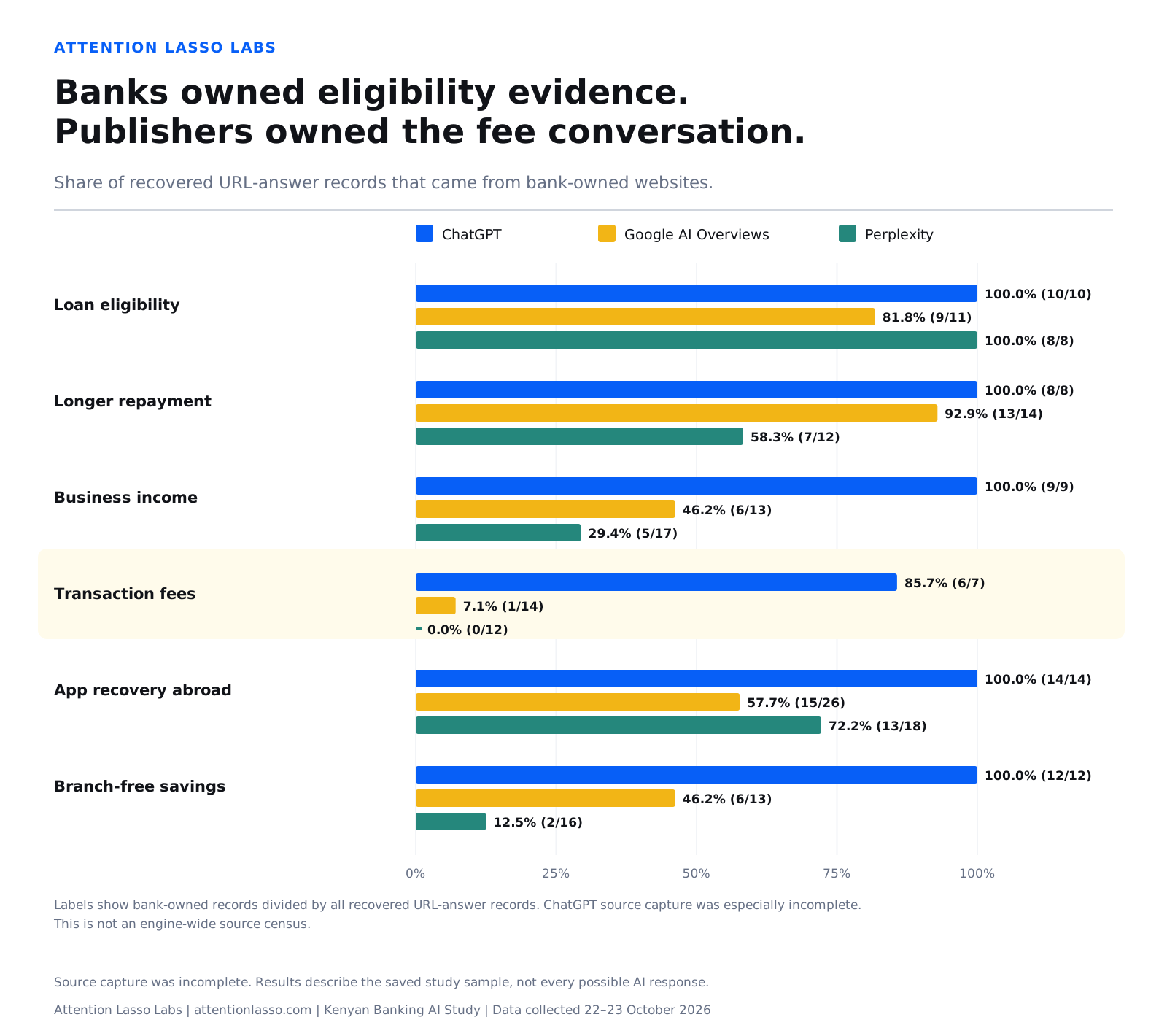
When people asked who qualifies, official product pages did much of the explaining. When they asked what a transaction would cost, comparison sites, publishers, social posts, and other third parties took over.
That suggests two different marketing jobs.
For eligibility and support, banks need precise first-party pages that state the product, market, documents, restrictions, and exceptions. For comparison questions, the bank also needs current information that publishers can verify, dated fee examples, and a process for correcting old or incomplete coverage.
The page format alone is not the finding. This study did not manipulate tables, FAQs, schema, or HTML. It observed the pages present in the captured answers.
Google’s AI answers and visible search results shared a neighbourhood
The Google screenshots gave us another useful comparison. Each search showed nine standalone organic-result cards alongside the AI Overview.
Of 84 observed AI citation-domain instances, 57 also appeared among those visible organic cards. Twenty-seven did not. Ten of the twelve Google answers cited at least one domain outside the captured cards.
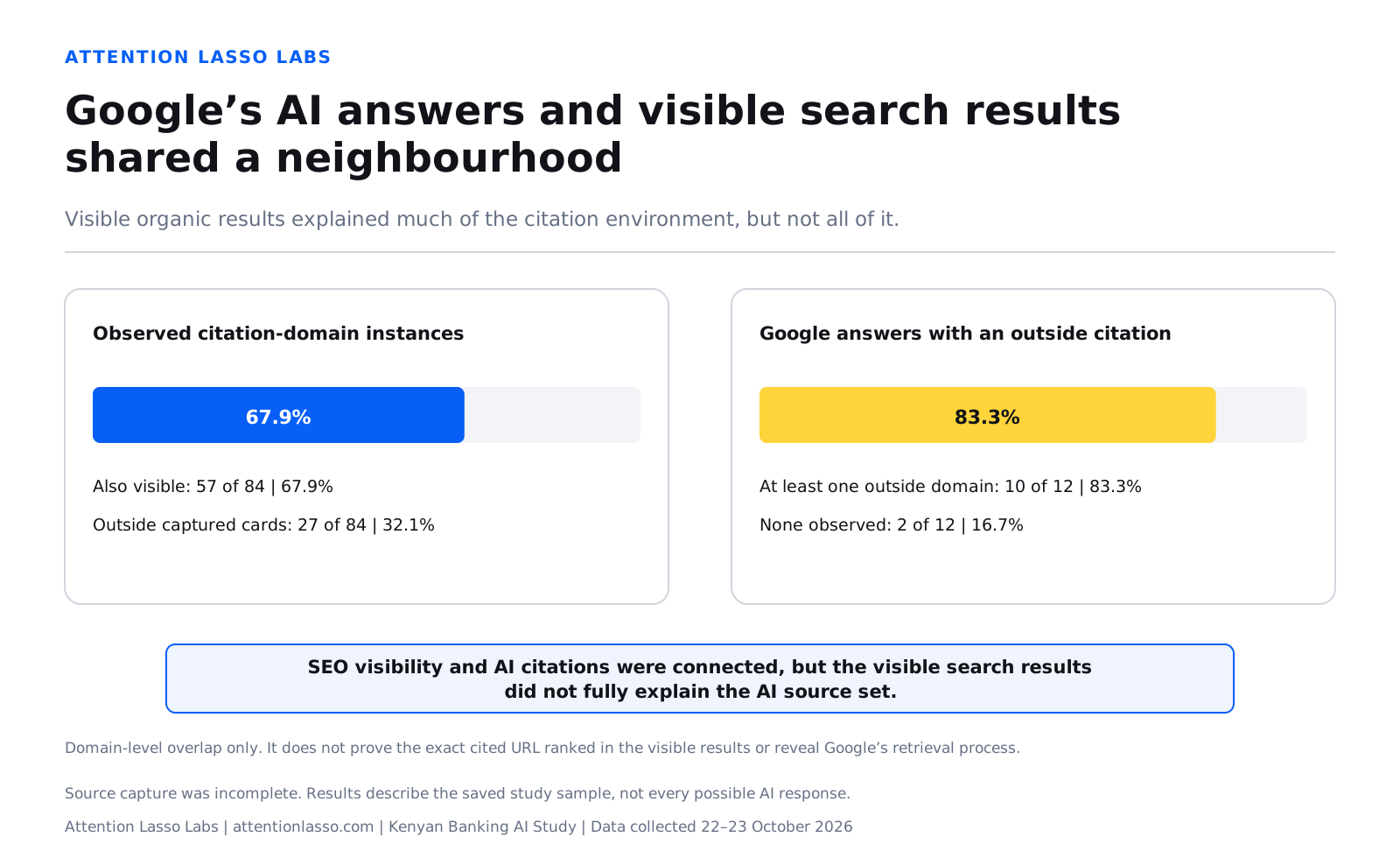
This is domain overlap, not proof that an exact cited URL ranked in the top ten. It also cannot reveal Google’s internal retrieval process.
The practical reading is more restrained: ordinary search visibility and AI citations were connected, but the visible SERP did not fully explain the AI source set.
For a marketing team, that supports an integrated approach. Technical SEO, useful product pages, digital PR, accurate comparison coverage, and customer-centred content all belong in the same discovery system. A separate bag of “GEO hacks” is not a strategy.
Google’s own guidance for AI features in Search similarly treats this work as part of SEO and discourages special files and gimmicks.
Did customer language change the answers?
All twelve English versus mixed-language pairs produced different full bank sets across the three platforms.
That is interesting. It is not proof of a Kiswahili or Sheng effect.
The identical English question changed too. The two English remote-access formulations also changed. Collection order, elapsed time, platform settings, retrieval, and account state were not isolated.
The useful marketing decision is to keep bilingual and natural-language testing in the prompt set because different customers express the same need differently. Report the result as a wording condition until a controlled study can separate language from ordinary answer variation.
Did comments, reviews, or engagement cause visibility?
We cannot establish that relationship from this data.
The comment samples covered different posts, dates, and audiences. We did not collect comparable reach, complete review totals, or consistent exposure windows for every bank. None of the recovered Perplexity sources directly cited the Facebook threads used for customer-language research.
The relationship we can demonstrate is:
Customer statement → coded need → authored prompt → captured answer → inspected source → proposed marketing action
Comments and reviews helped us discover better questions. They were not proven ranking factors.
That distinction protects marketers from turning correlation into strategy. Voice-of-customer research tells you what to investigate and answer. It does not automatically tell you why an AI platform selected a bank.
What this study says about GEO
| Common claim | What the data supports |
|---|---|
| One AI response establishes a brand’s ranking | Challenged by the identical-input repeats. |
| A citation means the claim is correct and independent | Challenged by product conflicts, omitted conditions, and sponsored content. |
| Every platform recommends the same brands | False for these matched captures, although familiar banks recurred. |
| Mixed Kiswahili-English caused the answer changes | Not established. Unchanged English prompts also moved. |
| More comments or engagement creates more AI visibility | Untested by this dataset. |
| A special GEO format increases visibility | Untested. No page intervention occurred. |
| Accurate, discoverable customer information is useful | Consistent with the observed citations and customer problems, but the causal mechanism still needs testing. |
The phrase “GEO” currently covers useful marketing work and claims the evidence cannot support.
A screenshot-based ranking report is weak. Researching customer questions, checking how a brand is represented, improving the evidence, and measuring whether accurate answers become more likely is useful work.
The next experiment must connect that work to a result a bank values.
What a bank marketing team can do next
| Customer journey | Content or reputation task | Measurement after the change |
|---|---|---|
| Loan eligibility | State accepted income evidence, documents, account history, restrictions, and market | Accurate eligibility descriptions and qualified application starts |
| Longer repayment | Compare similar products by term, amount, fee, and channel; correct materially wrong coverage | Correct product-term pairing and suitable enquiries |
| Business income | Explain whether business records, bank statements, or M-Pesa evidence qualify for each product | Kenya-specific answers and qualified SME enquiries |
| Small transfer fees | Maintain dated examples by amount, channel, account type, tax, and promotion period | Correct scenario costs and relevant account-opening enquiries |
| Access from abroad | Separate app use, activation, new-device reset, OTP loss, unlocking, and branch exceptions | Preserved constraints, successful recovery, and fewer repeat contacts |
| Remote savings | Put prerequisite accounts, KYC, opening, and activation conditions beside the application | Eligible completed openings and fewer failed attempts |
Start with one commercially important journey. Capture repeated baseline answers under recorded settings. Improve a specific page or correct a specific external claim. Keep a comparable topic unchanged. Then repeat the questions.
Define success before the change. Presence and first position are useful observations. Accurate inclusion, a current supporting source, preserved eligibility conditions, and a suitable next step are stronger marketing measures. Qualified applications, completed openings, or resolved support problems are the business outcomes.
How we ran the study
We tested six selected customer needs under two wording labels on three platforms, producing 36 saved answers from 11 unique prompt strings. L01 repeated the same English question.
ChatGPT and Google AI Overviews were captured on 22 October 2026 in incognito windows. Every ChatGPT capture was the first response in a fresh chat and tab. Google received the same questions.
Perplexity was captured on 23 October using a newly created signed-in account, an incognito window, and a new chat for every prompt. The previous chat was deleted before the next run. Account-level memory was not recorded. The first screenshot showed an advanced-search preview banner, so identical underlying mode cannot be confirmed for every response.
We counted a bank once when it appeared in the substantive recommendation set. Products belonging to the same bank were combined. Incidental examples and non-bank alternatives were excluded. One secondary DTB recommendation is retained and flagged in the files.
The analysis contains 182 bank-answer observations and 234 recovered URL-answer records representing 158 unique normalised URLs. Those records are clustered inside 36 answers, not independent experiments.
Source capture was incomplete. Some ChatGPT citation chips did not preserve URLs, and Perplexity’s complete source panels were not extracted. We performed 15 targeted checks, including supported examples, conflicts, and unresolved claims. They were selected for usefulness, not randomly sampled to estimate accuracy.
Michael collected the prompts, answers, and screenshots. AI assistance and scripts supported coding, comparisons, calculations, visualisation, and drafting. Raw commenter identities and browser screenshots are excluded from the public package.
Inspect the evidence or run the study yourself
The public research download contains the anonymised answer data, coded bank candidates, recovered citations, matched comparisons, claim checks, method, figures, blank tracker, and recalculation script. No email is required.
If you reuse a finding or figure, retain its denominator, collection dates, and limitations and link to this page. Suggested attribution:
Attention Lasso, Kenyan Banking AI Study. Thirty-six saved answers from ChatGPT, Google AI Overviews, and Perplexity. Data collected 22 and 23 October 2026.
The banks did not commission, approve, or participate in the research. If you find a factual or coding error, send the answer ID and supporting evidence. We will review it and record material corrections.
Get noticed is only the first column
Attention Lasso’s promise is simple: Get noticed. Get chosen. Get paid.
An AI mention can help a bank get noticed. This study shows why the work cannot end there.
Getting chosen requires the answer to fit the customer, preserve the important conditions, and earn trust from evidence that survives inspection. Getting paid requires an eligible customer to complete a useful action.
That is the difference between tracking attention and engineering it for growth.
We can apply this method to one of your customer journeys: research the questions people actually ask, test how your brand is represented across search and AI, identify the evidence gaps, and design a measurable improvement.
Free implementation toolkit
Run a stronger AI visibility study for your brand.
Get the 500+ Kenya-specific banking prompt library, GEO audit workbook, prompt tracker, bank action planner, executive presentation template, implementation guide and future study updates.
- 500+ Kenya-specific banking prompts
- GEO audit spreadsheet
- Prompt-tracking template
- Bank marketing action planner
- Executive presentation template
- Run this study for your brand workbook
- Short implementation guide
- Future study updates
Frequently asked questions
What did the Kenyan Banking AI Study test?
The study tested six customer needs under two wording labels across ChatGPT, Google AI Overviews and Perplexity. It produced 36 saved answers from 11 unique prompt strings because one English question was deliberately repeated.
Does this study prove that GEO works or does not work?
No. No bank page was changed during the study, so it cannot estimate the causal effect of GEO. It shows why one-off screenshots, mention counts and citation counts are weak measures of marketing success.
Did Kiswahili or Sheng cause different AI answers?
The study does not establish that. The mixed-language and English pairs differed, but an unchanged English question also produced different answers. Language should remain a testing condition until ordinary answer variation is controlled.
Can I reuse the data or charts?
Yes. The public research pack is available without an email gate. Retain the collection dates, denominators and limitations, and link back to the case study when citing a finding or figure.
Get noticed is only the first column
Make AI visibility useful to the customer and valuable to the business.
We help marketing teams research real customer questions, strengthen the evidence and measure what happens next.
Keep pulling the thread