

Imagine you have been put in charge of a surprise birthday party for someone in your friend group.
You know them, technically. You have shared a few tables and laughed at the same stories. But you are not close enough to know whether they would love a crowded rooftop party or spend the evening quietly plotting your death for arranging one.
What would a sensible person do?
You would speak to the friends who know them better. You would ask what they order, what music they like, who they would want in the room and whether they even enjoy surprises. You would collect clues before booking the venue.
You would not interview yourself, write down your own assumptions, and call the result research.
Yet that is how many AI visibility audits choose the prompts they track.
A tool scans a company's website, generates questions from the company's own words, runs those questions through an AI platform, and produces a visibility score. The website supplies the assumptions. The audit turns those assumptions into prompts. Then it grades the brand against them.
It is a beautifully automated way to plan the wrong party.
This article explains the method we use at Attention Lasso to get closer to the questions a particular market might actually ask. It will help you build a traceable prompt library, choose a smaller set worth tracking, and use weak AI answers to find practical marketing problems.
Why generic AI visibility prompts produce misleading audits
Orbit Media reviewed 100 free AI visibility audits and found that buyer research was often the missing step. Fifty-eight per cent of the tools ran prompts, but those prompts were usually generated from website copy. Only 3 per cent addressed buyer personas.
That matters because a company's website describes the market from the company's side of the counter.
A bank publishes unsecured personal loan. A customer says, I am paid through M-Pesa, I don't have a payslip and I need school fees before Friday.
A hotel publishes flexible business accommodation. A traveller asks whether the generator runs through the night, whether breakfast starts before a 6 a.m. flight, and whether a late check-in will cancel the room.
The topic may be the same. The decision is not.
This is more than a copywriting preference. In OpenAI's large-scale study of how people use ChatGPT, 49 per cent of messages were classified as “Asking”, where users seek information, advice or decisions. Microsoft Research later examined more than 200,000 real-world human and ChatGPT interactions and found that almost 80 per cent of the queries could not plausibly be answered as conventional web searches.
People are not merely moving short keywords into a chat box. They can bring a situation, a constraint and a desired outcome with them.
If your audit tracks only polished category questions, it may miss the conversations in which a recommendation becomes valuable.
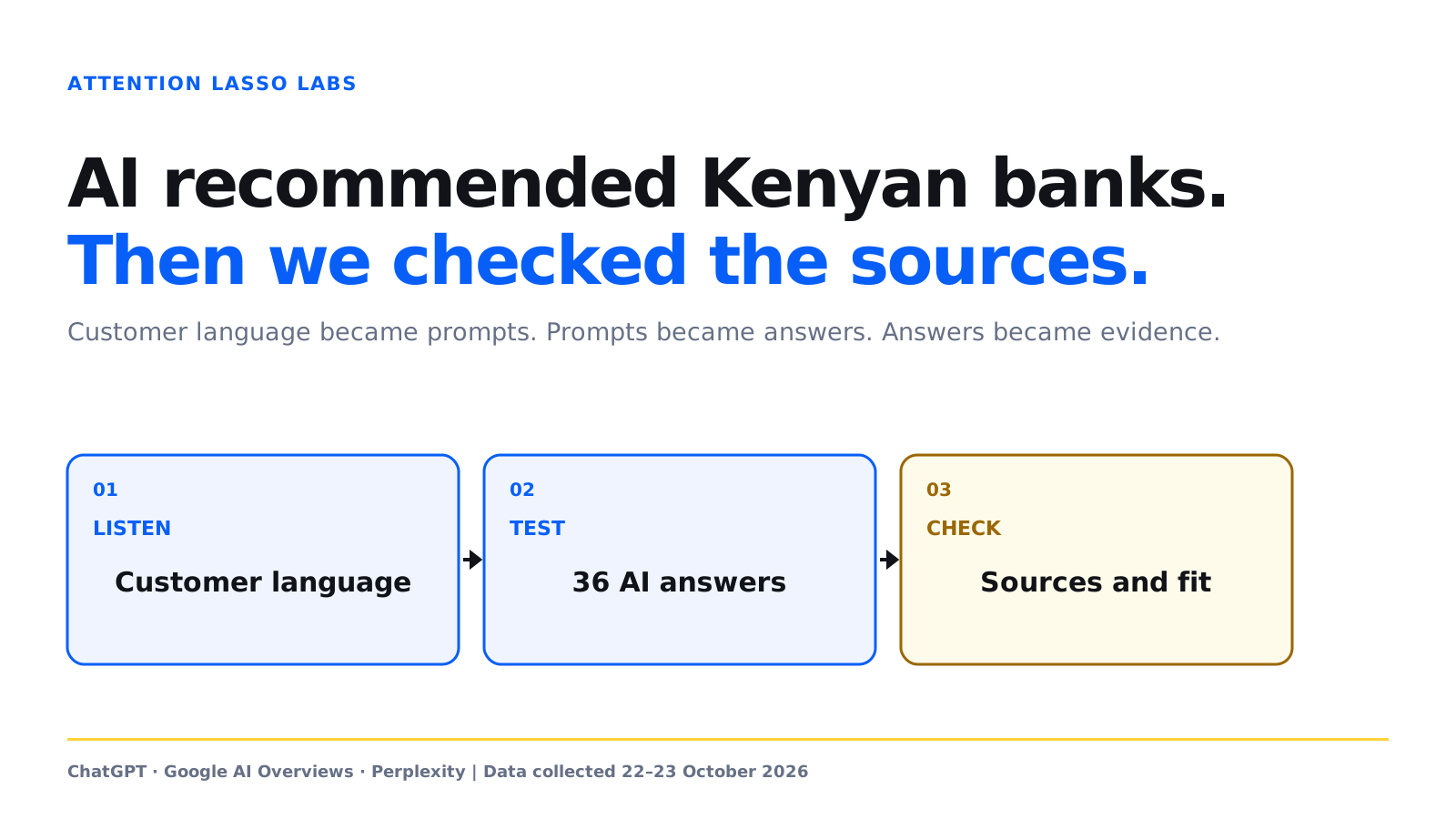
Want to see the method in the wild? Our Kenyan banking AI study began with customer language, then tested what ChatGPT, Google AI Overviews and Perplexity actually recommended.
How we built 500+ AI visibility prompts from Kenyan banking conversations
For the banking study, we could have typed “best banks in Kenya” into a prompt generator and finished before lunch.
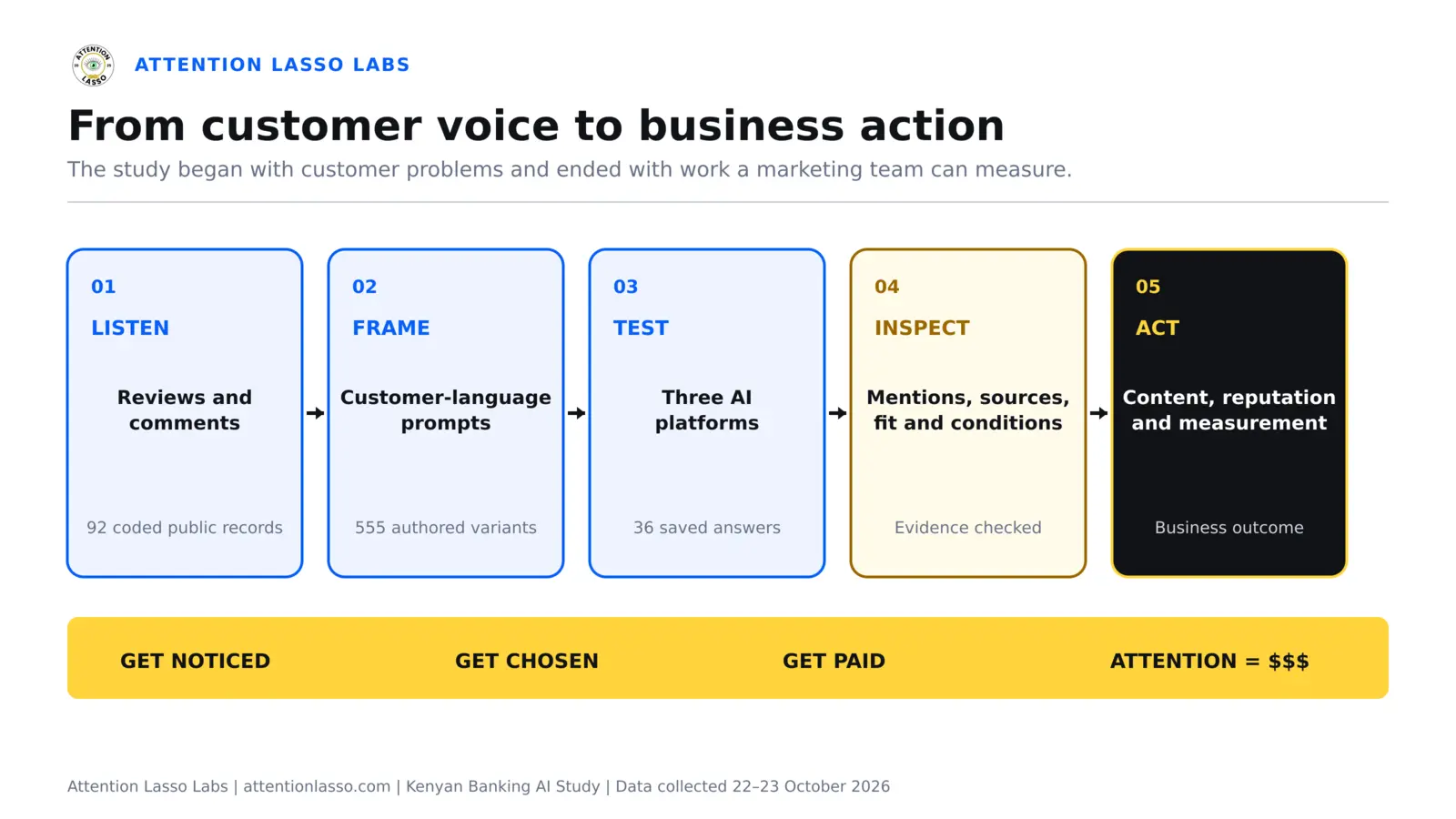
Instead, we examined reviews and comments around Kenyan banks, including public social conversations where people were already asking for help, complaining about failures, comparing products and explaining what had happened to them.
That work was untidy. Customers did not arrange themselves into a neat funnel. They mixed English, Kiswahili and Sheng. They shortened words, omitted context, replied to other people and sometimes described a serious financial problem in a single line.
But underneath that mess were recognisable decisions:
- Someone needed credit but had no payslip.
- Someone wanted to know why money had left an account.
- Someone living abroad needed a bank they could operate without repeated branch visits.
- Someone cared less about the advertised interest rate than the total cost and repayment period.
- Someone wanted a working app, but only because reaching a branch was difficult.
We used AI to help organise the evidence, not to invent the customer. The result was a library of more than 500 Kenya-specific banking prompts, including original-language and English variants.
Only a smaller sample went into the published experiment. A prompt library is the researched universe of relevant questions; a tracking set is the controlled sample you can afford to test consistently.
That agrees with one of the strongest recent guides in the field. Aleyda Solis argues that a representative AI search prompt library should cover the products, audiences, markets, stages and constraints that matter, rather than trying to become exhaustive. Our method goes further upstream by keeping the customer evidence and language trail that produced each prompt family.
1. Define the market your prompts should represent
“What do bank customers ask?” is too broad to research properly.
Which customers? In which country? About which products? At what point in the decision? Under what financial and regulatory conditions?
Before collecting a single comment, write a short scope statement:
We are studying how prospective and existing retail-bank customers in Kenya describe decisions and problems involving everyday accounts, digital banking, transfers and personal credit.
That sentence prevents drift. It also tells you which evidence belongs in the library and which interesting material should wait for another study.
Your boundary should define:
- The geographic market
- The audience or customer type
- The product or decision category
- The stages you want to understand
- The period covered by the evidence
- Important exclusions
Without a boundary, a large dataset creates the illusion of depth while mixing people whose needs cannot sensibly be compared.
2. Find where customers already describe the problem
The best source is not always the loudest channel. It is the channel that preserves useful context about a decision.
The GOV.UK Service Manual's user-research guidance makes a simple point that marketing teams often skip: observing real users helps a team learn the language people use, understand the highs and lows of the experience, and reduce unchallenged assumptions.
For a prompt study, your sources might include:
| Source | What it reveals | What can mislead you |
|---|---|---|
| Sales calls and enquiry notes | Triggers, budgets, alternatives, objections and decision criteria | Salespeople may translate the customer's wording into company language |
| Support tickets and live chat | Urgent problems, confusing conditions and recurring failure points | Existing customers may behave differently from prospects |
| Social comments | Natural wording, public expectations, local language and follow-up questions | A viral complaint is not automatically a common complaint |
| Reviews of you and competitors | Reasons for choosing, satisfaction, regret and comparisons | Reviews can be fabricated, incentivised or stripped of context |
| Reddit, forums and community groups | Detailed situations people may not disclose to a company | Identity, location and purchase intent can be uncertain |
| Search Console and site search | Queries already connected to your website | Search terms are often shorter than conversational prompts, and Search Console does not expose every query |
| Interviews and surveys | The reasoning behind the decision | Leading questions can manufacture the answer you expected |
Reviews deserve particular care. The US Federal Trade Commission's rule on consumer reviews and testimonials addresses fake or AI-generated reviews, paid sentiment, insider reviews and review suppression. Even outside the rule's jurisdiction, the warning is useful: public review text is evidence, not unquestionable truth.
In our banking research, some Google reviews sounded generic or suspiciously polished. Social comments often contained more specific events, constraints and follow-up exchanges. That did not make every social comment “true”. It made it richer material for finding hypotheses and language patterns.
Triangulation is the protection. If the same need appears in support logs, search data and independent conversations, it deserves more confidence than a sentence copied fifty times from one suspicious review page.
3. Create an evidence ledger for your AI prompt library
This is the part that separates customer research from prompt theatre.
For every useful excerpt, keep a row that records where it came from and what you believe it represents. A simple ledger can contain:
| Field | Example |
|---|---|
| Evidence ID | BANK-042 |
| Channel and URL | Facebook comment beneath a bank service post |
| Date collected | 18 October 2026 |
| Original wording | Redacted customer phrasing |
| Language | English with Sheng construction |
| Trigger | Needs urgent school-fee credit |
| Desired outcome | Receive a small loan before Friday |
| Constraint | No payslip; irregular mobile-money income |
| Decision criteria | Eligibility, speed, total cost and account requirement |
| Frequency | Repeated theme or isolated issue |
| Confidence note | Similar need seen in two other channels |
| Prompt family ID | CREDIT-07 |
Do not delete one-off issues merely because they are rare. Mark them as isolated. A low-frequency question can still be commercially important, legally sensitive or devastating when answered badly.
The ledger gives every prompt a provenance trail. When someone asks, “Why are we tracking this?”, you can show the evidence rather than explaining that an AI tool thought it looked plausible.
4. Use ChatGPT to analyse customer language without inventing it
AI earns its place after the evidence is collected.
It can cluster hundreds of excerpts, detect repeated situations, identify contractions and mixed-language patterns, and separate different wordings of the same underlying need. It can also confidently fill gaps with stereotypes. Your instruction has to make the boundary explicit.
Here is a reusable analysis prompt:
Analyse only the supplied customer-language dataset. Group excerpts by trigger, desired outcome, obstacle, eligibility constraint and decision criteria. Preserve representative phrases exactly, with their evidence IDs. Identify English, Kiswahili, Sheng and mixed-language patterns without translating or “correcting” them. Separate repeated themes from isolated issues. Flag excerpts with insufficient context. Do not invent customers, needs, frequencies, quotations or market characteristics. For every conclusion, list the evidence IDs that support it.
Then review the clusters manually. AI is helping you see the pile. It is not qualified to declare that the pile represents an entire country.
5. Turn one customer problem into useful prompt variations
Saying “create variants” without showing what changes and why is useless.
Take this simplified scenario based on a pattern, not a verbatim individual comment:
A Kenyan customer receives irregular income through mobile money, has no payslip, needs a small emergency loan, and does not want to move their main bank account.
That one situation can generate a controlled prompt family:
| Variation | Prompt | What it tests |
|---|---|---|
| Natural English | Which banks in Kenya offer a small emergency loan if my income is irregular and I do not have a payslip? | Whether the platform handles the full circumstance |
| Short conversational | Which bank can loan me a small amount without a payslip? | Whether brevity changes the shortlist or caveats |
| Eligibility-first | I earn through M-Pesa and have no payslip. Which Kenyan bank loans could I actually qualify for? | Whether eligibility survives the recommendation |
| Account constraint | Can I get an emergency bank loan in Kenya without moving my salary or opening another main account? | Whether account requirements are surfaced |
| Comparison | Compare suitable Kenyan bank loans for someone with irregular income and no payslip. Include total cost, repayment period, documents and account requirements. | Whether the answer supports an informed decision |
| Adviser-style follow-up | Of those options, which one is realistic if I need the money before Friday, and what should I verify before applying? | Whether the model narrows and adds a safe next step |
If the original evidence includes Kiswahili, Sheng or mixed language, retain that wording as another variant. But do not perform fake localisation by adding a few Kenyan words to an otherwise foreign sentence.
The English variants matter too. Many people will speak to an LLM in English while still bringing locally specific circumstances into the conversation. Language and market context are different variables. Test them separately.
6. Choose the AI visibility prompts worth tracking
Five hundred prompts make a valuable research asset and a terrible weekly tracking schedule.
Score candidate prompt families from 0 to 2 on each of these five questions:
| Criterion | 0 | 1 | 2 |
|---|---|---|---|
| Evidence strength | Invented or unsupported | One credible instance | Repeated across sources or strongly supported first-party evidence |
| Commercial relevance | No plausible business action | Indirect influence | Clear consideration, enquiry, application or purchase decision |
| Need specificity | Generic category query | Some context | Clear goal, constraint and decision criteria |
| Answer testability | Pure opinion | Partly verifiable | Product fit, facts, sources and next step can be checked |
| Portfolio value | Duplicates existing prompts | Adds wording variation | Adds a distinct need, stage or customer group |
A prompt can score ten points. Start with the highest-scoring families, then check the set for balance. Do not let twenty near-identical “best provider” questions crowd out service failures, eligibility, switching, comparisons and post-purchase needs.
For a first tracking set of 25, I would use:
- 10 high-intent need and recommendation prompts
- 5 comparison prompts with explicit decision criteria
- 4 eligibility or condition prompts
- 3 problem-resolution prompts
- 2 follow-up prompts that test whether the journey moves towards action
- 1 identical-prompt repeat used as a control
That is a starting design, not a universal benchmark. A regulated bank and a neighbourhood restaurant should not have identical research programmes.
7. Repeat unchanged prompts before measuring language effects
In our banking study, we compared original-language prompts with clean-English versions. Different wording often produced different recommendations.
Then one pair complicated the story.
The “original” and English versions of L01-V3 were identical, yet the platforms still returned different results. Nothing in the wording had changed.
That accidental placebo was more useful than a tidy conclusion. It showed that a one-run difference cannot automatically be attributed to language. The platform itself can vary.
The 2026 preprint *Don't Measure Once: Measuring Visibility in AI Search (GEO)* reaches the same broad warning: AI-search visibility varies across prompts, repeated runs and time, so a single answer should not be treated as a stable measurement.
Use three kinds of control:
- Exact repeats: same prompt, platform and test conditions
- Controlled wording pairs: same need, with only the intended language or phrasing changed
- Time repeats: same test repeated on a documented schedule
Record the platform, date, account state, location, mode and whether the conversation was fresh. You will not eliminate variation. You will stop pretending every fluctuation was caused by your last blog post.
8. Track recommendation quality, not only brand mentions
The customer does not win because your logo appeared in paragraph three.
For each answer, record six different things:
- Presence: Was the brand included?
- Prominence: Where did it appear?
- Need fit: Did the recommended product solve the stated problem?
- Evidence fit: Did the cited source support the claim, market and product?
- Condition survival: Did fees, eligibility, expiry dates and branch requirements remain visible?
- Business action: Could an eligible customer complete a useful next step?
Google explains that AI Overviews and AI Mode may use query fan-out, issuing multiple related searches across subtopics and sources. That makes a prompt more than a phrase to “rank for”. It can activate a network of supporting questions about price, eligibility, comparisons, risks and next steps.
Your content plan should therefore cover the decision, not create one thin page for every wording variation. Google continues to recommend useful, crawlable, people-first content and clear internal linking for its AI features.
Our guide to SEO, AEO and GEO explains how those disciplines work together. The short version is that discoverability, answer clarity and trustworthy third-party evidence are connected. None of them rescues an unsuitable product.
9. Turn weak AI answers into marketing actions
A weak answer is not automatically a writing problem. It may point to a product gap, buried condition, stale third-party page or broken conversion route.
Use the failure pattern to decide who should act:
| What the AI answer does | What may be happening | Who should investigate | Practical response |
|---|---|---|---|
| Omits the brand from a relevant shortlist | The offer is weak, poorly evidenced, hard to discover or rarely discussed independently | Product, SEO, PR and research | Confirm product fit first, then improve the primary page and credible third-party evidence |
| Recommends the brand for the wrong customer | Eligibility and use cases are unclear | Product, compliance and content | Publish explicit “who this is for” and “who is not eligible” information |
| Quotes conflicting fees or terms | Current facts are fragmented across pages, PDFs or old articles | Product owner, compliance and SEO | Create one maintained source of truth, update stale pages and expose dated conditions in text |
| Drops an important condition | The caveat is visually buried, image-only or absent from summaries | Compliance, UX and content | Place the condition next to the claim and explain its practical effect in plain language |
| Cites an inaccurate comparison page | Third-party narratives are outranking first-party evidence | Digital PR, partnerships and SEO | Correct reachable publishers, earn better independent coverage and strengthen first-party facts |
| Gives sound advice but no useful next step | The answer-to-action journey is broken | CRO, UX and analytics | Link the relevant product, eligibility check, branch finder or booking route and measure completion |
| Changes materially across exact repeats | The result may be normal model variability rather than an optimisation effect | Research and analytics | Increase repeats, report ranges and avoid single-run claims |
| Surfaces frequent complaints about a real failure | Marketing is revealing an operational problem | Customer service, operations and leadership | Fix the experience before publishing reassurance about it |
This is where the study becomes valuable to a marketer. It turns “our AI visibility score fell” into a specific question that a business can answer.
It also stops GEO from becoming a cottage industry for producing more pages. Sometimes the right optimisation is a clearer product condition. Sometimes it is correcting a sponsored comparison. Sometimes it is giving customers a functioning application path. Sometimes the market is telling you that the offer itself is not competitive.
If you need help connecting visibility evidence to decisions, see how we approach SEO, AEO and GEO strategy and marketing dashboards built for decisions.
A 10-step process for building your first AI visibility prompt library
You do not need 500 prompts to begin. You need a trail from customer evidence to a decision.
- Write a one-sentence market boundary.
- Choose three evidence sources with different biases, including at least one first-party source if you have access.
- Collect a manageable sample and remove personal or confidential information.
- Create an evidence ledger before clustering anything.
- Use AI to group situations and language patterns, with evidence IDs and a prohibition on invention.
- Manually verify the clusters and separate repeated themes from isolated but important issues.
- Create prompt families with natural English, short, eligibility, comparison and follow-up variations.
- Score the families and select a balanced tracking set.
- Add exact repeats and document the test conditions.
- Diagnose the answers across presence, prominence, fit, evidence, conditions and action.
After the first run, do not rush to publish a victory chart. Ask what the finding would change. If it changes nothing, you have probably measured an interesting detail rather than a useful decision.
Better AI visibility starts with listening to customers
The birthday-party problem was never a lack of ideas. You could invent a venue, menu and playlist in minutes.
The problem was confidence without knowledge.
Customer-language research does not promise that every prompt in your library is used verbatim by thousands of people. No ethical method can infer population frequency from a pile of public comments. What it does give you is something more defensible than imagination: traceable situations, authentic language, explicit limitations and a controlled way to learn.
Your customer is the hero making a difficult decision. Your brand's job is to become a useful guide. The prompt library helps you listen before you start giving directions.
Then you can test the machines.
Frequently asked questions
What are AI visibility prompts?
AI visibility prompts are questions or scenarios used to test how AI answer engines respond to customer needs, whether a brand appears, what sources support the answer and whether the recommendation is accurate and actionable.
How do I find real customer questions for AI visibility tracking?
Start with the channels where customers already explain decisions and problems: sales calls, support conversations, social comments, reviews, forums, Search Console and interviews. Keep enough context to record the trigger, desired outcome, constraint and decision criteria. Do not assume that a high-engagement comment is automatically representative.
How do you turn customer language into AI prompts?
Group the evidence by underlying customer situation, then create controlled variations that change one useful dimension at a time. These can include natural English, shorter conversational wording, eligibility constraints, comparison criteria and follow-up questions. Keep the original wording connected to its evidence ID.
How do you choose prompts for an AI visibility audit?
Start with documented customer situations, not a prompt generator's default list. Score each prompt family for evidence strength, commercial relevance, need specificity, answer testability and the distinct coverage it adds. Then select a balanced set across discovery, comparison, eligibility, problem resolution and action.
Can ChatGPT create my AI visibility prompt library?
AI can help cluster evidence and produce controlled wording variations. It should not be the sole source of customer needs. Feed it customer-language evidence, require source IDs for conclusions and prohibit invented frequencies or quotations.
How many AI visibility prompts should I track?
Use the smallest balanced set that covers the decisions you need to understand. Twenty to thirty prompts can be a practical first experiment, but the correct number depends on the market, products, customer groups and repeat schedule. Report the scope rather than presenting the number as universal.
Should I use customers' original language or English prompts?
Use both when the evidence supports both. Keep the underlying need comparable, and treat language as a variable. A Kenyan market prompt can be written in English and still contain locally specific constraints, products and decision criteria.
Can I copy customer comments into an AI tool?
Remove names, account numbers, contacts, transaction identifiers and confidential information. Check your privacy obligations and the tool's data controls before processing first-party conversations. Preserve the useful situation without exposing the person.
Are reviews and Reddit comments reliable customer research?
They are useful sources, not representative samples by default. Record provenance, compare channels, flag suspected manipulation, distinguish frequency from intensity and validate important themes through first-party data or interviews where possible.
How often should prompts be repeated?
Repeat enough identical tests to estimate normal answer variability before claiming that wording or optimisation caused a change. Keep a stable core for comparison, then rotate a smaller exploratory set as products and customer behaviour change.
Does an AI mention prove GEO is working?
No. A mention can recommend the wrong product, omit a decisive condition, rely on a poor source or lead nowhere. Track presence alongside prominence, need fit, evidence fit, condition survival and business action. ---
Build a prompt library worth tracking.
Listen before you measure.
Attention Lasso researches how a market describes its problems, tests how AI platforms answer and turns the evidence into content, product and measurement priorities.
Keep pulling the thread