
Imagine spending millions to make sure voters see your name, hear your message, and visit your campaign website. Then imagine sending them to a homepage whose latest campaign news includes announcements from 2020 and 2022.
That isn't a hypothetical funnel diagram invented to frighten a campaign manager. We found it while reviewing the official website of a candidate in a congressional race that had already attracted more than $11.5 million.
Welcome to the 2026 US midterms, where:
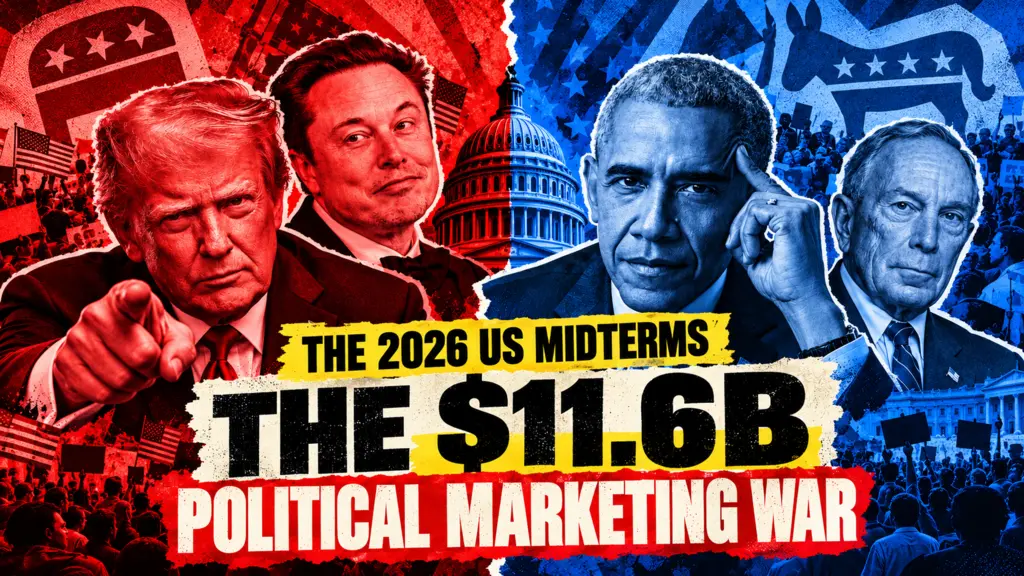
- Campaigns are projected to spend a record $11.6 billion on political advertising
- Creators are being paid to make political promotions feel like ordinary posts
- Newsrooms are turning reporting into platform-native video
- Some campaigns are still leaking attention at the final handoff
The obvious story is that American politics has become extremely expensive. The more useful story is what all that money is trying to buy.
It isn't merely reach. Political marketing now buys, borrows, and earns attention, then tries to convert it into donations, email addresses, volunteers, persuasion, and votes.
Some campaigns are building a connected system. Others are pouring V-Power into a Suzuki Alto.
The 2026 midterms are not merely an ad war. They are an attention-supply-chain war, and the expensive failures happen at the handoffs.
Planning a political or election campaign? Attention Lasso connects political advertising, content, creators, search, websites, AI visibility, and measurement so that attention has somewhere useful to go. See how we help campaigns prepare for 2027.
What we examined
This study's research cuts off on October 24, 2026. We reviewed 8 races:
- California elections 2026: Xavier Becerra and Steve Hilton for governor; David Valadao and Randy Villegas in the 22nd Congressional District; Doris Matsui and Mai Vang in the 7th Congressional District
- Virginia elections 2026: Mark Warner and Bert Mizusawa for Senate; Jen Kiggans and Elaine Luria in the 2nd Congressional District; Eugene Vindman and Doug Ollivant in the 7th Congressional District
- Oregon elections 2026: Tina Kotek and Christine Drazan for governor; Janelle Bynum and Patti Adair in the 5th Congressional District
We examined official campaign websites, current issue and news pages, calls to action, public campaign-finance information, reported advertising activity, political influencer arrangements, platform rules, and recent research on how Americans get news.
We did not score ideology, predict winners, or treat social engagement as proof of voter intent. We also don't have access to the campaigns' private analytics, targeting data, or conversion reports. Public likes can show visible interaction. They cannot tell us who was persuaded, donated, volunteered, or voted.
That limitation matters because election marketing leads people to draw confident conclusions from remarkably little evidence.
How much will political campaign advertising cost in the 2026 US midterms?
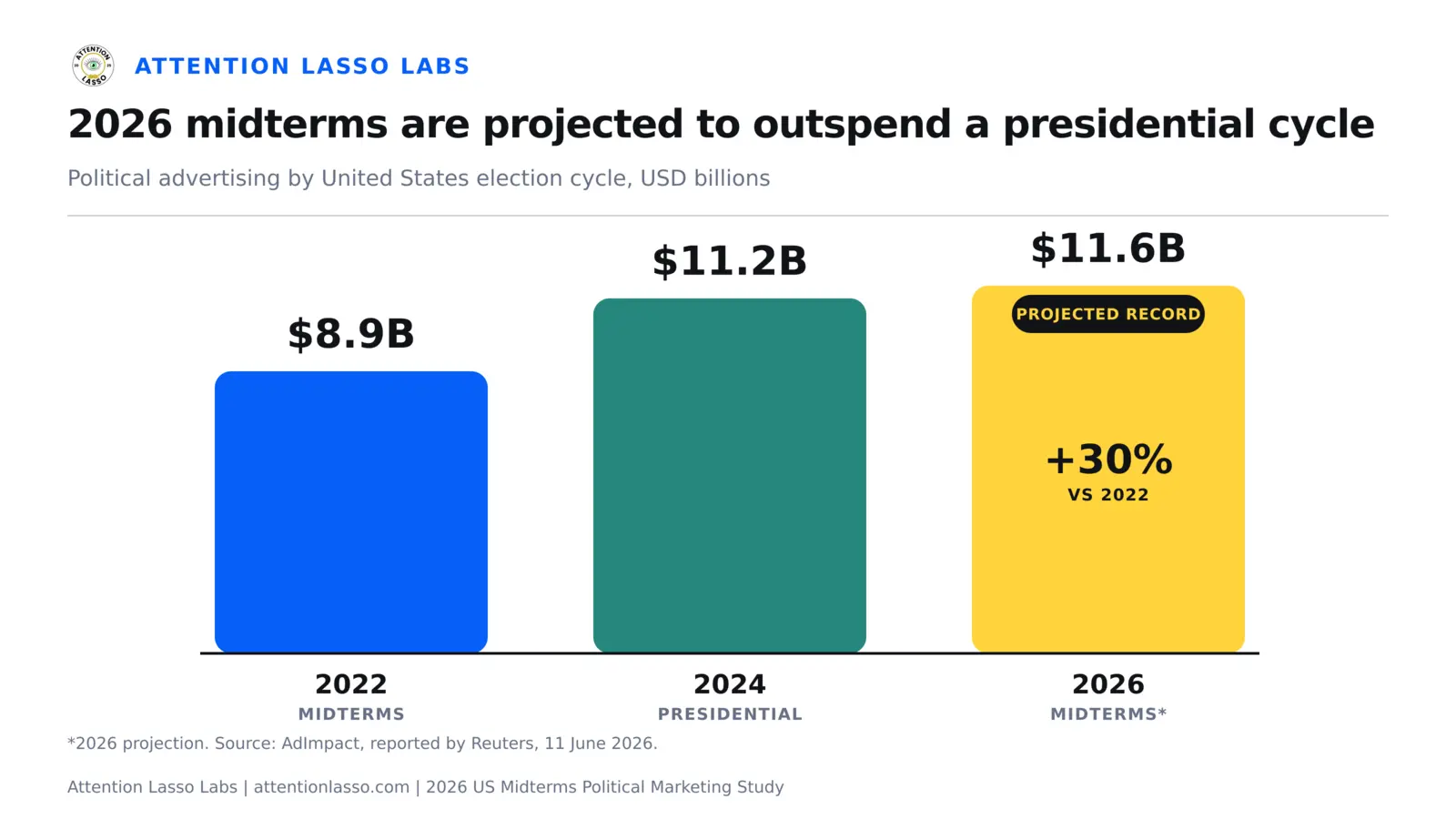
AdImpact projects that 2026 political advertising will reach $11.6 billion, according to Reuters.
That would be:
- About 30% more than the $8.9 billion spent during the 2022 midterms
- About 4% more than the $11.2 billion spent during the 2024 presidential cycle
- A record for political advertising in any United States election cycle
By October 19, spending had already passed $10 billion. Some individual races now resemble national product launches. TIME reported approximately $500 million in combined advertising and reservations for the Texas Senate race, more than $450 million for Ohio's Senate race, and roughly $200 million for Maine's Senate contest.
Those figures don't include every campaign expense. They measure advertising, not the full cost of staff, travel, field operations, technology, events, or voter outreach.
The broader financial machinery is even larger. Federal Election Commission filings covering January 1, 2025 through June 30, 2026 show:
- Congressional candidates had spent $2 billion
- Political parties had spent $1 billion
- PACs had spent $6.5 billion
These figures cover different activities from the advertising projection, so you shouldn't add them together. They do show how many organizations are competing to shape the same finite supply of public attention.
A campaign isn't competing only with its named opponent. It is competing with parties, PACs, billionaires, publishers, creators, algorithms, breaking news, entertainment, and every other advertiser trying to enter the same feed.
When does online political marketing start before an election?
No credible dataset proves every campaign should begin digital political marketing exactly 6, 9, or 12 months before Election Day. Anyone presenting one number as a universal law is offering advice, not settled evidence.
Still, the evidence shows that political marketing runs on two clocks. Infrastructure starts early. Paid intensity peaks late.
The early clock: campaigns build attention before the election feels close
By August 26, 2025, US political advertisers had already spent $900 million across the channels AdImpact tracks. That was 434 days before the November 3, 2026 federal election. Congressional races accounted for 21% of that early spending, compared with 5% at the equivalent point in 2023 and 17% in 2021. Axios called it unprecedented early spending.
That $900 million figure wasn't digital-only. It covered political advertising across broadcast, connected TV, radio, and major digital platforms. It proves that the political advertising market was active more than a year before Election Day. It does not prove that every dollar was effective.
Academic evidence supports the same timing pattern online. A study published in the American Political Science Review examined federal, statewide, and state-legislative candidates in the 2018 election. Among candidates using both Facebook and television, Facebook advertising began earlier in the campaign.
That makes practical sense. Digital political marketing isn't used only for final persuasion. It can raise money, recruit volunteers, test messages, capture contact information, and build an audience the campaign can reach again.
The late clock: online political advertising still surges near Election Day
The early start doesn't mean campaigns spend evenly. In the 2024 US election cycle, political advertisers spent $1.35 billion on Google and Meta. By August 31, less than half, $619 million, had been spent. Campaigns spent more from September 1 through Election Day than in the previous 20 months combined.
The final 2 months attract extraordinary pressure. The inventory becomes more competitive, the stakes are clearer, fundraising intensifies, and campaigns need repeated exposure before voting ends.
Waiting for that final surge is still dangerous. A campaign that arrives then has no tested message, no first-party audience, no reliable creator network, no search-visible issue library, and no time to fix a broken conversion journey.
What the $122,000 California influencer payment actually proves
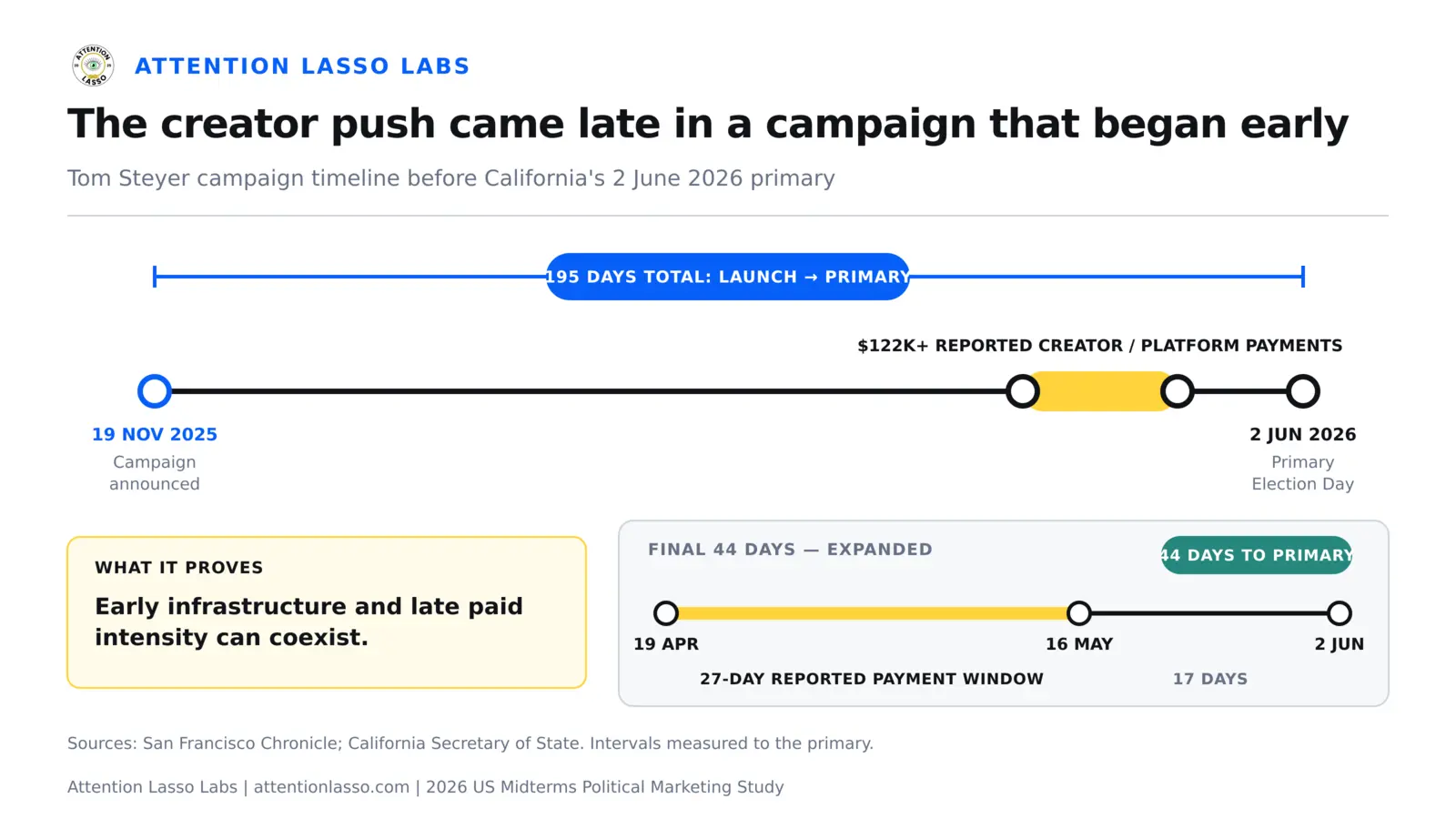
Tom Steyer announced his campaign for California governor on November 19, 2025. The statewide primary was held on June 2, 2026.
The timeline is verifiable:
| Event | Date | Time before the primary |
|---|---|---|
| Steyer announced his campaign | November 19, 2025 | 195 days |
| Reported influencer-payment window began | April 19, 2026 | 44 days |
| Reported influencer-payment window ended | May 16, 2026 | 17 days |
| California statewide primary | June 2, 2026 | Election Day |
The influencer payments were part of Steyer's effort to survive the June primary and reach the November ballot. They were not spending for a November general-election campaign. Steyer finished outside the top two and did not advance.
That distinction changes the lesson. The $122,000 does not prove that influencer marketing wins elections, nor does it establish an ideal campaign length. It shows that a campaign operating for 6 months still deployed creators heavily in the final 44 days before its decisive vote.
Our evidence supports an operating model, not a guarantee:
- 9 to 12 months out: build the website, measurement, research, issue library, response rules, creator governance, and first-party audience
- 6 to 9 months out: publish consistently, test messages, recruit supporters, and learn which channels create qualified action
- Final 8 to 12 weeks: scale the strongest messages, increase paid distribution, strengthen rapid response, and remove conversion leaks
This is Attention Lasso's recommended planning framework, inferred from the observed early-build and late-spend pattern. It is not a claim that starting 9 months early guarantees victory.
The political marketing stack behind the 2026 US midterms
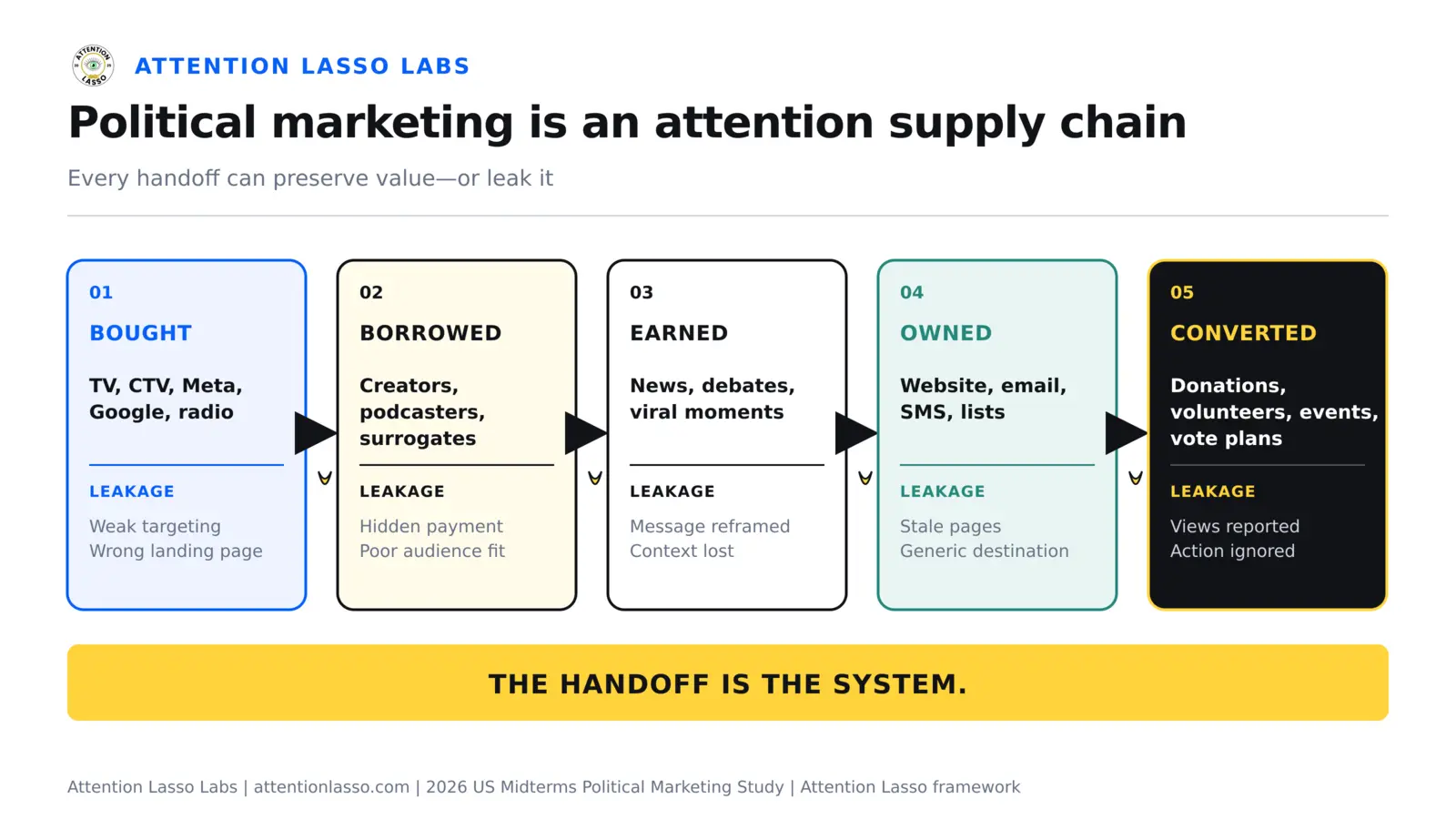
The strongest campaigns aren't using one channel. They are assembling an attention stack.
| Layer | What campaigns use | What it is supposed to do | Where attention leaks |
|---|---|---|---|
| Bought attention | Television, connected TV, Meta, Google, YouTube, radio, direct mail | Guarantee distribution | High frequency without persuasion, weak targeting, or an irrelevant landing page |
| Borrowed attention | Influencers, celebrities, podcasters, surrogates, endorsers | Transfer familiarity and trust | Undisclosed payment, poor audience fit, or a creator message that does not survive scrutiny |
| Earned attention | News coverage, interviews, debates, viral moments | Add legitimacy and wider distribution | Coverage frames the campaign differently from the campaign's intended message |
| Owned attention | Political campaign website, email, SMS, volunteer list | Preserve the relationship | Stale pages, unclear issue information, intrusive forms, or one generic destination for every message |
| Converted attention | Donations, volunteer signups, event attendance, vote plans | Turn interest into action | The campaign reports impressions and likes while losing the action that justified the spend |
A television spot may start the journey. A creator may make the candidate feel more familiar. A newspaper clip may make the claim feel more credible. Google may surface an issue page days later. The campaign's website, email, or SMS list must then turn that scattered exposure into a relationship.
The handoff is the system.
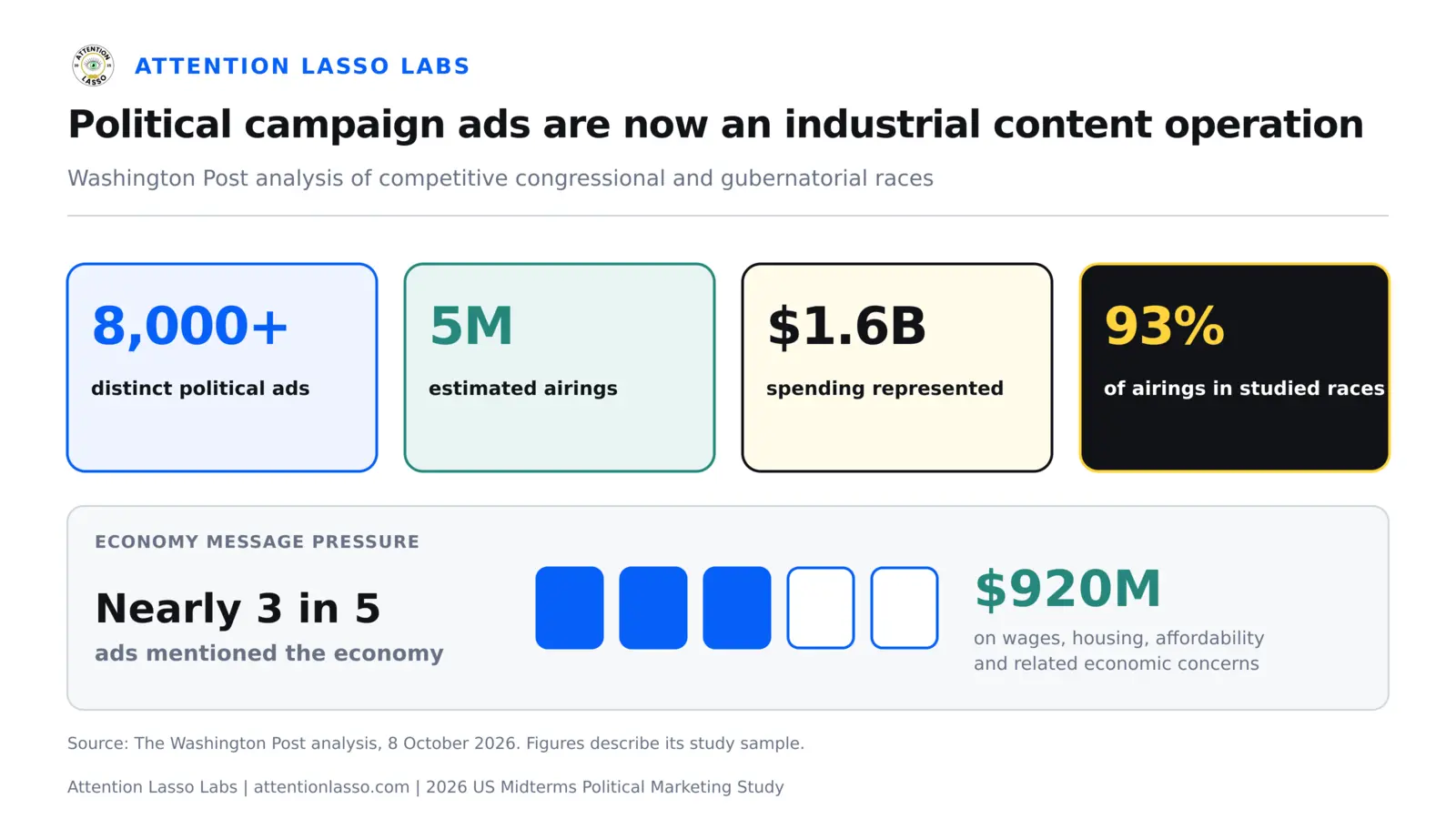
Political campaign ads are becoming an industrial content operation
The scale isn't limited to money. It includes creative volume.
The Washington Post analyzed more than 8,000 political campaign ads that ran about 5 million times across competitive congressional and gubernatorial races. The sample represented $1.6 billion in spending and 93% of all airings in the races it studied. Nearly 3 in 5 ads mentioned the economy, and ads about wages, housing, affordability, and other economic concerns accounted for about $920 million.
That tells campaign marketers 2 things.
First, message competition is severe. Saying families are struggling with costs doesn't make a campaign distinctive when hundreds of millions of dollars are carrying variations of the same argument.
Second, high output makes message discipline more important, not less. Every television cutdown, YouTube pre-roll, influencer brief, social clip, interview, landing page, and volunteer script should preserve the same useful idea without sounding as if a committee glued it together.
Campaign teams should be able to answer:
- Which audience problem is this creative addressing?
- What does this version add that the last 12 versions did not?
- What should an interested person do next?
- Does the destination continue the same argument?
- Can we distinguish exposure from a meaningful action?
If the answer to the final question is "we got many views," the campaign knows people looked. It doesn't yet know what the attention did.
Political influencer marketing is advertising with a ring light
California gave the 2026 election cycle one of its clearest political influencer marketing case studies.
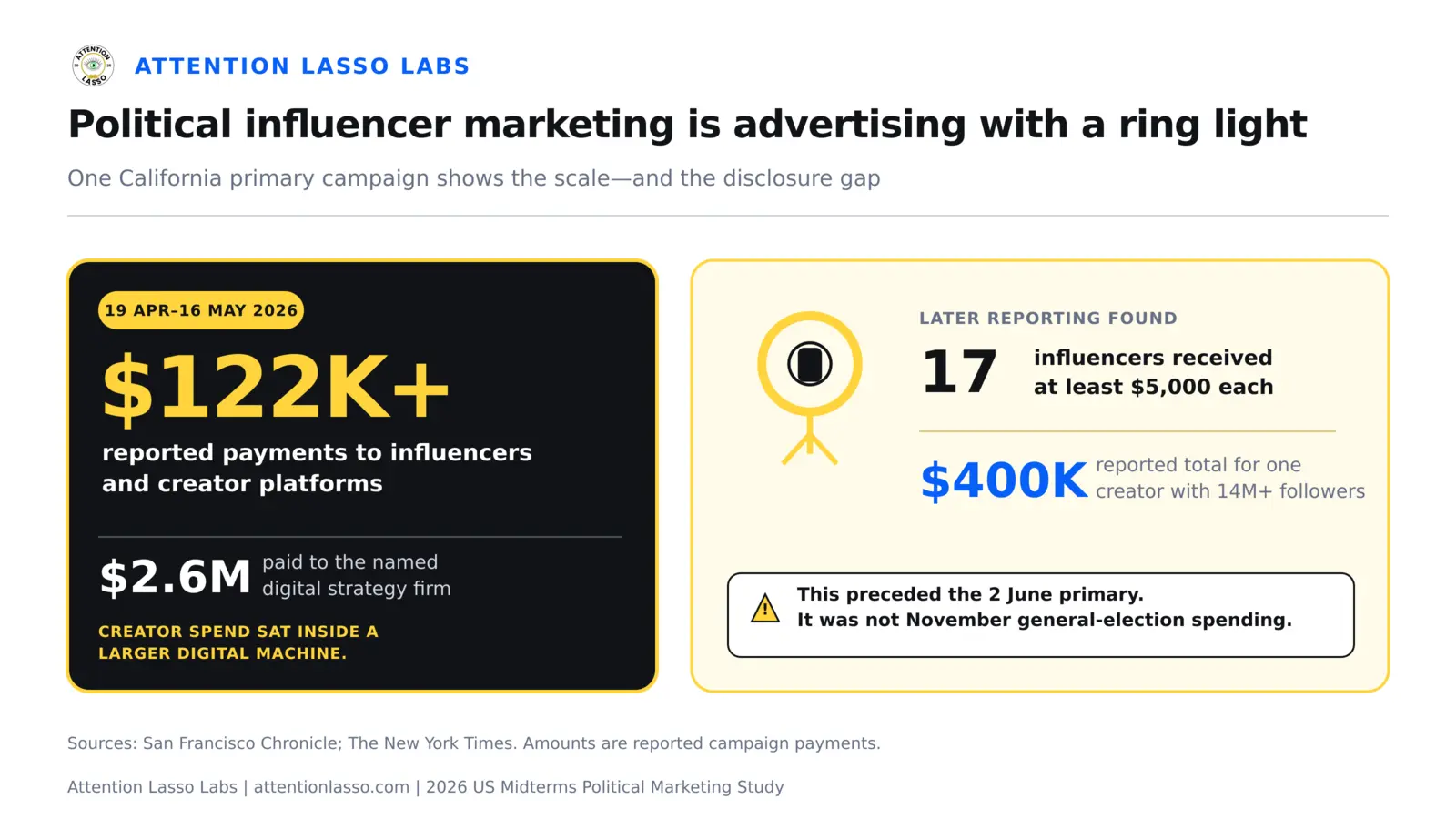
Campaign-finance filings reported by the San Francisco Chronicle showed that Steyer's gubernatorial campaign paid at least $122,000 to social media influencers and creator platforms between April 19 and May 16. During the same period, the campaign also paid $2.6 million to digital strategy firm Group Project, which solicited creators to publish campaign content.
The $122,000 wasn't the campaign's largest expense. By the time the Chronicle reported, Steyer had already spent more than $200 million. The influencer line matters because it paid to insert campaign messages into voices and relationships audiences had chosen before the campaign arrived.
Later reporting by The New York Times found that the campaign paid 17 influencers at least $5,000 each. One creator with more than 14 million TikTok followers reportedly received $400,000 in total.
This wasn't simply a celebrity-endorsement program. Reporting described a layered operation involving large creators, smaller creators, meme accounts, and platforms paying people to produce volumes of campaign-friendly posts.
The strategic logic is obvious. A political advertisement arrives dressed as a political advertisement. A creator's video arrives between lunch, a joke, a relationship story, and a skincare recommendation. It borrows the creator's tone, audience relationship, and ordinary place in the feed.
This is no longer a fringe experiment. The Democratic National Committee told The Washington Post that it had collaborated with more than 500 creators with a combined following above 75 million. According to the party, DNC-related content generated more than 100 million impressions between mid-2025 and mid-2026. Those are self-reported distribution figures, not proof of persuasion. Still, they show the scale at which political organizations now treat creators as media infrastructure.
The disclosure system hasn't caught up.
The Center for Democracy and Technology found that political creator relationships are often arranged through intermediaries, payments can range from a few dollars to more than $30,000 per post, and campaign-finance reports may identify the intermediary without revealing which creators were paid or what they posted.
That creates a wonderfully absurd regulatory gap. A creator recommending a sports drink may need to disclose the commercial relationship. A creator paid to influence an election may not face a general federal requirement to tell the audience. However, narrower federal rules, state laws, and platform policies can still apply.
California has a disclosure rule for covered paid political creator content. Meanwhile, TikTok says it prohibits paid political advertising, including creators being compensated to make branded political content.
Paid political content has still appeared on TikTok.
That isn't proof that every creator post is secretly purchased. It is evidence that platform policy, campaign-finance reporting, creator contracts, and the content people actually see don't form one transparent system.
Campaign teams need a creator-governance process:
- Record the creator, intermediary, amount, deliverables, platforms, dates, and required disclosure.
- Approve factual claims and the disclosure before publication.
- Preserve the live URL and a screenshot of every paid post.
- Give each creator a distinct tracked destination.
- Measure qualified actions, not views alone.
- Stop working with creators who can't clearly disclose the relationship.
Opacity may buy a few moments of borrowed authenticity. Discovery can turn the same campaign into a story about manipulation.
Why legacy media still matters to digital political marketing
It is easy to look at declining newspaper circulation, shrinking newsrooms, and platform fragmentation and declare legacy media dead as a dodo.
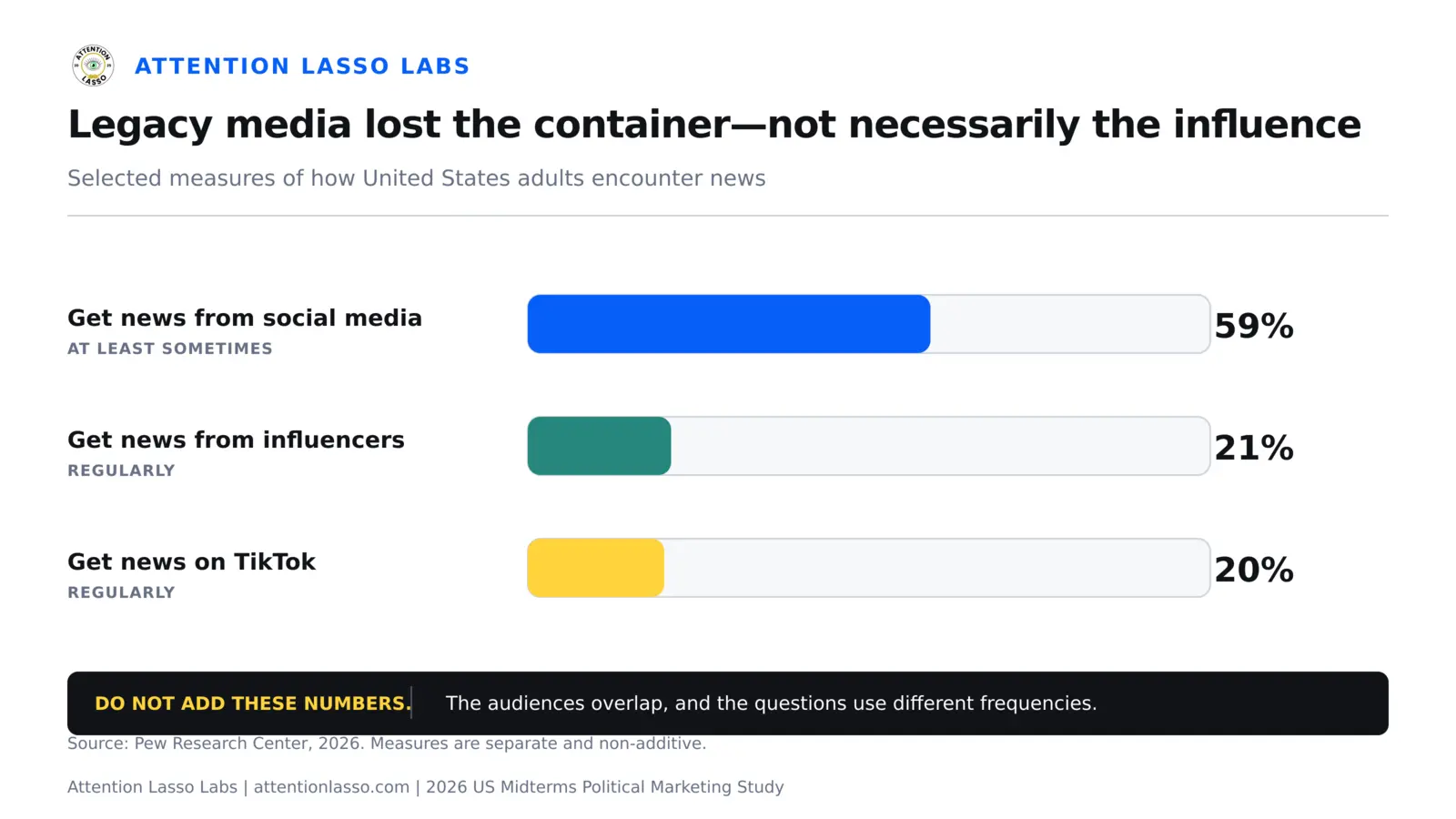
That conclusion mistakes the container for the influence.
Pew Research Center reports that 59% of United States adults get news from social media at least sometimes. Separate Pew research found that 21% regularly get news from social media influencers, rising to 38% among adults under 30. One in 5 United States adults regularly gets news on TikTok.
Those numbers show that distribution has changed. They don't show that reporting institutions have stopped supplying the material being distributed.
Legacy and local publishers still provide:
- Reporters who produce original facts and interviews
- Recognizable editorial brands
- Search-visible archives
- Video clips that can be reposted across platforms
- Debate infrastructure and voter guides
- Independent coverage campaigns can quote, criticize, or celebrate
- Source material that search engines and AI systems can retrieve
The candidate pages we reviewed showed this hybrid system in plain sight. Mai Vang's campaign site presents appearances from
- CapRadio
- KCRA
- The Majority Report
- Breaking Points
- Hasan Piker's Twitch stream
The campaign isn't choosing between legacy and new media. It is collecting authority and reach from both.
Campaign teams should care about the distinction between source and downstream distribution.
A newsroom may break the story. A creator explains it. A campaign cuts the useful exchange into a vertical clip. Supporters redistribute it. Search engines index it. AI systems may later cite the publisher's page when someone asks about the candidate.
Legacy media can lose control of where people consume the news while retaining enormous influence over what everyone else has to discuss.
The same information chain will matter in Kenya. Our analysis of how social media and AI could shape Kenya's 2027 election explains why a campaign's searchable record now matters beyond Google rankings.
What 16 campaign websites across 8 races revealed
The October baseline revealed 4 recurring patterns.
1. Campaign websites have become conversion machines
Most prominent political campaign websites quickly ask for some combination of an email address, phone number, ZIP code, donation, or volunteer commitment.
That makes commercial sense. Social followers are rented. An email or SMS subscriber can be contacted again without waiting for an algorithm to cooperate.
But the request often arrives before the visitor has received enough reason to trust the campaign. A large form isn't a strategy merely because it captures a phone number.
The better sites connect the ask to a clear message, provide substantial issue information, and offer more than one meaningful action. Xavier Becerra's site, for example, maintains a current newsroom, multiple issue pages, volunteer routes, and contribution choices. Mai Vang's site offers donations, field activities, house parties, yard signs, jobs, media appearances, and district information.
2. Some campaigns are paying for attention while neglecting the destination
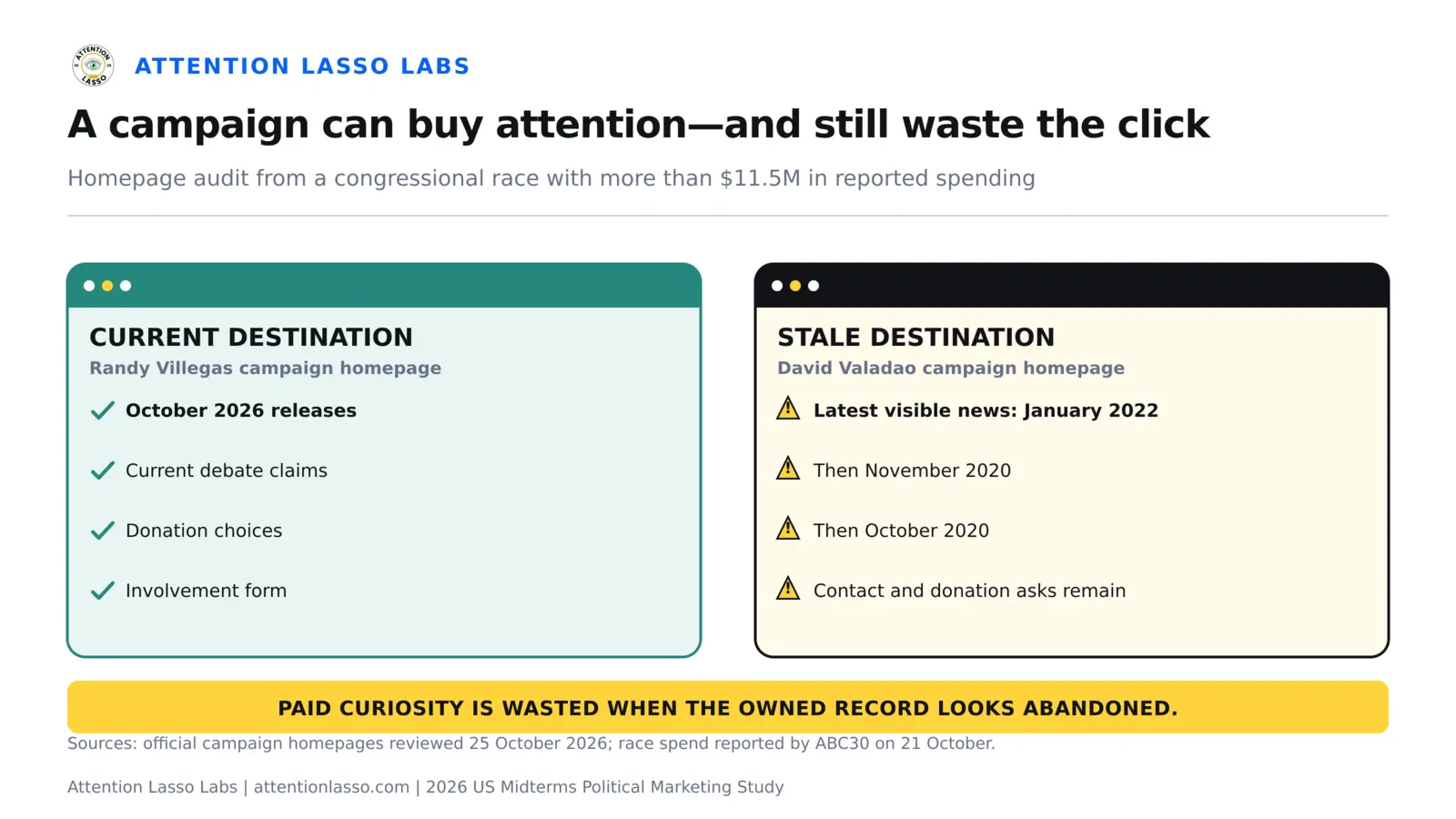
California's 22nd Congressional District had attracted more than $11.5 million by October 21. When we reviewed David Valadao's official campaign homepage, its visible "latest" news entries were dated January 2022, November 2020, and October 2020.
The page still collected contact information and donations. It offered visitors remarkably little current campaign evidence before asking for them.
Randy Villegas's opposing site displayed October 2026 releases, current debate claims, donation choices, and an involvement form.
This comparison doesn't tell us who will win. It reveals a preventable political marketing problem. A campaign can spend heavily to create curiosity, then meet that curiosity with an owned page that looks abandoned.
It also creates a search and AI visibility problem. Social posts vanish down feeds. A maintained issue page or newsroom gives search engines, journalists, supporters, and AI systems a stable source to retrieve.
3. Campaign websites are becoming distribution hubs
Several sites don't behave like static online manifestos. They collect recent social posts, ad transcripts, press appearances, debate clips, endorsements, and action routes.
Eugene Vindman's homepage surfaced current voting messages and social updates alongside donation and volunteer paths. Jen Kiggans embedded Facebook content and paired it with issue pages, a media kit, volunteer options, and contribution buttons. Tina Kotek and Christine Drazan published current ad and campaign announcements that journalists, supporters, and search systems could reference.
The website's job isn't to replace social media. It is to stop the campaign's evidence from disappearing inside it.
4. Attention strategy is visible in the range of actions
Donation buttons appear almost everywhere, but campaigns reveal more of their organizing model through their secondary actions.
A campaign offering house parties, field activations, lawn signs, events, voting information, volunteer shifts, and creator appearances is building several ways for supporters to participate. A campaign offering only "donate" and "join" may still perform well, but its public pathway is much narrower.
That difference is measurable. Campaigns should report how many people progress from each channel into each action, not throw every visitor into one generic conversion bucket.
The 8 measurements every political campaign dashboard needs
Campaign reports love large numbers because large numbers look comforting on presentation slides. Impressions, views, and total engagements can all be useful. None should be mistaken for persuasion or votes.
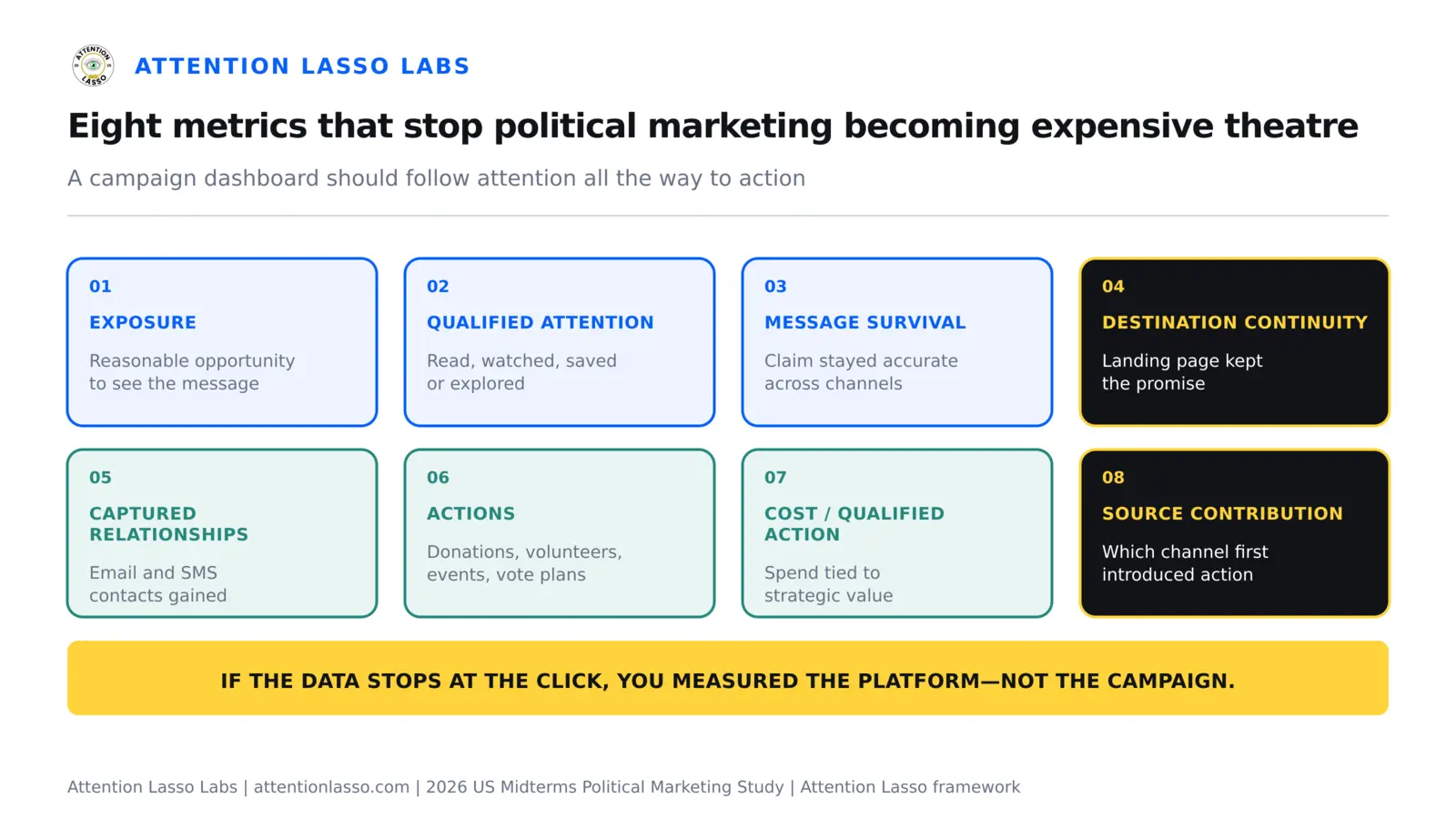
A practical political campaign dashboard should separate:
- Exposure: How many people had a reasonable opportunity to see the message?
- Qualified attention: How many watched, read, saved, shared, or explored long enough to do more than glance?
- Message survival: Did the important claim remain accurate as it moved through ads, creators, news coverage, and supporter posts?
- Destination continuity: Did the landing page continue the promise made by the post or advertisement?
- Captured relationships: How many visitors became contactable email or SMS subscribers?
- Actions: How many donated, volunteered, attended, requested a ballot, or made a voting plan?
- Cost per qualified action: What did the campaign spend for each action that had strategic value?
- Source contribution: Which ad, creator, publisher, search query, or social post introduced the people who acted?
Use different links for every paid creative, creator, publisher placement, and major organic campaign. Preserve UTM parameters through the donation, signup, and volunteer journey. Reconcile platform reports with website analytics and the campaign CRM.
If the data stops at the click, the campaign has measured the platform's success, not its own.
Our guide to marketing dashboards explains how to keep reporting tied to decisions instead of decorating a screen with metrics.
What the US midterms mean for Kenya's 2027 election marketing
The early-build, late-surge pattern has an uncomfortable implication for Kenya.
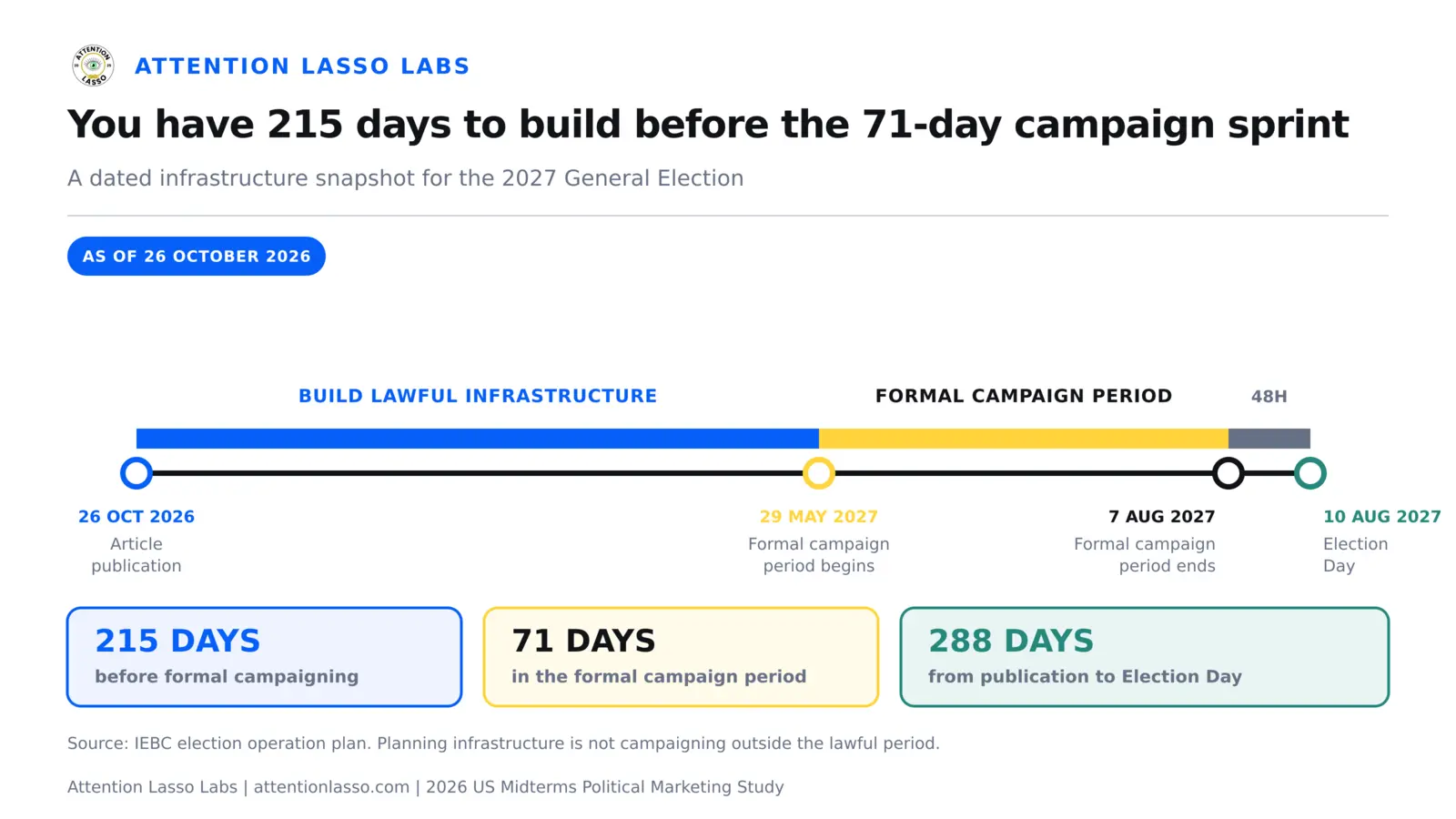
IEBC's current election operation plan identifies August 10, 2027 as Election Day. It says the formal campaign period will run from May 29 to August 7, ending 48 hours before the vote. IEBC published those dates, not a political consultant's preferred sales calendar.
On this article's publication date, October 26, 2026, you have:
- 215 days before the formal campaign period begins
- 288 days before Election Day
- 71 calendar days in the formal campaign period
This isn't a suggestion to campaign outside the lawful period. It is a case for building lawful infrastructure before May 29:
- Research
- Website architecture
- Analytics
- Content standards
- Issue-source pages
- Approval systems
- Creator rules
- Crisis escalation
- The team's ability to respond under pressure without inventing facts
A team that waits for the formal campaign period will have 71 days to build everything while also trying to use it.
That is why the live countdown on our Kenya 2027 political and election marketing page isn't decorative. It shows how long campaign teams have left to build the machinery behind the message. Our wider analysis, Kenya 2027: Elections, AFCON and the attention battle, explains why brands will be competing for the same national attention at the same time.
What political campaign teams should fix before spending another dollar
The following checklist is less exciting than a viral video. It is also more likely to prevent expensive waste.
- Give every major issue one current, indexable source page.
- Send each ad to a destination that continues the same message.
- Put a date and named source beside factual claims that can change.
- Create separate tracked links for every creator and distribution partner.
- Add political-disclosure checks to the content approval workflow.
- Archive every paid ad, creator post, landing page, and material revision.
- Review homepage and issue-page freshness every 24 hours during the final 2 weeks.
- Track donations, volunteer signups, email captures, event registrations, and voting-information actions separately.
- Compare engagement rates within the same platform and format. Don't compare a TikTok view with an email signup as if they mean the same thing.
- Record what the campaign will change when a metric rises or falls.
Campaigns also need an escalation rule. If a creator post attracts reach but creates confusion, if a landing page contradicts the advertisement, or if a news report changes the factual context, the team should know who can pause distribution, correct the source page, and publish an update.
That is attention engineering under election pressure.
Frequently asked questions
When are the 2026 US midterm elections?
The regularly scheduled federal general election is Tuesday, November 3, 2026. Congressional midterms elect all 435 members of the House and roughly one-third of the Senate, alongside many state and local races.
How early should political marketing start before an election?
No credible evidence establishes one universally optimal start date. Current data shows political advertising and digital infrastructure being built more than a year before Election Day. At the same time, online spending still concentrates heavily in the final 2 months. Attention Lasso recommends building the foundation 9 to 12 months out, then scaling tested messages during the final 8 to 12 weeks.
How much will be spent on advertising in the 2026 US midterms?
AdImpact projects $11.6 billion in political advertising, exceeding both the 2022 midterm record and total political advertising during the 2024 presidential cycle.
Was Tom Steyer's $122,000 influencer spend for the November midterms?
No. The reported payments occurred from April 19 to May 16, 2026, ahead of California's June 2 gubernatorial primary. They were intended to help Steyer advance to the November general election. Still, he did not finish in the top two.
Are paid political influencers required to disclose campaign payments?
Not under one general federal creator-disclosure rule. Campaign-finance rules, state laws, and platform policies can still apply, and California requires covered paid political creator posts to carry disclosures.
Does high social media engagement predict election results?
No. Engagement shows visible platform behavior, not private persuasion or verified votes. Compare it with fundraising, volunteer actions, voter contacts, turnout work, and official results.
Is legacy media still relevant to digital political marketing?
Yes. Its role increasingly includes producing original reporting, searchable source material, interview clips, voter guides, and credible evidence that circulates through social platforms, creators, search engines, and AI systems.
Attention is expensive. Leakage is optional.
Before buying more reach, inspect the journey you are already funding.
Attention Lasso connects political advertising, creators, search, campaign websites, AI visibility and measurement into one political marketing system.
Keep pulling the thread