
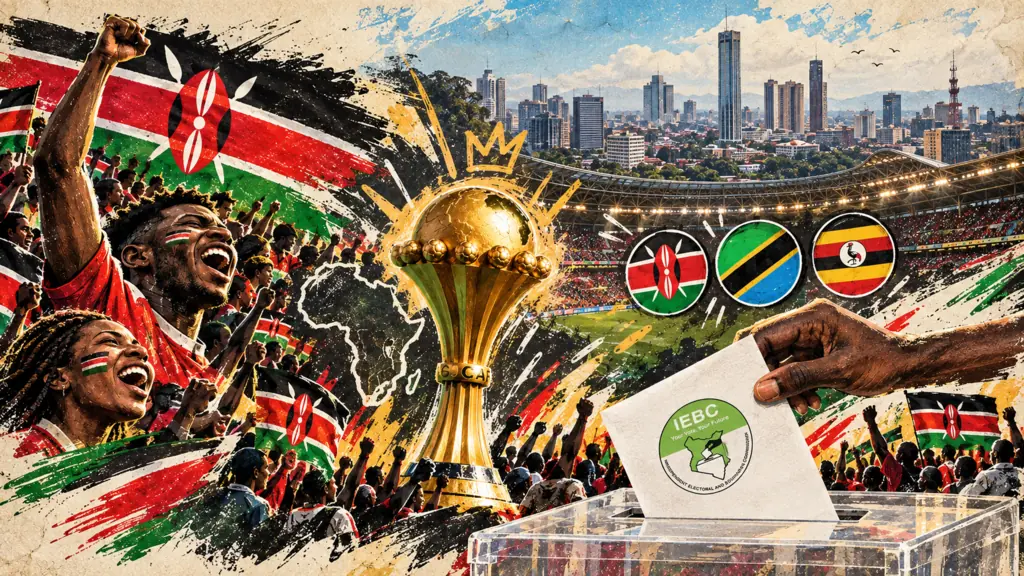
If you think marketing in East Africa is noisy now, 2027 has scheduled two megaphones at once.
First comes football.
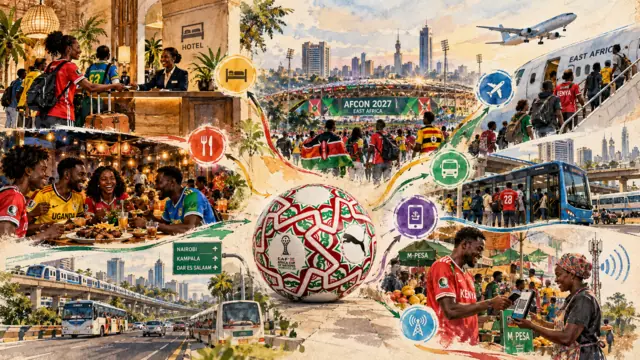
AFCON Pamoja 2027 runs from 19 June to 17 July. Kenya, Uganda and Tanzania will become the first three countries to co-host the tournament.
Then comes politics.
Kenya's General Election is scheduled for 10 August 2027.
That is twenty-four days after the AFCON final.
One month, the country will be debating formations, penalties and whether the referee needs new glasses. The next, it will be debating manifestos, coalitions and whether politicians need the same thing.
Why 2027 will be the year of attention
Our Kenya 2027 strategy hub brings the election and AFCON opportunity into one planning centre.
Not because everyone will stare at one screen for twelve straight months. They will not.
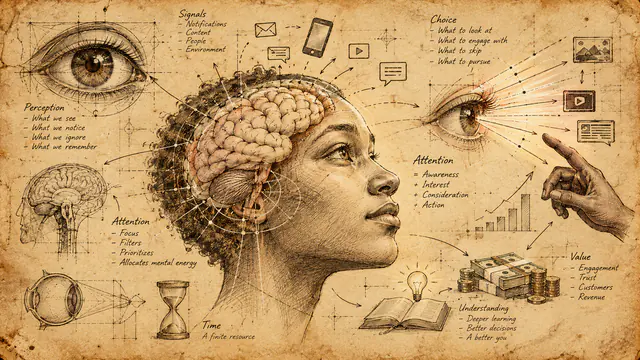
It matters because two enormous public events will compete for the same scarce resource within weeks of each other.
Focus.
For campaigns, the challenge will be earning trust in a fast and emotional information environment.
For brands, the challenge will be turning a historic sporting moment into something more useful than a logo wearing a football jersey.
Both need to start before the noise peaks.
Part 1: Why Rallies Will Not Win the 2027 Election Alone
The dedicated 2027 General Election page tracks the political attention challenge, the countdown and what campaign teams need to build before voting day.
Kenyan politics knows the traditional playbook.
Charter a helicopter. Print a small mountain of T-shirts. Hire buses. Find the loudest sound system in the county.
That playbook is not dead.
Physical rallies still matter. Community networks still matter. Radio still matters. A candidate who ignores the ground will discover, very publicly, that Wi-Fi does not vote.
But the rally can no longer carry the whole campaign.
The political story now travels before the candidate arrives. It keeps moving long after the convoy leaves.
Kenya's news habits have changed
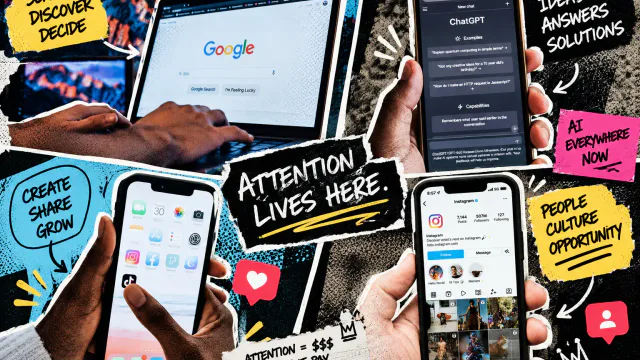
The Reuters Institute's 2026 report on Kenya describes social media as central to the country's news ecosystem. It says TikTok and YouTube are important entry points to news, especially for younger audiences. WhatsApp is also a major channel for political information, rumours and mobilisation.
The report found that more than half of its Kenyan respondents used TikTok for news in the previous week.
There is an important caveat.
This was an online survey. The Kenyan sample was mainly English-speaking. It should not be translated into “more than half of all Kenyans.”
The direction is still impossible to ignore.
Political information is no longer delivered only by a news anchor at nine o'clock. It arrives through clips, forwarded messages, livestreams, satire, creators and comment sections.
Traditional media remains important. Reuters also says its position is gradually weakening, while print remains in long-term decline.
This is not the death of television.
It is the end of television having the room to itself.
Reach can outrun the original account
Kenya has already seen what happens when political content meets recommendation systems.
Ahead of the 2022 election, Mozilla Foundation research identified more than 130 TikTok videos containing hate speech, incitement or political disinformation. The videos came from 33 accounts and collectively attracted millions of views.
That research did not prove that TikTok changed individual votes.
It proved something else.
A small account can publish a message that travels far beyond its followers. That can help a useful explanation spread. It can also give nonsense a motorbike.
Campaigns therefore need more than content volume.
They need accurate information, fast verification, clear responses and people who understand the language and context behind the conversation.
Through our Audience Intelligence workflows, we analyse public concerns in aggregate. We do not pretend every angry comment represents a constituency. We look for recurring questions, language patterns and information gaps, then test them against broader evidence.
Our Capture systems help campaigns publish clear, searchable and properly sourced information across the places voters look for answers.
The goal is not to manipulate private individuals.
It is to make accurate information easier to find before rumours do the job instead.
Part 2: AFCON Pamoja 2027 and the Business Behind the Ball
While candidates compete for votes, brands will compete for football attention.
Our AFCON 2027 business guide breaks that opportunity down across hospitality, food, transport, finance and telecommunications.
AFCON Pamoja 2027 is historic before the first whistle.
It is the first AFCON hosted by three countries. It also brings the competition back to East Africa for the first time since Ethiopia hosted it in 1976.
CAF says the tournament can reach more than 400 million people across East Africa. It also expects more than 1.5 million fans to visit the three host countries.
Those are CAF projections, not guaranteed arrivals.
Even so, the commercial direction is clear.
Hotels will compete for bookings. Telecom companies will compete for data use. Beverage brands will compete for tables. Banks and fintech apps will compete for transactions. Retailers, transport companies and restaurants will all want a piece of matchday behaviour.
The competition will not only happen inside stadiums.
It will happen in search results, WhatsApp groups, viewing lounges, hotel lobbies and millions of short videos.
The commercial benchmark has already moved
The latest AFCON numbers are bigger than the original draft suggested.
CAF reported that the 2025 tournament in Morocco produced:
- More than 3.2 billion in cumulative global TV audience.
- Six billion digital views.
- Twenty-three commercial sponsors.
- More than 90% growth in competition revenue compared with the previous edition.
The commercial revenue and sponsor figures come from CAF's tournament report. The audience figures are reported by CAF and should be understood as cumulative audience totals, not 3.2 billion unique human beings sitting down together.
Côte d'Ivoire also showed what hosting can set in motion. The country invested more than $1 billion in stadiums, roads, airports, hospitals and hospitality infrastructure for AFCON 2023. CAF's 2023-2024 annual report says Nielsen estimated a $1.5 billion positive effect on the host economy.
That does not mean every host will spend or earn the same amount.
It means AFCON now moves more than football.
It moves infrastructure, travel, media, sponsorship and spending.
A logo is not a tournament strategy
Many brands will wait until opening week.
Then someone will place the logo next to a football, add “Pamoja” in a large font and ask social media to do its thing.
Social media will do its thing.
Mostly without them.
The brands that win will be useful before they are loud.
A hotel can own search demand around accommodation and transport. A bank can make cross-border payments easier. A telecom company can solve connectivity problems. A beverage brand can build viewing experiences people actually want to attend.
The opportunity is not “mention football.”
The opportunity is to solve a problem created by football attention.
Our Capture systems can build visibility around local and tournament-related searches. Our Conversion systems can turn that demand into bookings, app downloads, enquiries or store visits. Our Marketing Automation systems can help route and follow up those actions while the campaign is moving quickly.
Fast content matters.
But a fast route from attention to revenue matters more.
The Dangerous Mistake: Waiting Until 2027
Every major event creates the same meeting.
Someone looks at the calendar far too late and says, “We should do something.”
By then, media space is crowded. Partners are booked. Creative approvals are moving at the speed of a government queue.
The better timeline starts now.
Late 2026: Build the foundation
- Identify the audiences and problems that matter.
- Fix measurement and conversion tracking.
- Create useful, crawlable and properly sourced content.
- Build landing pages and first-party audience journeys.
- Set approval rules for fast content and rapid response.
Early 2027: Test the machine
- Test messages before attention becomes expensive.
- Build repeatable video and publishing workflows.
- Measure search visibility and audience response.
- Train teams on escalation, verification and brand safety.
- Secure partnerships, venues and production capacity.
June to August 2027: Execute
- Publish quickly without abandoning accuracy.
- Respond to real audience needs.
- Route interest into measurable actions.
- Monitor performance daily.
- Change what is not working.
There are three reasons not to wait.
1. Crowded media changes the price of attention
We cannot honestly promise that every advertising cost will double.
But more campaigns chasing the same audiences, placements and creators creates pressure. Starting early gives you more room to test before every mistake becomes expensive.
2. AI visibility cannot be switched on overnight
You do not “train ChatGPT” to recommend your brand.
You build clear, credible and crawlable information. You earn mentions and links. You keep your public facts consistent. Then you measure whether search and AI systems can find and use that information.
Google says the same core SEO practices apply to AI Overviews and AI Mode. It also says there is no special schema or secret AI file required.
In other words, no wizardry.
Just good information architecture doing its job.
3. Trust needs a head start
By the time the tournament begins or election day approaches, audiences will be drowning in slogans.
That is a terrible time to introduce yourself.
Useful content published early has time to earn recognition. It also gives your team time to learn what people genuinely need.
What Attention Lasso Is Building for 2027
We are not selling a pile of disconnected campaign tasks.
We are building two focused attention systems.
For political leaders and coalitions
We build systems for understanding public concerns, publishing accurate answers and responding quickly when the conversation changes.
That can include:
- Aggregated analysis of public discussion.
- Search-demand and question mapping.
- Constituency information hubs.
- Rapid factual response workflows.
- Content production and approval systems.
- Measurement across search, social and owned channels.
The work must respect privacy, electoral law and platform rules.
Winning attention is not permission to abuse it.
For consumer and corporate brands
We build tournament-ready acquisition systems.
That can include:
- Local and tournament-related search campaigns.
- Fast short-form video workflows.
- Useful visitor and fan content.
- Landing pages tied to one clear action.
- WhatsApp and email routing.
- Conversion and attention analytics.
Official sponsorship rights still matter. A brand can participate in the surrounding culture without pretending to be an official CAF partner or misusing protected tournament assets.
Creativity is not a legal defence.
You can learn more about our background on The Boss page and our approach on the Attention Lasso story.
Frequently Asked Questions
Why is digital media important for Kenya's 2027 election?
Can brands activate around AFCON 2027 without becoming official sponsors?
How does Attention Lasso measure political or brand sentiment?
What should a brand build first for AFCON 2027?
2027 will not be won in 2027
The dates are known. The advantage is preparation.
If you want to build the system before the noise peaks, let us make the attention useful.
Keep pulling the thread