

You just approved an ad invoice.
The dashboard proudly says 150,000 people saw your brand this month.
So you open your bank account. Then your sales inbox.
Crrr. Crrr. Crrrr.
Crickets.
What is attention engineering?
It connects how people find you with what happens next.
That could start on Google. Or ChatGPT. Or TikTok. It should end somewhere useful. A call. A booking. A sale. Something your finance team will recognize.
Traditional online marketing often stops at visibility. Attention engineering asks a harder question:
Did the attention do anything?
If your marketing feels like lighting money on fire, you may not have a traffic problem.
You may have an engineering problem.
The Reality Check: The Illusion of Digital Impressions
Sometimes modern online marketing goes like this.
An agency takes your money. It designs a flyer. It runs Meta ads or bids on broad Google keywords.
At the end of the month, you receive a PDF full of upward green arrows.
“Look at the impressions!”
Lovely.
Google Ads defines an impression as each time an ad is shown. In some placements, only part of the ad may appear.
That does not mean impressions are useless. It means they are incomplete.
An impression does not prove that someone read your message. It does not prove that they remembered your name. And it definitely does not prove that they bought anything.
Maybe your ad appeared while someone was riding a matatu and watching funny videos. Maybe they noticed it. Maybe they did not.
The dashboard cannot tell you that on its own.
This is where attention engineering changes the question.
Instead of asking, “How many people could have seen us?” we ask:
- Did the right person find us?
- Did the message match what they needed?
- Did they take the next step?
- Can we connect that step to revenue?
Reach matters. But reach without relevance is just a louder way to disappear.
How Modern Discovery Actually Works: SEO vs GEO vs TikTok Search
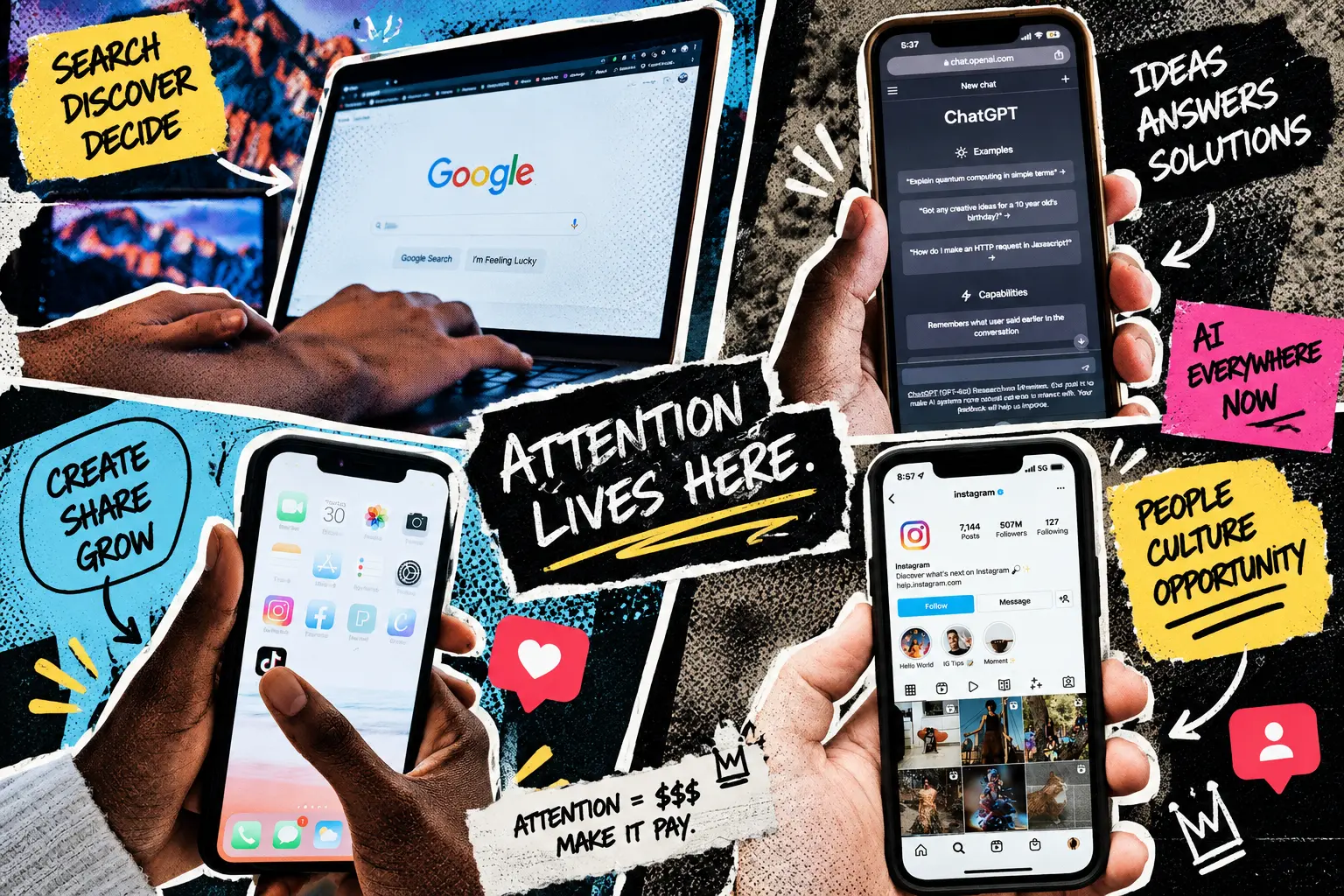
Online discovery is no longer one blue link on Google.
People move between search engines, AI tools and social platforms. Sometimes in the same buying journey.
- Google SEO helps people find, compare and evaluate options.
- ChatGPT and GEO shape conversational research and synthesized comparisons.
- TikTok search gives buyers demonstrations, reviews and real experiences.
These routes overlap.
A buyer might discover you on TikTok. Compare you in ChatGPT. Then search your name on Google before trusting you with a shilling.
That is why single-channel strategies crack under pressure.
Google SEO still matters
SEO is not dead. It is not even resting.
Google says its established SEO practices still apply to AI Overviews and AI Mode. A page must still be indexed and eligible to appear in Google Search before it can appear as a supporting link in those experiences.
That is why our intent-mapped SEO systems focus on the questions and commercial searches that matter to the business.
Not traffic for traffic’s sake.
Useful visibility.
AI changed the comparison stage
People are also using AI tools to compare options.
OpenAI says hundreds of millions of people use ChatGPT to find, understand and compare products. Its shopping research experience is built specifically for deeper comparisons, trade-offs and buying decisions.
This is where Generative Engine Optimization, or GEO, enters the picture.
The labels can become confusing quickly. Our SEO, AEO and GEO comparison explains what each layer does and where the boundaries overlap.
A 2024 GEO research paper found that different content improvements increased source visibility in generative answers by up to 40% in its experiments. Citations, relevant quotations and statistics helped. But the results changed across topics and queries.
In plain English: facts help. Sources help. Clear writing helps.
There is no magic paragraph that guarantees ChatGPT will fall in love with your brand.
TikTok became a discovery tool
TikTok is not only dance videos and someone explaining why your birth month makes you emotionally unavailable.
It is also a discovery platform.
People use it to see products in action. They look for restaurant reviews, tutorials, walkthroughs and first-hand experiences. Researchers have also documented TikTok’s development of search products and recommended search queries.
This is why TikTok search marketing can matter.
Not for every business. Not for every buyer.
But when people need to see the proof, video can answer questions a corporate brochure never will.
A Real-World Case Study: 62,800 AI Citations in Telehealth
This is not theory for us.
Before founding Attention Lasso, I spent more than six years leading content strategy and digital growth work for Quick Med Cards, a US telehealth company.
Healthcare search is not gentle.
The content must earn trust. Regulations change from one state to another. Advertising is restricted too. Google’s current policy places certification and location requirements on telemedicine advertising.
We could not depend on random posts and hopeful reporting.
We had to build systems.
We developed technical schema. We mapped thousands of state-specific regulatory answers. We built conversion-focused pages and automated content workflows.
According to the internal reporting used during that work, the results included:
- 46.5% year-over-year registration growth, from 49,200 to 72,100.
- 165% improvement in organic conversion rate.
- More than 62,800 brand citations in AI-generated answers.
We also built a custom internal-linking tool.
It combined Google Search Console and Semrush data with page-level analysis. It could point to the paragraph and sentence where an internal link belonged. It suggested direct-match anchors and contextual alternatives.
The old process took around twelve hours.
The tool did it in about five minutes.
The API bill was exactly zero.
That is attention engineering in practice.
It is not one campaign. It is a system that gets smarter, faster and more useful over time.
You can see more of the work behind Attention Lasso on The Boss page.
The Five Pillars of the Attention Lasso System
We do not believe in throwing random marketing experiments at a wall and calling the splatter “strategy.”
We build one connected machine.
It has five pillars.
Capture: Modern Discoverability
First, the right people need to find you. We build visibility across Google Search, AI-assisted discovery and relevant social search platforms.
Explore this systemConnect: Audience Intelligence
We analyze search queries, reviews, forum conversations and social discussions, then build the message around what people actually say.
Explore this systemConvert: Friction-Free Funnels
We simplify landing pages, sharpen the offer and make the next action obvious. Traffic is useless if your website makes people work too hard.
Explore this systemMeasure: Attention Analytics
We connect visibility, engagement and conversion data so attention leaves evidence and reporting reaches meaningful business outcomes.
Explore this systemEngineer: Automation and AI Agents
We build systems that qualify leads, route enquiries, book appointments and update records. The machine handles repetition. Your team handles judgment.
Explore this systemGoogle has also introduced dedicated Search Console reporting for generative AI features, including AI Overviews and AI Mode.
Because “people seemed to like it” is not a measurement plan.
Is Your Marketing Leaking Cash?
Take thirty seconds.
Answer these questions honestly:
- If you search for your main service in ChatGPT, does your company appear, or does a competitor get the recommendation?
- If an interested prospect messages your business on WhatsApp at 9:00 PM, do they receive a useful response, or do they wait until morning?
- Can your team state the cost of acquiring a customer, or does the report stop at impressions and clicks?
If you do not like the answers, your marketing may not need more content.
It may need a better system.
Frequently Asked Questions
What is the difference between digital marketing and attention engineering?
Why does classic SEO not work alone anymore?
How does TikTok search fit into a serious B2B or corporate strategy?
What tools does Attention Lasso use to measure attention?
How do I get started with an Attention Audit?
Your attention should pay you back
Attention is expensive. Wasted attention is worse.
If you are ready to find the leaks and build a system around them, let us make the attention useful.
Keep pulling the thread