
Picture a restaurant owner in Westlands on a Friday night in 2027.
A match has just ended in Nairobi. Thousands of fans are looking for food, music and somewhere to argue about the referee.
Our restaurant owner is standing outside an empty venue holding five hundred glossy flyers.
They arrived from the printer that afternoon.
Across the road, a rival has a queue around the block.
The rival did not discover football that morning. They spent months improving their Google Business Profile, publishing useful local videos and building a WhatsApp reservation flow that actually works.
One business has flyers.
The other has demand.
How can brands prepare for AFCON Pamoja 2027?
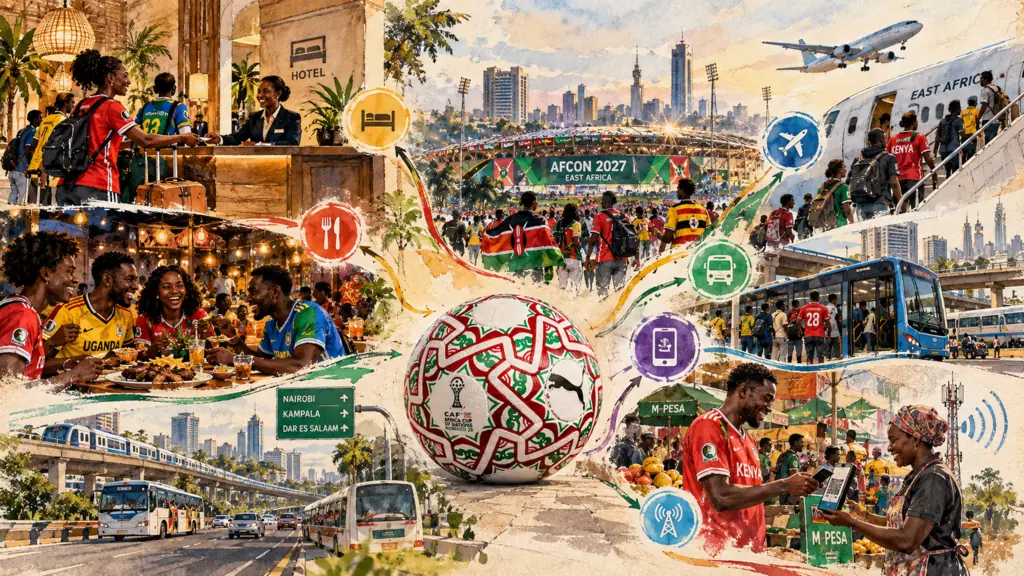
Start by treating sports tourism as a customer journey. Fans need somewhere to sleep, eat, travel, pay and connect. The businesses that answer those needs clearly and early will be easier to find when demand arrives.
Not every business will “cash in.”
Some will be busy. Some will be invisible. A few will be both, which is a very expensive way to learn about operations.
The opportunity is real.
But it still needs engineering.
Our AFCON Pamoja 2027 landing page tracks the tournament countdown and the systems brands should have ready before kickoff.
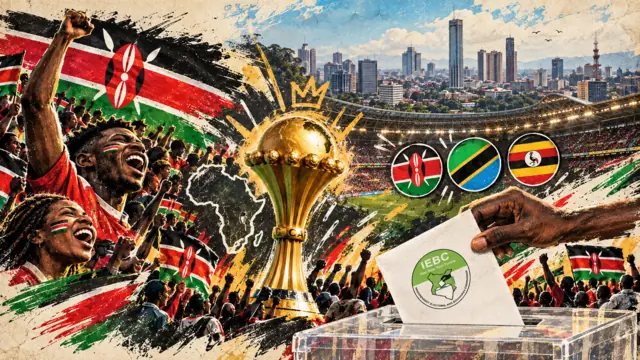
The tournament also lands only twenty-four days before Kenya's General Election. Our 2027 attention analysis explains why brands will be competing with more than football for the country's focus.
The Economics of Sports Tourism: What We Actually Know
Major tournaments do not keep spending inside the stadium.
Fans need flights, beds, meals, data, payments and transport. Media crews need the same. So do sponsors, officials and tournament staff.
UN Tourism cites market research estimating that the sports tourism market could grow by 17.5% between 2023 and 2030.
That is a global estimate. It is not a promise that every host city or business will grow by 17.5%.
For AFCON Pamoja 2027, the more useful number comes from CAF.
CAF expects more than 1.5 million fans to visit Kenya, Uganda and Tanzania during the tournament.
Again, that is a projection across three countries. It is not 1.5 million hotel bookings in Nairobi.
Still, the host market is not starting from zero.
Kenya’s 2025 Tourism Sector Performance Report recorded roughly:
- 2.7 million international arrivals
- 5.2 million domestic trips
- KES 500 billion in tourism earnings
- 47% of international arrivals coming from within Africa
Those figures were reported by the Tourism Ministry and summarised by Citizen Digital.
That final number matters.
AFCON is an African tournament. Kenya already receives a large share of its international visitors from the continent. The opportunity is not to invent a completely new travel market.
It is to serve a much louder version of one that already exists.
The infrastructure story will not end with the final whistle. Nairobi will use the renovated Kasarani Stadium again for Africa's first World Athletics Championships in 2029.
Five Industries With the Most to Gain
These sectors are not guaranteed winners.
They are the industries closest to needs that traveling fans cannot avoid.
1. Hospitality and Short-Term Accommodation
Every visiting fan needs a bed.
So do journalists, production crews, sponsors, officials and corporate guests.
Hotels will compete for that demand. So will serviced apartments, hostels and professionally managed short-term rentals.
The opportunity will not be distributed evenly. A room does not become discoverable simply because someone placed fresh towels on the bed.
International guests will search by price, location, safety, transport access, cancellation policy and distance from the places they need to reach.
What accommodation brands should build now
- Accurate Google Business Profile information
- Fast mobile booking pages
- Clear room availability and pricing
- Location pages that explain nearby transport and amenities
- Useful photographs that match the real property
- WhatsApp support with a human escalation route
- Structured hotel, lodging and local-business data where appropriate
Our Capture discoverability systems help accommodation brands answer the questions travelers ask before they book.
We cannot guarantee that ChatGPT will crown one property “the top answer.”
We can make the business easier for search engines, AI tools and human travelers to understand.
That is the useful part.
2. Food, Beverage and Nightlife
Football is a communal ritual.
People celebrate together. They complain together. They explain obvious tactical errors to complete strangers together.
Restaurants, bars, lounges, cafés and beverage brands can benefit from that behaviour.
But “we have a large screen” is not a complete tournament strategy.
Fans will want to know:
- Is the match being shown?
- Is a reservation required?
- What does food cost?
- Is the venue easy to reach?
- Can a group sit together?
- What time does the kitchen close?
- Is there parking or a safe ride home?
What food and nightlife businesses should build now
- Searchable matchday and group-booking pages
- Updated menus, hours and price ranges
- Short videos that show the real atmosphere
- Google Maps visibility and current photographs
- Table reservations connected to WhatsApp
- Clear capacity rules and booking deposits
- Proper commercial screening permissions where required
TikTok can help here because the buying question is visual.
People do not only want to hear that a venue has atmosphere.
They would like to see evidence that the atmosphere has attended work.
3. Transport, Aviation and Logistics
Pamoja is a three-country tournament.
That makes movement one of the biggest practical challenges.
Fans may need flights between host countries, road transport, airport transfers, car hire and local rides within host cities. Teams, broadcasters and sponsors will create additional logistics demand.
One easy mistake is to assume fans can move between Nairobi, Kampala and Dar es Salaam using Kenya’s Standard Gauge Railway.
They cannot.
The SGR can support travel on the routes it actually serves. It does not currently connect the three host capitals.
That correction reveals the real opportunity.
Travel information will be fragmented. The business that explains routes, prices, luggage rules, pickup points and travel times clearly can reduce serious friction.
What transport brands should build now
- Route and airport-transfer landing pages
- Transparent prices and baggage policies
- Group-booking workflows
- Mobile-friendly confirmations
- Real pickup instructions with map pins
- Customer support for delays and missed connections
- Search campaigns based on actual routes, not imaginary railway lines
A booking page should answer the traveler’s question before asking for their money.
That feels obvious.
The internet remains full of evidence that it is not.
4. Fintech, Mobile Money and Banking
Kenya has one of the world’s best-known mobile money markets.
The Central Bank of Kenya’s financial inclusion strategy credits mobile money with driving much of the country’s expansion in financial access.
That does not mean cash has disappeared.
It also does not mean every visitor can land at JKIA and instantly use every local payment product.
Travelers may face questions about card acceptance, foreign-exchange charges, mobile money registration, cross-border transfers and merchant payments.
That confusion is the opportunity.
What banks and fintechs should build now
- Simple guides for visitors and merchants
- Transparent exchange rates and transaction fees
- Clear eligibility and identification requirements
- Safe card and mobile-payment options
- Merchant onboarding before the tournament
- Fraud education for fans and businesses
- Multilingual support for common payment problems
The winner will not be the app with the longest feature list.
It will be the one that makes “How do I pay for this?” disappear fastest.
5. Telecommunications and Connectivity
Every fan carries a small broadcasting company in their pocket.
They use it for maps, tickets, payments, messages, video and the occasional blurry goal celebration.
That creates demand for roaming, tourist SIMs, eSIMs, Wi-Fi and dependable mobile data.
Large crowds can place extra pressure on networks. But it would be reckless to promise that every tower will “choke” or that every visitor will buy an eSIM.
The real commercial question is simpler.
Can a traveler understand the offer and activate it without needing a telecommunications degree?
What telecom brands should build now
- Clear tourist SIM and eSIM landing pages
- Current prices and bundle limits
- Coverage information for host cities and travel routes
- Exact identification and activation requirements
- Airport and city pickup locations
- Multilingual setup guides
- Fast support when activation fails
Search visibility matters here because the question often appears before arrival:
“How do I get mobile data when I land in Kenya?”
The brand that answers clearly can enter the buying journey before the plane touches the runway.
The Attention Lasso Three-Step Playbook
The five industries are different.
The acquisition system is not.
Step 1: Map the demand
Start with real questions.
Use search data, customer-service logs, reviews, booking conversations and public travel discussions. Separate curiosity from intent.
“Who will win AFCON?” is interesting.
“Airport transfer from JKIA for six people” is a customer.
Our Audience Intelligence systems help brands identify those differences and build messaging around them.
Step 2: Build the conversion route
Do not send every traveler into the same generic contact form.
A hotel booking, table reservation and airport pickup are different jobs. Each needs its own information, next step and confirmation.
Our Conversion systems can connect landing pages to WhatsApp, email, payments and human follow-up.
Automation can answer common questions at 2:00 AM.
It should also know when to stop being clever and call a person.
Step 3: Publish useful search content
Do not build the entire strategy around memes.
Create content that solves small, urgent problems:
- How to travel from the airport to your hotel
- Where to eat after an evening match
- What a tourist SIM requires
- How group bookings work
- Which payment methods a venue accepts
Use the same clear question in the video title, spoken introduction, on-screen text and caption where it fits naturally.
That consistency helps people understand the content. It also gives search and recommendation systems clearer context.
It is not a guaranteed ranking trick.
Nothing worth building is.
Frequently asked questions
Why should a business start preparing for AFCON 2027 in 2026?
Because businesses need time to test booking flows, fix listings, train staff, secure partners, publish useful content and measure what converts. Starting early gives the business time to learn before mistakes become public and expensive.
How much do sports tourists spend compared with ordinary tourists?
There is no trustworthy universal figure for every tournament, country and traveler. Spending changes with ticket prices, trip length, accommodation, origin market and event type. Plan around expected customer journeys, capacity and local pricing.
Can small businesses compete with official tournament sponsors?
Yes, by solving a nearby customer problem better than anyone else. They must still respect protected tournament names, logos, broadcast rights and sponsorship rules.
How does Attention Lasso help brands prepare for major events?
We connect discovery, conversion, measurement and automation. That can include search strategy, audience intelligence, useful content, landing pages, WhatsApp routing and analytics tied to a real business outcome.
The whistle is not your starting gun
The advantage belongs to businesses that prepare early.
Build the acquisition system before AFCON demand arrives.
Keep pulling the thread