
Your candidate is already attending interviews they were never invited to.
A voter opens TikTok and watches a fifteen-second clip cut from a forty-minute speech. Another asks ChatGPT what the candidate stands for. Someone else searches Google, finds an old scandal before the current policy page and forwards the result to a family WhatsApp group with seventeen members and one uncle who types exclusively in capital letters.
Nobody called the campaign office.
The decision still moved.
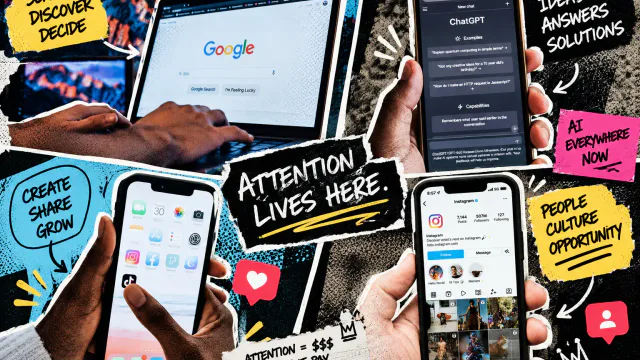
This is the new political information environment. Social media decides which fragments travel. Search engines decide which records surface. AI systems increasingly turn those fragments and records into one confident answer.
How could social media and AI shape Kenya's 2027 General Election? Social platforms will influence which political messages people encounter, repeat and debate. AI tools may influence how voters research candidates, compare policies and interpret claims. Neither technology can guarantee a vote. Both can change the information available before a voter makes that choice.
The serious campaign response is not to manufacture more noise. It is to build a public information system that makes the candidate's record easy to find, understand, verify and quote.
That is the Attention Lasso opportunity.
Jump to a section
- Kenya's political information system has changed
- Social media is no longer just distribution
- AI has created a private political interviewer
- Deepfakes are dangerous, but they are not the whole problem
- The real campaign risk is an information vacuum
- The Attention Integrity System
- The legal and ethical boundary
- What campaign teams should build now
Kenya's political information system has changed
The rally still matters. Radio still matters. Television still matters. The chief guest arriving four hours late will, regrettably, probably still matter.
But the political story no longer waits for the evening bulletin.
The Reuters Institute's 2026 Kenya report describes social media as central to Kenya's news ecosystem. It identifies WhatsApp as an important channel for political information, rumours and mobilisation, while TikTok and YouTube have become major entry points to news and current affairs, particularly for younger audiences.
The report also says Kenya stands out for the prominence of news creators, including influencers, activists and digital personalities who interpret events as they unfold.
This needs one important caveat. Reuters Institute's Kenyan survey represents mainly English-speaking online news users. It is not a census of every Kenyan voter. It tells us what is happening inside a highly connected part of the electorate, not what every person from Mombasa to Mandera does before breakfast.
The direction is still clear. A campaign speech now produces several political products at once:
- The full speech heard by the crowd.
- The television segment selected by an editor.
- The short clip selected by a social media manager.
- The reaction selected by a creator.
- The screenshot selected by a rival.
- The summary produced by a search or AI system.
- The voice note forwarded by someone who watched none of the above.
The campaign does not control all those versions. It can control whether the original facts are clear, accessible and difficult to misrepresent.
Social media is no longer just distribution
Many campaign plans still treat social media as a younger, faster poster wall.
Design the artwork. Add the candidate's photograph. Write “The future is now.” Post it everywhere. Ask the youth team why it only received twelve likes.
That misses what the platforms actually do.
Social feeds are recommendation systems. They decide what to place in front of people who never followed the campaign account. A message can travel because it is useful, funny, outrageous, frightening or easy to argue with. The algorithm does not attend manifesto meetings. It watches behaviour.
Kenya saw this dynamic before the 2022 election. Mozilla Foundation researchers documented more than 130 TikTok videos containing hate speech, incitement or political disinformation from 33 accounts. The videos collectively attracted millions of views.
That study did not prove that those videos changed election results. It proved that political content from a relatively small number of accounts could travel far beyond their immediate followers.
Recent experimental research gives us another reason to take feed design seriously. In a 2026 Nature study involving 2,000 participants, engagement-based ranking amplified more intergroup, moralised and emotional political content than a reverse-chronological feed during the 2024 US election period. That was an American experiment, not a Kenyan election. We should not paste its results onto Kenya and call it local insight. It does demonstrate that feed design can change the political material people encounter and their perception of the wider conversation.
For a campaign manager, the lesson is practical: distribution is not finished when the post goes live.
You need to know:
- Which part of the message the platform is amplifying.
- Which creators or communities are adding context.
- Which questions keep returning in the comments.
- Whether the clip still makes sense outside the full speech.
- Where an interested person can verify the original claim.
Virality without a verification path is attention rented from chaos.
Build the system before the clip escapes the room. Attention Lasso helps campaign teams connect audience intelligence, verified content and measurable public journeys. Make Attention Pay.
AI has created a private political interviewer
Social media made political information public, fast and fragmented. Generative AI adds a quieter layer.
A voter can now ask:
- What has this candidate achieved?
- Compare the two candidates' healthcare policies.
- Has this promise been made before?
- What controversies surround this coalition?
- Which candidate has a plan for small businesses?
The campaign may never see the question. The answer may still affect the voter's understanding.
The Reuters Institute's 2026 Digital News Report found that weekly use of AI chatbots for news across its surveyed markets rose from 7% to 10% in one year. That is still a minority behaviour. It is also moving in one direction.
Recent research suggests these conversations deserve more attention than the average website FAQ receives. A 2025 Nature study ran preregistered experiments around elections in the United States, Canada and Poland. Conversations with AI models shifted some participants' candidate preferences. The models mainly persuaded using facts and evidence, although some of those facts were inaccurate.
Again, these were not Kenyan voters. The study does not tell us how a multilingual Kenyan electorate will use AI in 2027. It tells campaign teams that conversational answers can affect political attitudes and that confident inaccuracies are not a theoretical inconvenience.
AI can also help rather than harm. In 2026, the Brennan Center tested six widely used AI products against common election conspiracy theories. The chatbots generally pushed back against falsehoods. However, they also made mistakes and struggled to identify some generated media. The researchers warned that chatbots may be less helpful during an active election when there is little authoritative information to rely on.
That last point should make every campaign team sit up.
When reliable public information is missing, outdated or scattered, the machine has fewer trustworthy ingredients. It may use old reporting, a rival's framing or a page that happens to be easier to retrieve than yours.
Your candidate can have the better policy and still lose the answer.
Deepfakes are dangerous, but they are not the whole problem
The easiest AI election article to write begins with a robot, adds the word “deepfake” fifteen times and ends with democracy on fire.
Reality is less cinematic and more inconvenient.
Deepfakes are already present in Kenya. Africa Check has documented fabricated videos appearing to show Ruto speaking French and Uhuru Kenyatta announcing a 2027 run. Both examples show how a recognisable face and voice can be used to make false political material feel familiar enough to share.
Kenya's own election authority is treating this as a real operational risk. The IEBC Election Operation Plan for 2025 to 2027 identifies misinformation, disinformation, hate speech, fake news, deepfakes and propaganda among the threats facing the election.
At the same time, evidence from South Africa's 2024 election offers a useful warning against panic. Africa Check found AI-generated impersonations and deepfakes, but reported that traditional forms of false or misleading content remained a larger part of the information problem.
The dangerous post may therefore be:
- A sophisticated AI video.
- A real video with one sentence removed.
- An old photograph given a new date.
- A fake newspaper cover.
- A misleading chart.
- A genuine quote attached to the wrong person.
- A rumour typed in a WhatsApp group by someone whose evidence is “my cousin works there.”
Campaign readiness cannot begin and end with buying a deepfake detector.
It needs a verification process that handles false information regardless of whether it was produced by artificial intelligence, Photoshop, selective editing or ordinary human creativity after midnight.
The real campaign risk is an information vacuum
Here is the Attention Lasso view.
The biggest digital risk is not only that somebody will publish something false about your candidate. It is that the public, the press, search engines and AI systems will have nowhere better to go.
We call this an attention vacuum.
It appears when:
- Policy documents exist only as large PDFs nobody can search properly.
- The candidate's current position is buried beneath six months of social posts.
- Speeches contain claims without linked evidence.
- Different campaign spokespeople give different numbers.
- The official website has biographies but no useful answers.
- Old pages remain live without dates or corrections.
- A crisis response appears as a screenshot that cannot be indexed or verified.
In that vacuum, other people define the candidate. Sometimes it will be a journalist doing careful work. Sometimes it will be a rival. Sometimes it will be a creator chasing engagement. Sometimes it will be an AI system assembling a polite paragraph from whatever survived online.
The campaign's job is not to control every conversation. It cannot.
Its job is to become the clearest credible source inside the conversation.
The Attention Integrity System
Political attention is often managed channel by channel. The website team publishes pages. The social team posts clips. The PR team sends statements. The research team guards policy documents like family land. When a crisis arrives, everyone opens a new WhatsApp group and begins asking who has the final version.
An Attention Integrity System connects the work before that moment.
1. Build one public source of truth
Create a searchable evidence hub for the candidate's biography, record, policies, claims, speeches and corrections.
Every important page should show:
- A clear answer near the top.
- The evidence supporting it.
- The date it was published or updated.
- The person or team responsible.
- Links to primary documents.
- A legitimate next action.
This is not a digital filing cabinet. It is the factual spine of the campaign.
2. Map the questions before writing the slogans
Campaign research often begins with what the candidate wants to say. Audience intelligence begins with what people are already trying to understand.
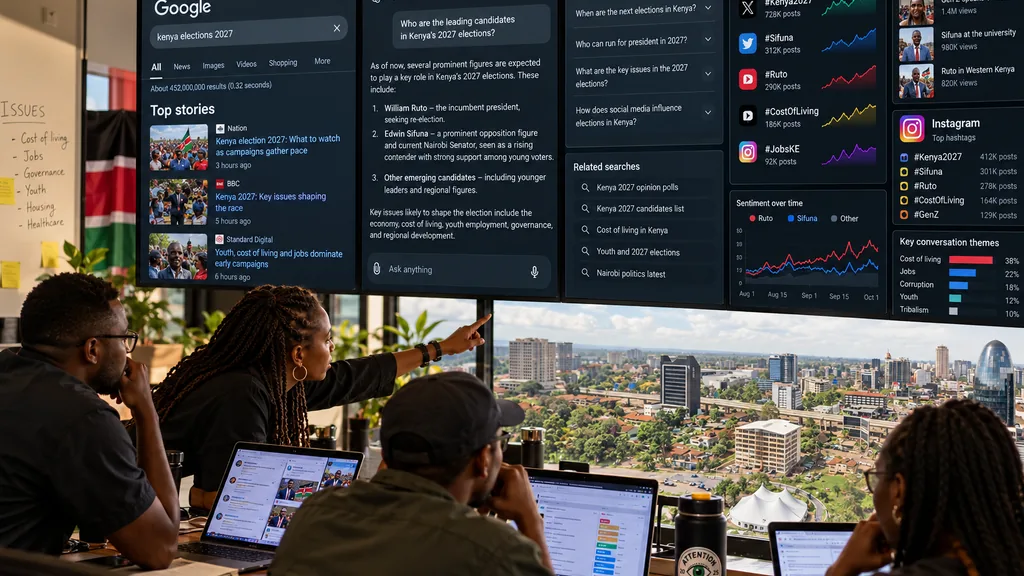
Our Audience Intelligence system can organise recurring public questions from search demand, public discussions, media coverage, town halls and first-party enquiries. Public comments are signals, not a representative opinion poll. We separate what the evidence shows from what we infer.
The output should be a living question map:
- What are people asking?
- Which questions indicate confusion?
- Which claims require evidence?
- Which language do people naturally use?
- Where does the official answer currently fail?
No invented voter persona called “Hustling Brian.” No national strategy built from four angry tweets.
3. Connect every social fragment to full context
A short clip should not be forced to carry an entire policy.
Use the clip to earn attention. Then provide a clean path to the complete speech, policy page, cost explanation, source document or verified statement. Captions, comments, profiles and video descriptions should help an interested viewer move from the fragment to the evidence.
That improves public understanding. It also creates crawlable, citable material for search and AI systems.
Through our search and AI discoverability work, we structure key answers so both people and machines can identify the candidate, the policy, the date and the supporting sources without guessing.
4. Monitor the answers, not only the rankings
Traditional campaign monitoring watches headlines, mentions and sentiment. That is no longer enough.
Campaign teams should regularly test the questions voters may ask Google, ChatGPT, Gemini, Perplexity and other answer systems. Record:
- Whether the candidate appears.
- Which sources the answer cites.
- Which facts are outdated or missing.
- Whether names, coalitions and policy positions are confused.
- How answers change across languages and phrasing.
This is not about “training ChatGPT” with a secret file. It is about improving the public information environment the systems can retrieve, then measuring what they actually produce.
5. Build a response route before the falsehood arrives
The response team needs more than a social media password and courage.
For predictable risks, agree in advance:
- Who verifies the claim.
- Which source is authoritative.
- Who approves the response.
- Where the permanent correction will live.
- Which channels will distribute it.
- When legal, security or platform escalation is necessary.
- How corrections will be logged and updated.
The social post may be temporary. The correction page should remain findable.
6. Measure movement, not applause
Millions of impressions can produce very little understanding.
Our Attention Analytics system would connect visibility to actions such as:
- Reading a complete policy explanation.
- Downloading a manifesto or source document.
- Registering for an event.
- Joining an authorised volunteer channel.
- Submitting a question.
- Finding a verified campaign contact.
- Returning after a correction or major announcement.
Likes show that something happened on a platform. They do not show that the message survived.
Your candidate does not need another poster factory. Build the research, evidence, response and measurement system behind the campaign. Make Attention Pay.
The legal and ethical boundary
An election campaign is not exempt from data protection because everybody is busy.
The Office of the Data Protection Commissioner's electoral guidance requires political and electoral organisations to identify a lawful basis for processing personal data. It states that valid consent must be express, specific, informed and freely given. The guidance also gives people rights concerning access, objection, correction and deletion, and addresses decisions with significant effects made solely through automated processing.
That creates a clear boundary for ethical audience intelligence.
We can analyse public questions in aggregate. We can map search demand. We can measure content performance. We can organise voluntarily supplied enquiries and campaign relationships with a lawful purpose.
We should not scrape together invasive personal dossiers, buy questionable voter lists, hide the source of contact data or let an automated system make consequential political decisions without meaningful human review.
The line is not “Can the software do it?”
The line is “Do we have the right, the reason and the safeguards to do it?”
Platform rules create additional boundaries. TikTok prohibits paid political advertising, including paid creator promotions by political figures and entities, although compliant organic political content is allowed. Google requires election advertisers to disclose synthetic content. Meta's published election approach also requires disclosures in certain political ads created or altered using AI and labels detected or disclosed AI-generated content.
Policies change, enforcement varies and local eligibility rules matter. Every paid campaign should be checked against the platform's current rules and Kenyan law before launch.
What campaign teams should build now
The Kenya 2027 General Election page counts down to 10 August 2027. That clock should not be mistaken for a planning schedule.
Trust, search visibility and operational readiness need a head start.
In the next 30 days
- Audit what Google and major AI systems currently say about the candidate.
- Identify outdated biographies, duplicate pages and unsupported claims.
- List the fifty questions the campaign must be able to answer clearly.
- Create rules for sources, dates, approvals and corrections.
- Review how supporter and voter data was collected.
In the next 60 days
- Build or repair the public evidence hub.
- Publish structured pages for priority policies and the candidate's record.
- Connect social content to permanent source pages.
- Establish an internal verified-source library.
- Create the misinformation and crisis-response workflow.
In the next 90 days
- Test messages with real audiences without confusing engagement for truth.
- Track search visibility and AI answer accuracy.
- Train spokespeople, researchers and social teams on one source system.
- Run a simulated misinformation incident.
- Measure whether attention reaches a useful next action.
The candidate remains the voice. The campaign team remains responsible for the judgement.
Attention Lasso builds the machine that helps the right information travel clearly.
Frequently asked questions
Can social media determine who wins Kenya's 2027 election?
There is no credible basis for claiming that social media alone will determine the result. It can still affect which information people encounter, which issues receive attention and how political events are interpreted.
Will AI chatbots influence Kenyan voters?
We do not yet have Kenyan evidence showing how much AI chatbots will affect vote choice in 2027. AI is becoming part of political information discovery and should be monitored without pretending its Kenyan electoral effect is already known.
Should a campaign use AI to create political content?
AI can assist with research organisation, transcription, translation, content versions and workflow automation. Every factual claim still needs human verification, and synthetic media must not mislead audiences.
What should a campaign do when a deepfake appears?
Preserve the evidence, verify the original media, publish a permanent correction with supporting sources, distribute it through verified channels and report the content through the relevant platform process.
Does Attention Lasso build voter profiles?
We do not build invasive personal dossiers or use unlawfully obtained voter data. Our work focuses on lawful sources, aggregated patterns, public questions, search behaviour and authorised first-party information.
What is Ground Pulse?
Ground Pulse is an Attention Lasso concept in development for organising public questions, narrative shifts and verified source material. It is not currently available for purchase.
The machines will answer
Give them something worth finding.
Build a clearer, better-sourced political record before the noise peaks.
Keep pulling the thread