Imagine planning a presidential campaign for nearly 160 million registered voters.
Google won't take your political advertising money. TikTok won't take it either. You can't pay influencers to endorse your candidate. Paid or boosted online propaganda followed fixed legal windows and ended on October 22 before the October 25 runoff, while new AI depictions of candidates stopped even earlier.
You might expect television, rallies, and printed leaflets to reclaim the election.
They did not disappear. Instead, paid social advertising concentrated inside Meta. WhatsApp channels became mass-mobilization machines. Televised debates were chopped into memes and vertical video. Supporters built games, virtual rallies, explainers, and synthetic clips faster than any central campaign team could fully control.
Brazil's 2026 election is not proof that social media wins elections. It is a better case study in what happens when law, platforms, campaign money, organized supporters, legacy media, and algorithms compete to control the same finite resource: attention.
Our conclusion is more useful than “the internet changed politics.”
Brazil's strict election rules did not remove money or manipulation from the feed. They created a Meta bottleneck, then forced campaigns to combine rented reach with supporter networks, owned destinations, news coverage, and rapid-response content.
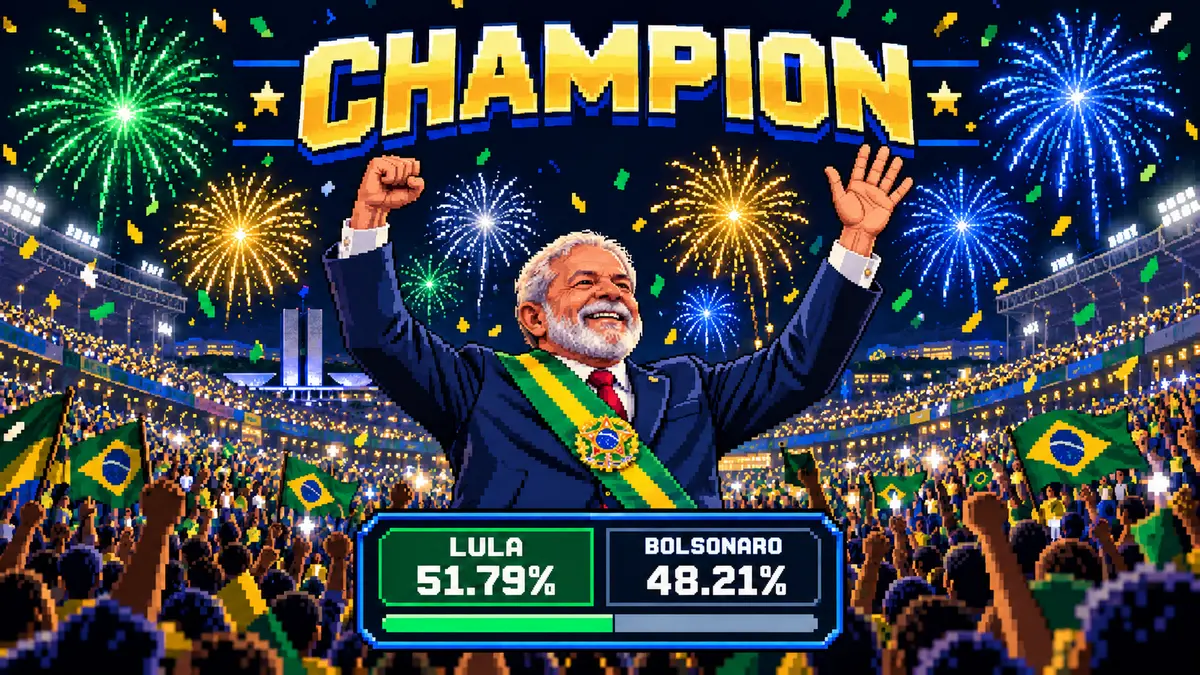
On October 25, Brazil's Superior Electoral Court declared Luiz Inácio Lula da Silva re-elected with 64,256,232 votes, or 51.79% of valid votes. Flávio Bolsonaro received 59,826,041 votes, or 48.21%.
Lula had finished the first round more than 2.2 million votes behind. He won the runoff by more than 4.4 million. The raw margin therefore moved about 6.66 million votes in his direction between rounds, although that figure is not a count of voters who switched sides because turnout and valid-vote totals also changed.
The result does not prove that Lula's digital pivot caused the reversal. It does prove why a marketer should never treat a first-round lead, an interaction count or a platform dashboard as the final customer outcome.
Planning an election campaign? Attention Lasso connects:
- Political advertising
- Audience research
- Content
- Websites
- Search
- AI visibility
- Analytics
- Response systems
So attention has somewhere useful to go.
What Attention Lasso Labs examined
This analysis follows the 2026 presidential campaign through the first round and runoff. We reviewed:
- Official first- and second-round results, campaign dates, advertising rules, and AI rules published by Brazil's Superior Electoral Court, the TSE
- Declared campaign expenses and published analyses of TSE financial records
- Google, TikTok, and Meta policies and statements
- Meta advertising activity reported by researchers and news organizations
- Public WhatsApp channel growth and social interaction data
- Research into AI-generated election content, irregular advertising, and ad-library transparency
- Current evidence about how Brazilians get news from social platforms, creators, television, and publishers
We didn't score ideology, predict the winner, or treat an interaction as a vote. We can't see private targeting, campaign CRM data, message-level conversion data, or what voters read inside encrypted conversations. Public advertising libraries also don't reveal enough information to calculate a reliable cost per persuaded voter.
Those are not decorative disclaimers. They define what this case study can honestly conclude.
Brazil's election advertising rules created a Meta bottleneck
The Brazil elections did not have an open digital advertising market in 2026.
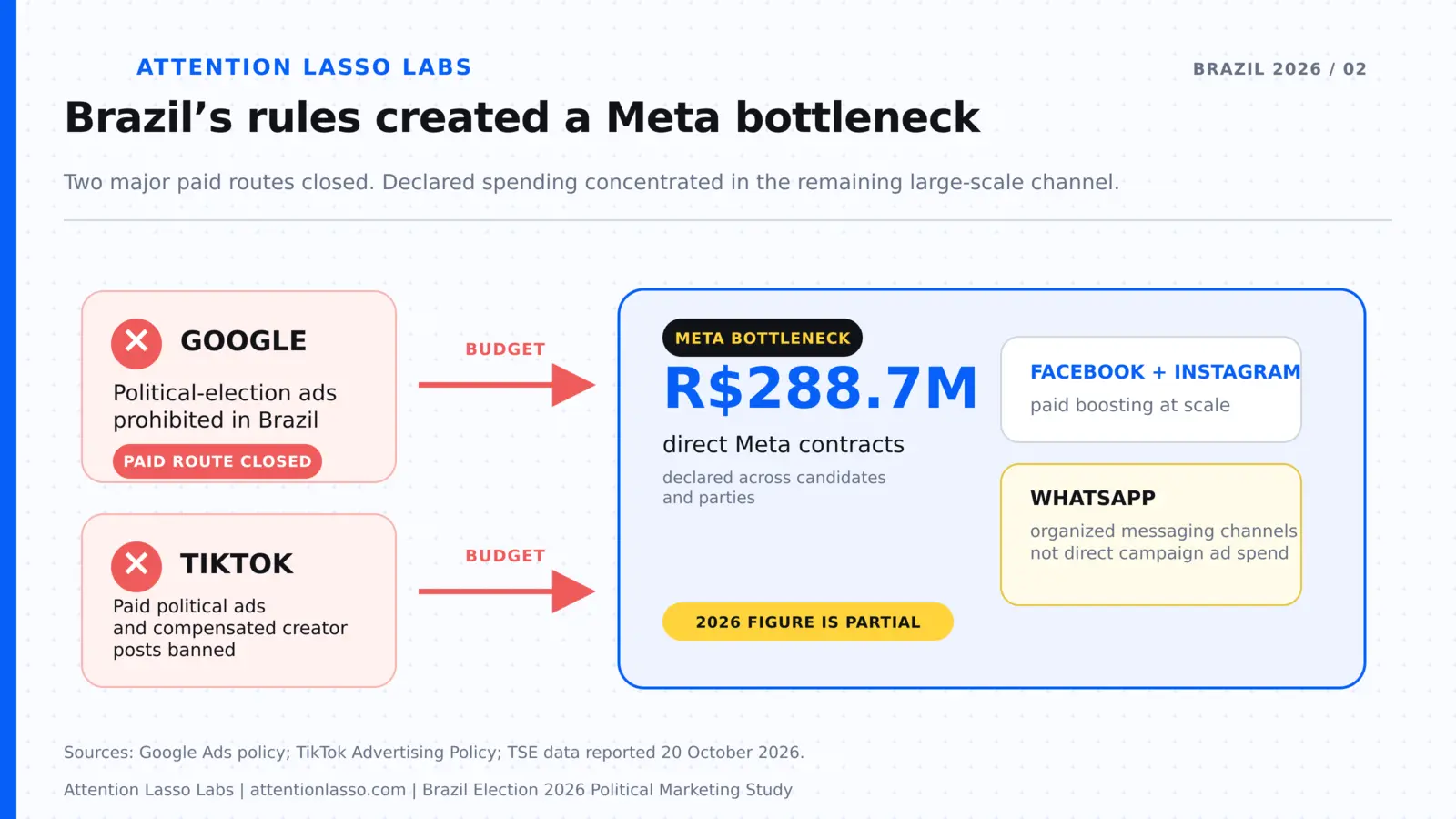
Google's advertising policy prohibits political-electoral content in Brazil as defined by the relevant TSE resolution. TikTok prohibits paid political advertising, including paid creator content and its Promote tool. Brazilian rules also prohibit candidates from paying influencers for campaign-benefiting content, although creators remain free to express genuine political support.
That left Meta's advertising systems, principally Facebook and Instagram, as the dominant large-scale paid social route available to campaigns.
The money followed.
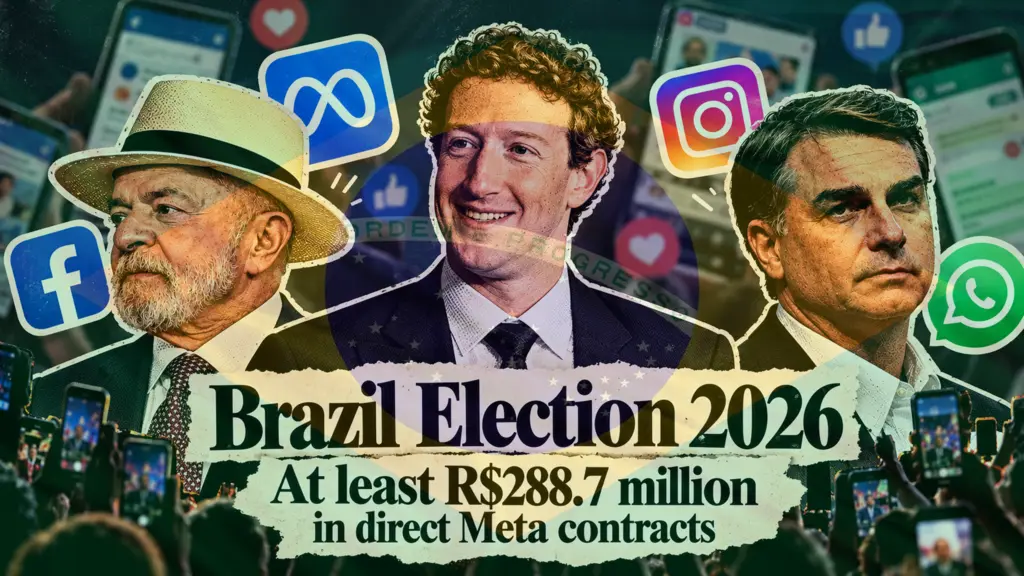
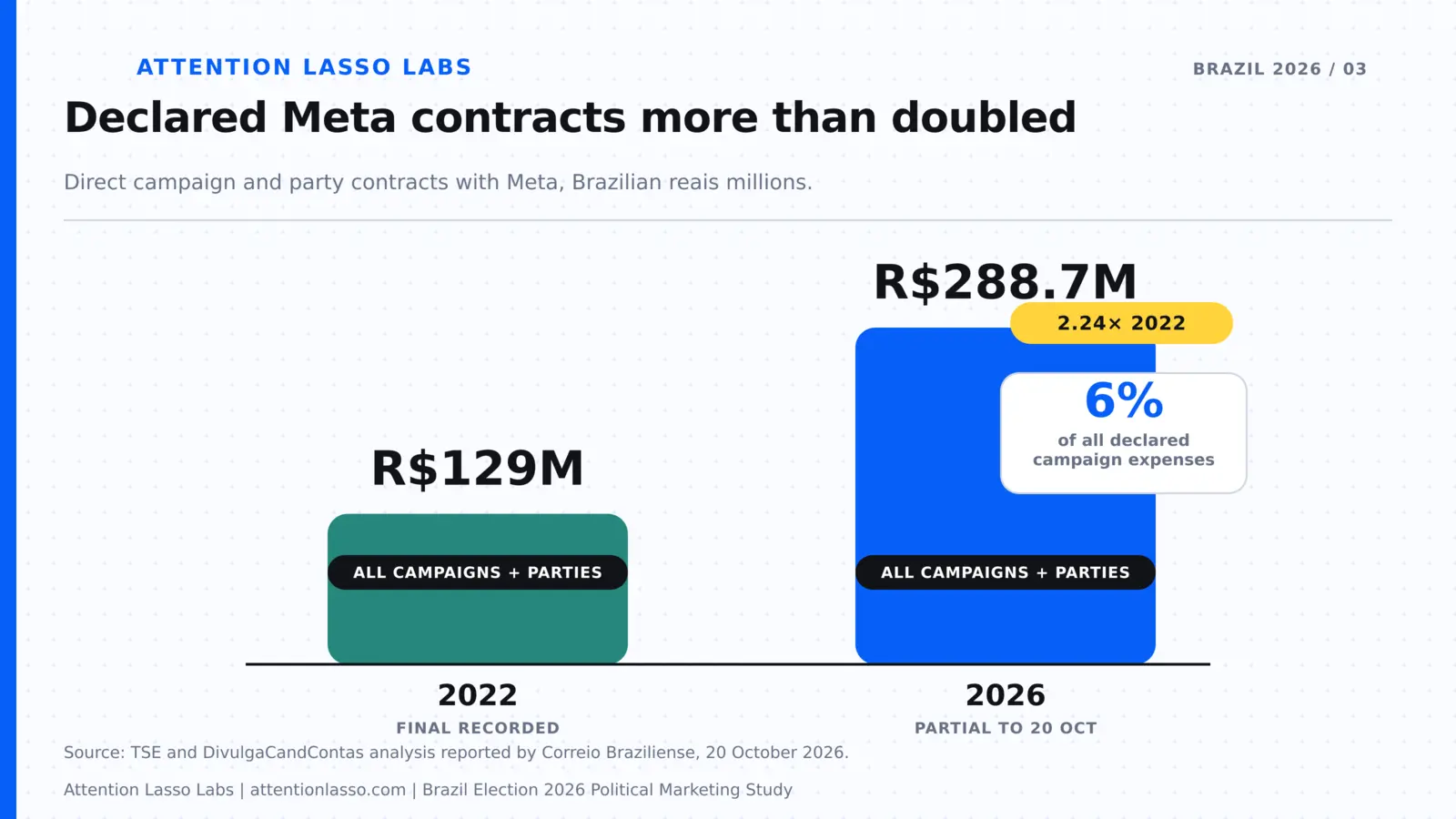
Candidates and parties had declared at least R$288.7 million in direct contracts with Meta by October 20, according to an analysis of TSE open data and campaign accounts. That was more than twice the R$129 million recorded in 2022. Direct Meta contracts represented 6% of all declared 2026 campaign expenses in that partial dataset.
The denominator matters. R$288.7 million covers candidates and parties across Brazil's elections, not only Lula and Flávio Bolsonaro or only the presidential race. The figures are also provisional. First-round candidates can file final accounts through November 3, and runoff candidates through November 14.
Even with those limits, the direction is difficult to miss. One technology company became Brazil's largest declared campaign supplier while also controlling Facebook, Instagram, and WhatsApp.
That is the first big lesson for political marketing teams:
When laws or platform policies remove channels, budget does not necessarily disappear. It can concentrate inside the channels that remain.
Concentration creates efficiency for buyers, but it also creates dependency. A technical fault, review error, policy interpretation, or distribution change can affect the main paid route during the shortest and most expensive part of a campaign.
That risk stopped being theoretical. Lula's campaign alleged unequal treatment and delivery problems. The TSE ordered Meta to prove it treated both campaigns equally. Meta denied political bias, described several technical incidents, and acknowledged that Lula's advertising account had been deactivated by mistake for slightly more than an hour. Both Lula's and Flávio's campaigns reported problems during the election.
No public evidence establishes intentional platform interference. Abundant evidence shows Brazil's campaigns had become so dependent on Meta's technical decisions that they became election news.
The first-round result exposed a political marketing imbalance
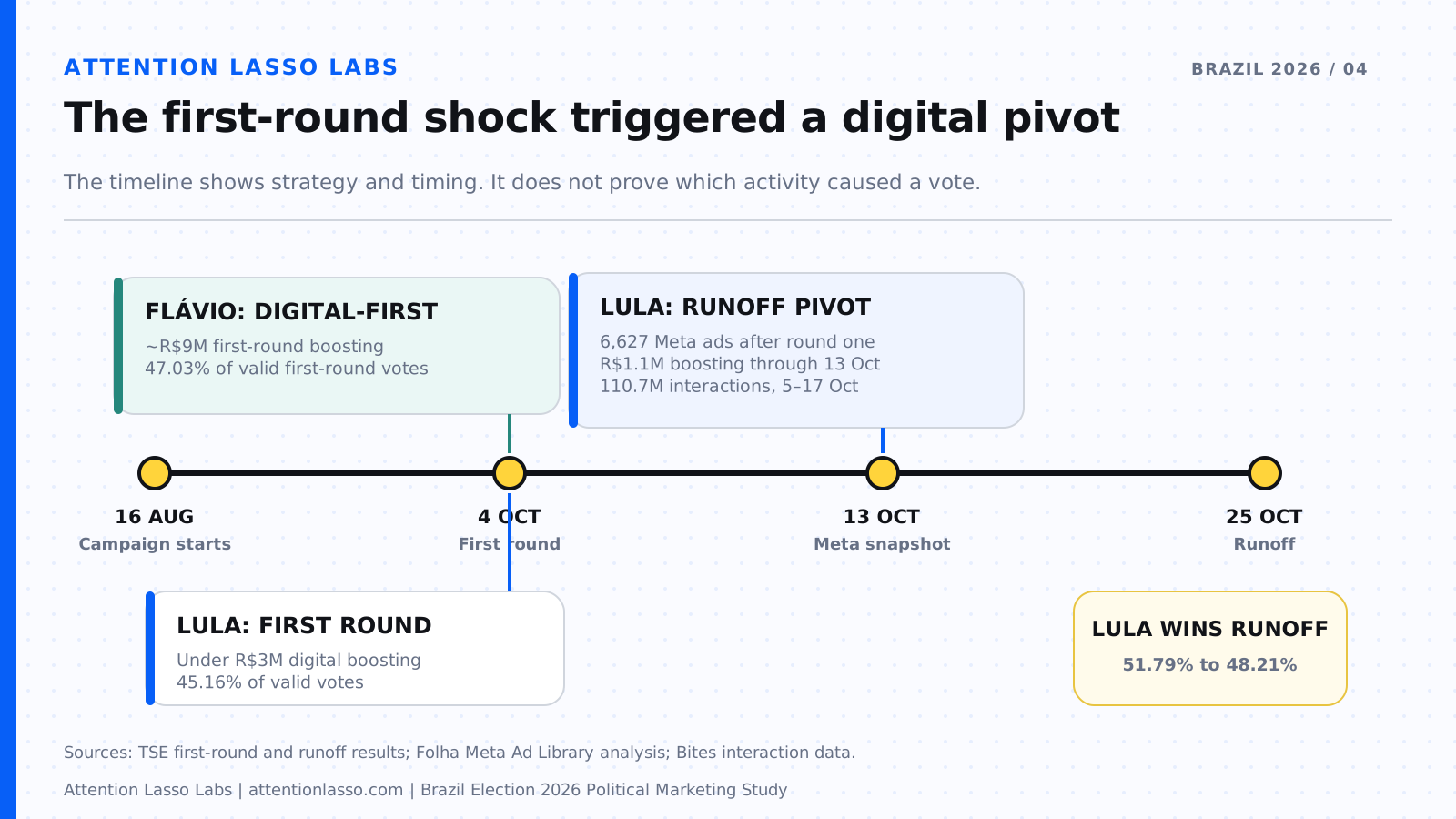
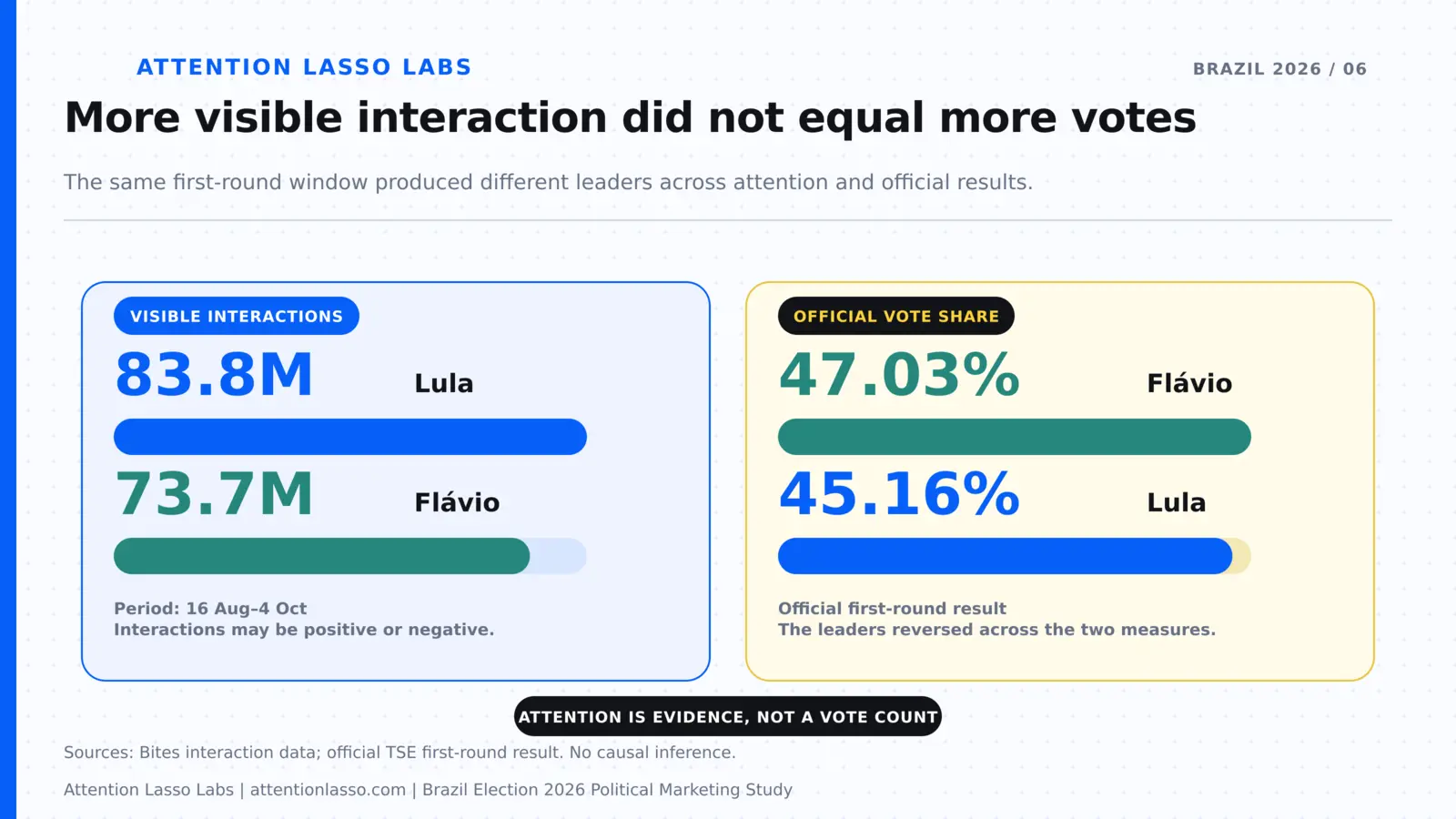
The official first-round result gave Flávio Bolsonaro 47.03% of valid votes and Lula 45.16%. Flávio led by more than 2.2 million votes.
The campaigns had not built the same attention system.
During the first round, Lula reportedly spent more than R$13 million on events, printed material, and street activity. Flávio's campaign put about R$9 million into digital boosting, compared with less than R$3 million from Lula.
This is not a clean field-versus-feed experiment. The candidates had different coalitions, histories, messages, regional strengths, media coverage, and voter perceptions. You can't isolate spending more online from all those variables.
What happened next is still revealing.
After the first-round shock, Lula's campaign changed its distribution strategy. The same Folha analysis found 6,627 Lula ads running between the first-round result and October 13. That was more than 68% of all ads the reviewed profiles had run since mid-July. The campaign spent about R$1.1 million on Facebook and Instagram boosting in that runoff period.
Flávio's reviewed profiles ran 125 ads during the same runoff snapshot and spent an estimated R$149,000 on Meta. His campaign disputed the completeness of Meta's figures and noted that the data excluded other channels such as Kwai, which does not provide a comparable public advertising library.
The point is not that one team had found the correct number of ads. A campaign can publish 6,000 weak variations and still learn less than a rival testing 60 disciplined messages.
The useful finding is the timing. Lula's operation didn't just increase its media budget. It reorganized around digital distribution after voting had already exposed a weakness.
The official runoff result completed the reversal. Lula moved from 45.16% in the first round to 51.79% in the second. Flávio moved from 47.03% to 48.21%. That does not isolate the effect of advertising, WhatsApp, field organizing, endorsements, turnout or any other campaign input. It shows that the attention system changed while the electoral outcome changed, which is a strong reason to investigate the handoffs and a weak reason to claim one platform won the election.
Lula won the visible interaction race before the votes were counted
The first round had already warned against confusing interaction volume with votes. Public figures cited in the research put Flávio at 83.8 million visible interactions and Lula at 73.7 million, while Flávio also led the official first-round vote. The runoff then produced a very different interaction pattern.
Between October 5 and 17, Lula's official profiles generated 110.7 million interactions across X, Instagram, Facebook, TikTok, and YouTube. Flávio's generated 31.3 million, according to data from Bites. Lula also added 2.3 million followers during that period, compared with 1.5 million for Flávio.
By the final campaign day, Quaest's digital popularity index ranked Lula 82.7 and Flávio 76.2. Lula published 115 posts that day. Flávio published 29. Lula averaged about 156,000 likes and 24,000 comments per post, while Flávio averaged about 19,000 comments.
The temptation is to announce a digital winner and work backward from the election result.
That would be bad analysis.
An interaction can be supportive, hostile, automated, curious, or accidental. A follower can live outside the constituency. A share can spread a message to an opponent's audience. A person can watch every video and still abstain. A campaign can also generate fewer public interactions while using private groups, field networks, churches, unions, or direct messages more effectively.
Here is what the public evidence supports:
| Question | What the evidence shows | What it does not prove |
|---|---|---|
| Did Lula's digital activity increase in the runoff? | Yes. Ad volume, interactions, followers, and WhatsApp reach all rose sharply. | That the official campaign caused every increase. |
| Did Lula lead the visible runoff conversation? | Several public datasets put him ahead on volume and interactions. | That the conversation was uniformly positive or persuasive. |
| Did Flávio's first-round digital emphasis matter? | It gave his campaign a larger visible paid-digital operation before the first vote. | The number of votes caused by that spending. |
| Did social media decide the election? | Public data can show timing, reach, activity, and correlation. | A causal vote total for any platform, ad, creator, or post. |
The official result makes the warning concrete. Lula led the visible interaction measures cited above and won the runoff. That is correlation, not a platform-attribution model. The same period also included changes in turnout, regional mobilization, news coverage, campaign coalitions, field work, economic arguments and candidate preference. Public interaction data cannot isolate the vote caused by a post, an ad or a WhatsApp channel.
WhatsApp turned subscribers into an organized distribution layer
The most consequential 2026 campaign channel may not have looked like an advertisement at all.
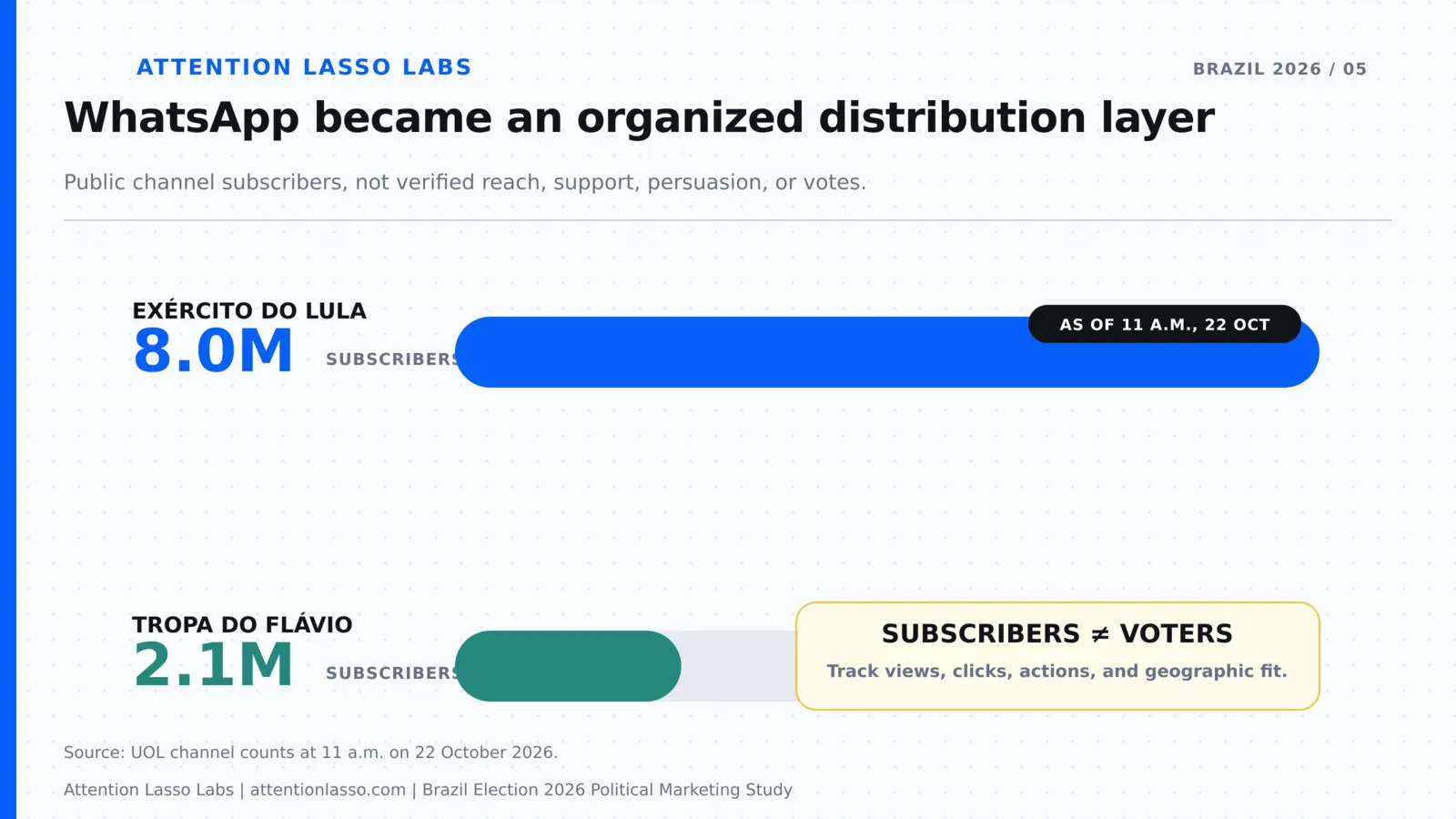
At 11 a.m. on October 22, the “Exército do Lula” WhatsApp channel had 8,002,710 subscribers. The “Tropa do Flávio” channel had 2,094,574, according to UOL's dated count.
Both channels directed supporters toward coordinated actions such as:
- Sharing content
- Participating in online searches
- Responding to claims
- Following campaign activity
- Amplifying moments from television coverage
The Lula-supporting channel was created earlier for other purposes, then used intensively after the first round. Flávio's channel was created after the first round. Both were registered as official campaign channels with Brazil's electoral authorities.
This is why “WhatsApp marketing for an election” is too narrow a description. The channel wasn't just another place to publish a poster. It was an instruction layer connecting campaign narratives to human distribution.
It also demonstrates why subscriber totals need care.
Eight million subscribers don't equal 8 million active readers, supporters, persuaded voters, or votes. Public researchers can't see forwarding chains, private conversations, geographic eligibility, message comprehension, or whether a subscriber follows the channel to monitor an opponent.
Campaigns should therefore measure a messaging network in stages:
- Subscribers who can legally and technically receive the message
- Message views or opens where reliable data exists
- Clicks to a distinct tracked destination
- Completed actions such as volunteering, donating, attending, or requesting voting information
- Repeat action and retention
- Geographic match with the electorate
The large number is attention inventory. The smaller numbers tell you whether it became campaign capacity.
Paid influencers were restricted, but influence was everywhere
Brazil offers a useful contrast with the United States.
Under current Brazilian rules, candidates can't contract paid influencer marketing that benefits a campaign. InternetLab and Redes Cordiais' 2026 guide explains that creators may participate in political discussion and offer genuine support, but compensation changes the legal position.
TikTok's own policy separately prohibits paid political advertising, including compensated branded political content.
Influence did not disappear. Politicians, actors, musicians, commentators, meme pages, news presenters, and ordinary supporters still translated campaign messages into their audiences' language. The difference is that the visible ecosystem relied more heavily on organic support, political figures who already behaved like creators, and volunteer mobilization than on openly purchased endorsements.
That distinction should change how a campaign plans.
If local law permits paid creators, the campaign needs contracts, disclosures, tracked links, content archives, and a payment ledger. If paid endorsements are prohibited, the campaign still needs relationship building, briefing materials, accurate source pages, and a rapid way for genuine supporters to find usable evidence.
Copying an American influencer plan into Brazil would not be “best practice.” It could be unlawful.
Legacy media did not die. It became feed material
Social media maintains a nine-percentage-point lead over television as a weekly news source in Brazil. The Reuters Institute's 2026 Digital News Report also found that 33% of Brazilians get content from creators or influencers who mainly focus on news.
That doesn't make television irrelevant.
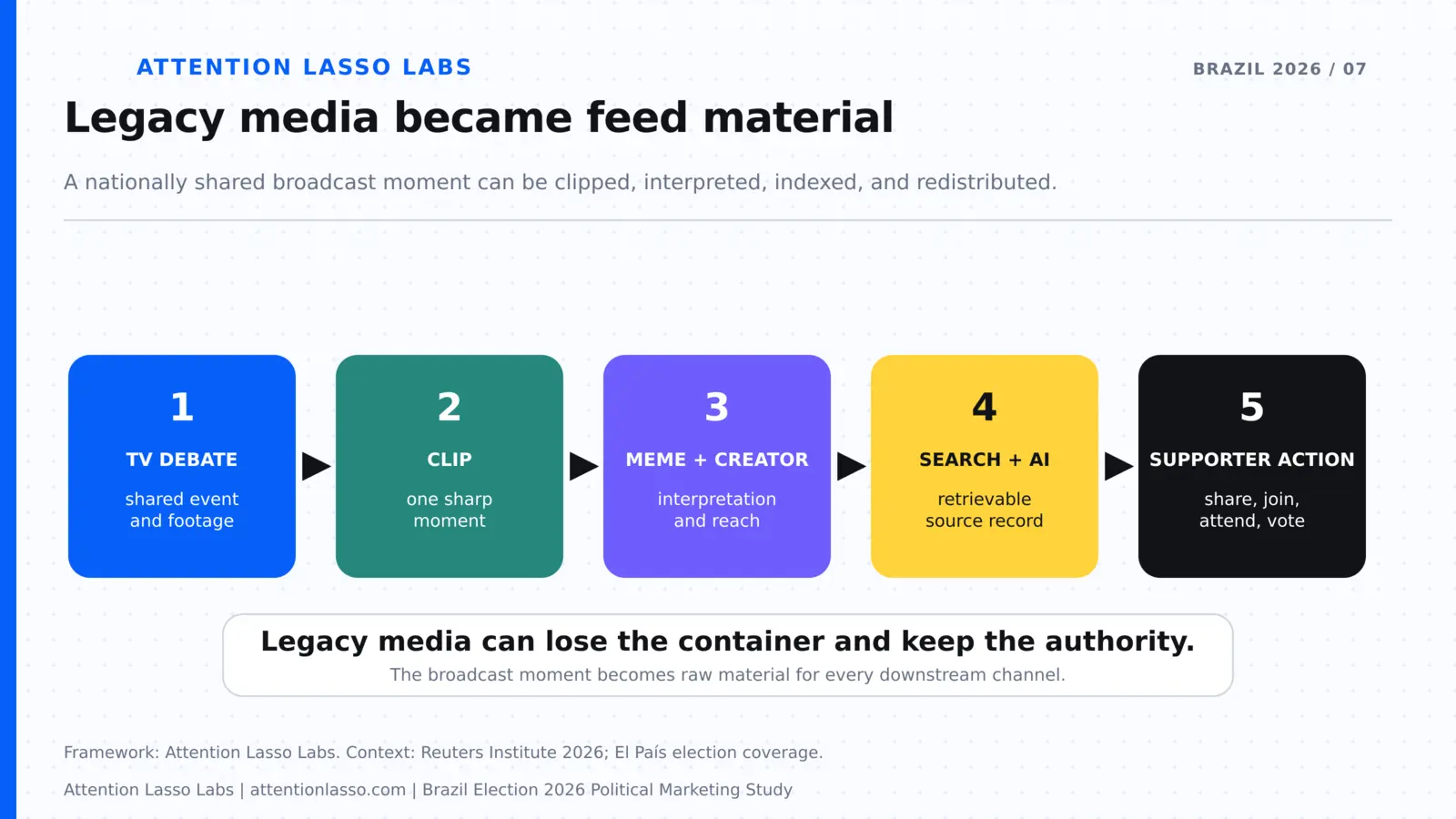
Brazilian debates supplied some of the campaign's most reusable social moments. A hand gesture, accusation, comeback, or awkward exchange could leave the studio as a clip, become a meme, attract commentary, enter search results, and return as material for the next round of coverage.
The broadcast created a nationally shared event. Social platforms multiplied and reinterpreted it.
This is the distribution relationship political teams should understand:
- Journalists and broadcasters create authoritative events, reporting, interviews, and footage.
- Campaigns and supporters cut those moments into platform-native formats.
- Creators add interpretation and audience trust.
- Search engines index the durable publisher and campaign pages.
- AI assistants may later retrieve those sources when voters ask about the candidate.
Declining newspaper circulation or television viewing doesn't erase institutional authority. It changes where people consume that authority.
Our analysis of how social media and AI could shape Kenya's 2027 election explains why a candidate's searchable record now travels far beyond a campaign website.
AI in political marketing became a production and compliance problem
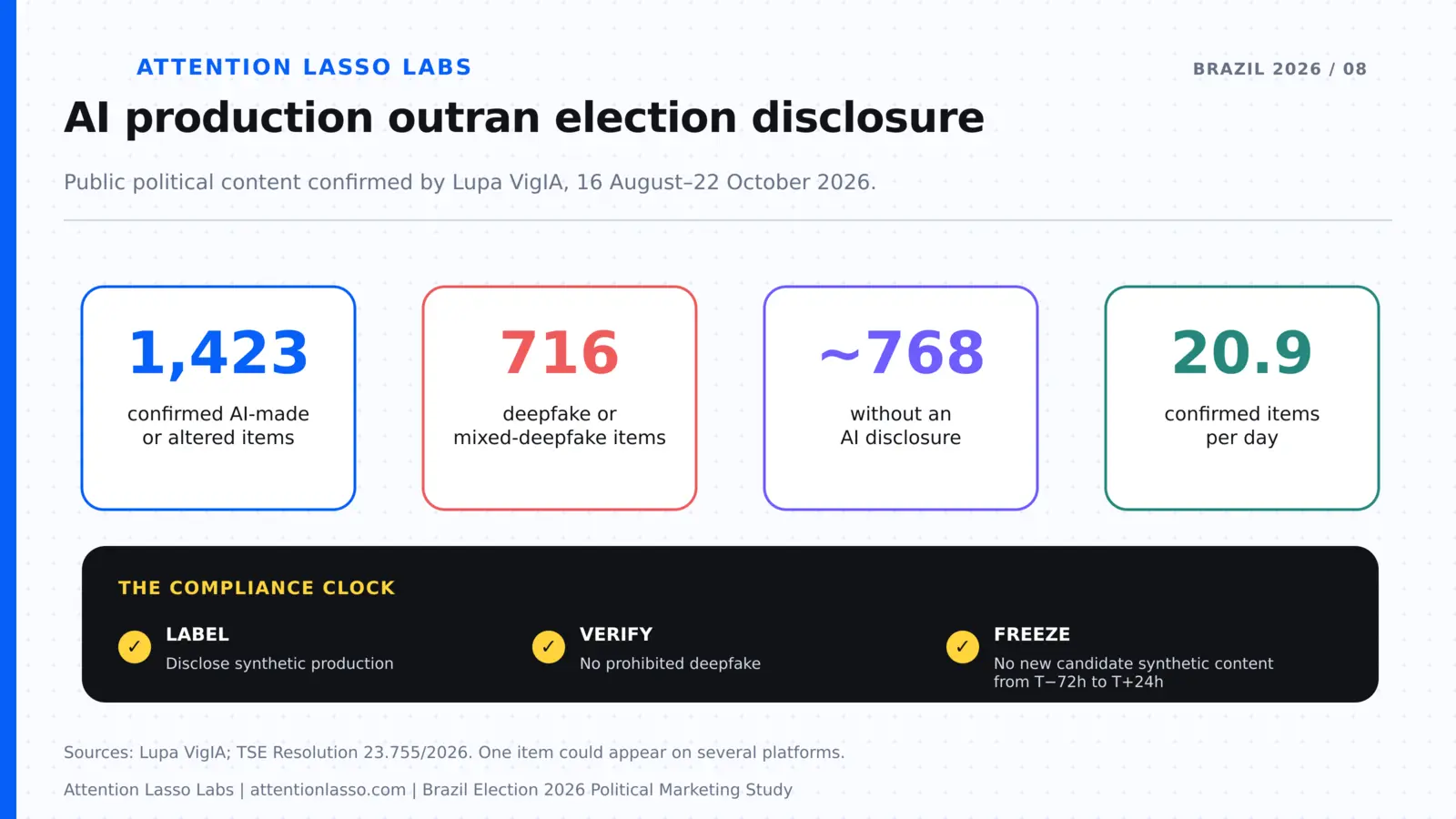
Brazil's 2026 rules required explicit, prominent disclosure when a candidate created or substantially altered campaign content with AI. Deepfakes used to benefit or harm a candidacy were prohibited. During the 72 hours before voting and the 24 hours after, even labeled new synthetic content using the image or voice of a candidate or public figure couldn't be published, republished, or boosted.
Production volume still outpaced the labels.
Lupa's VigIA project reviewed 1,486 suspicious political items posted between August 16 and October 22 and confirmed that 1,423 were produced or altered with AI. That works out to 20.9 confirmed items per day, close to one every hour.
Among those items:
- 716, or 50.3%, were deepfakes or combined deepfakes with other synthetic techniques
- About 768 did not disclose the use of AI
- 794 appeared on Instagram and 690 on Facebook, although one item could appear on more than one platform
- 55.2% promoted candidates, 25% attacked opponents, and 18.5% used humor or satire
The issue is not whether campaigns should use AI or ban every synthetic asset. The issue is operational control.
A campaign using AI needs an asset ledger containing:
- The original file and every published variation
- The tool and prompt or process used
- The human responsible for the factual claim
- The required label and where it appears
- The platforms, accounts, and dates of publication
- The candidate or public figure depicted
- The legal review status
- The removal or correction process
It also needs a hard publication freeze that matches the jurisdiction's final-hours rules. Scheduling software should not be able to republish a prohibited synthetic asset because someone forgot it was sitting in a queue.
Brazil's AI rules reached beyond campaign production. They also prohibited generative AI systems from ranking, recommending, or favoring candidates. Yet Reuters reported that an ITS Rio study found seven widely used chatbots ranked or ordered candidates in 90% of tested responses.
This is where AI visibility and election compliance collide. A campaign can't assume that an assistant will follow local law merely because the prompt asks a political question. Nor can it “optimize” its way around rules that prohibit the answer.
Brazil's ad transparency looked precise until researchers tried to use it
Brazil requires a public repository of election advertising. That sounds like enough information to compare campaign efficiency and platform treatment.
Researchers tried.
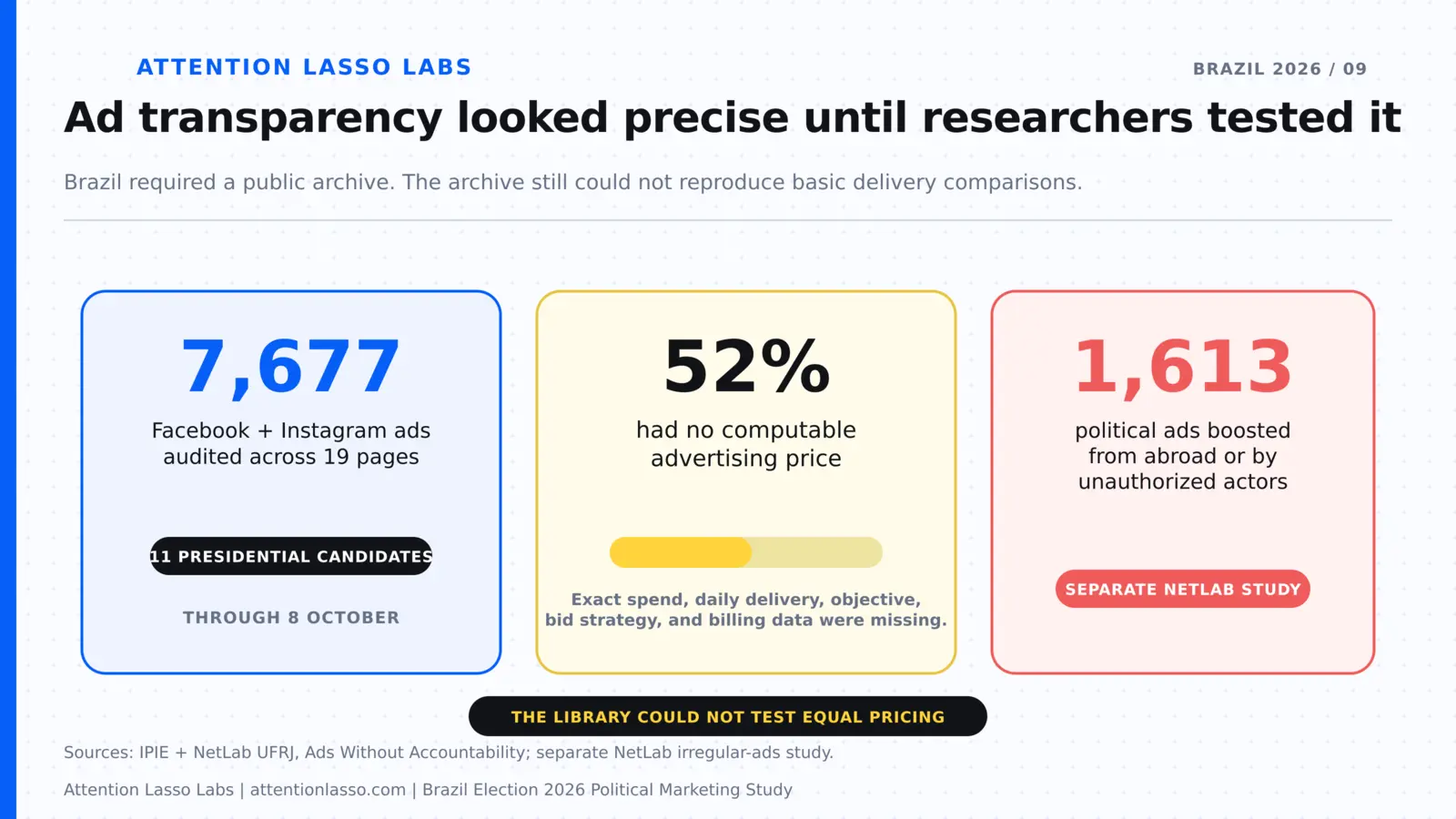
NetLab UFRJ and the International Panel on the Information Environment examined 7,677 Facebook and Instagram ads from 19 pages linked to 11 presidential candidates through October 8.
They found that:
- Spend was reported in broad ranges rather than exact amounts
- More than half of the ads, 52%, had no computable price
- The library showed scheduled dates rather than reliable daily delivery
- The payer field was self-declared
- Campaign objectives, bid strategies, billing country, and billing currency were missing
The researchers concluded that the public data could not show whether campaigns paid different prices for comparable reach.
A separate NetLab investigation identified 1,613 political ads boosted from abroad or by actors not authorized to run election advertising in Brazil. Some were recategorized as political only after they had already run.
The scientific conclusion is not “Meta favored candidate X” or “campaign Y bought votes more cheaply.” The available data can't establish either claim.
The defensible conclusion is still serious: even one of the world's more demanding political-ad transparency systems did not give independent researchers enough information to reproduce basic pricing and delivery comparisons.
Campaigns should preserve their own evidence rather than trusting a platform library to become a complete historical record:
- Exact spend by day, creative, audience, and placement
- Delivery and frequency by day
- Approval, rejection, and appeal timestamps
- Screenshots and IDs for every published ad
- Landing-page version and tracked destination
- Qualified actions and downstream outcomes
- Any outage, account restriction, or reporting discrepancy
If the campaign doesn't own that record, it can't properly defend, diagnose, or learn from its own election marketing.
The political marketing system behind Brazil's campaign
The election becomes easier to understand when the channels are separated by job.
| Attention layer | Examples from Brazil 2026 | What it was meant to do | Main measurement trap |
|---|---|---|---|
| Paid | Facebook and Instagram boosting | Buy controlled distribution | Treating impressions as persuasion |
| Organized | WhatsApp campaign channels and supporter missions | Mobilize repeat action | Treating subscribers as active voters |
| Earned | News coverage, interviews, debates, and spontaneous creator support | Borrow authority and reach | Treating all mentions as favorable |
| Owned | Campaign sites, issue pages, email, SMS, and data | Preserve evidence and relationships | Capturing contacts without measuring later action |
| Synthetic | AI-assisted images, videos, audio, and memes | Increase production speed and variation | Losing factual, legal, and version control |
| Electoral | Turnout, valid votes, regional shifts, and the official result | Determine the actual outcome | Backfilling a causal story from whoever won |
A strong campaign connects these layers. A weak one optimizes each dashboard separately and hopes the totals add up to a vote.
What digital political marketing teams should do before the next election
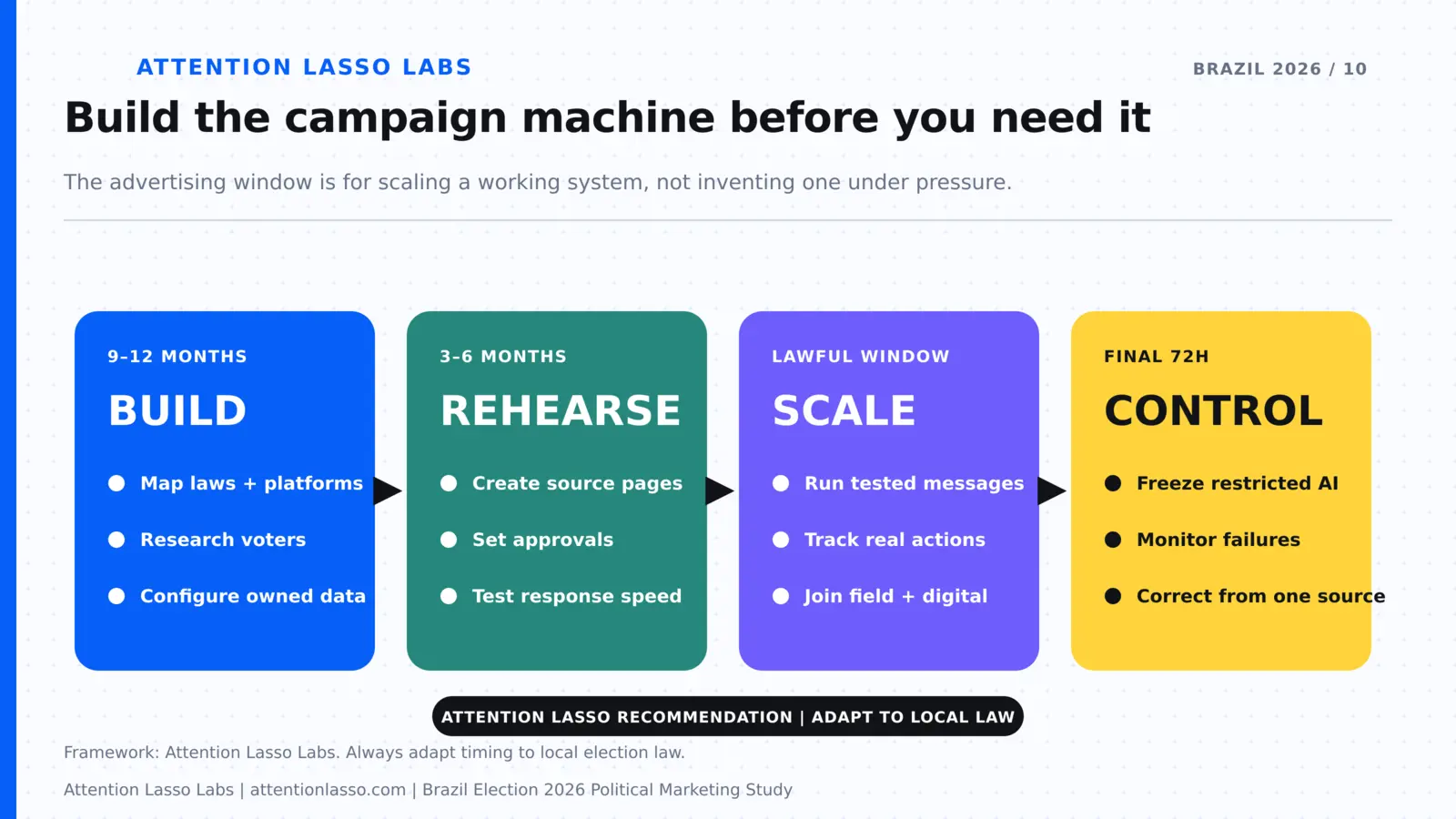
Brazil's 2026 campaign suggests a practical build sequence.
9 to 12 months before voting: build the lawful infrastructure
This is an Attention Lasso planning recommendation, not a universal causal benchmark.
- Map election law, advertising restrictions, data rules, disclosure requirements, and final-hours blackout periods.
- Audit which platforms accept political advertising in the market and what evidence each platform exposes.
- Research the electorate's questions, anxieties, language, media habits, and regional differences.
- Build current issue pages with named sources, dates, and correction ownership.
- Configure analytics, campaign CRM fields, conversion events, consent, and naming conventions.
- Decide which relationships the campaign needs to own through email, SMS, messaging channels, events, and volunteer networks.
3 to 6 months before voting: rehearse the content and response system
- Create an approval route for facts, legal review, AI disclosures, and crisis corrections.
- Build a creator and supporter briefing system that respects local compensation rules.
- Test landing pages, signup journeys, donation paths, and volunteer handoffs on mobile.
- Produce issue explainers and searchable evidence before a controversy makes them urgent.
- Run response drills. Time how long it takes to verify a claim, approve an answer, publish it, and distribute it across formats.
During the lawful campaign window: scale what survives measurement
- Give each advertisement, creator, publisher, and major organic initiative a distinct tracked destination.
- Measure qualified attention, captured relationships, and completed actions separately.
- Compare creative within the same platform, audience, objective, and period.
- Record what the team will change when a metric moves. A dashboard without a decision rule is election-themed decoration.
- Keep field, press, social, search, and website teams on the same factual source.
In the final 72 hours: reduce improvisation
- Freeze synthetic assets where local rules require it.
- Remove prohibited scheduled posts and boosts.
- Monitor high-risk claims, account restrictions, broken destinations, and impersonation.
- Give a small named team authority to pause distribution and correct the source.
- Preserve every material change for the post-election review.
Campaigns need creativity under pressure. They don't need surprise compliance questions at 11:47 p.m.
What Brazil's election means for Kenya's 2027 political marketing
Brazilian law isn't Kenyan law, and Brazil's platform mix shouldn't be copied blindly into a Kenyan campaign.
The transferable lesson is about timing and dependency.
Campaign teams often think digital political marketing starts when advertisements go live. Brazil shows that the expensive part begins much earlier: building source material, distribution relationships, audience permissions, analytics, approval systems, and the ability to respond before a 21-day runoff turns the entire strategy upside down.
A campaign that waits for Kenya's formal campaign period to build those capabilities will be trying to design the machine while driving it.
That is why the countdown on our Kenya 2027 political and election marketing page is not decorative. It shows how much time campaigns have left to build the research, content, measurement, and response systems behind the message.
Our guide to marketing dashboards that support decisions explains how to stop reporting reach as though it were a result. Our introduction to attention engineering explains how paid, earned, owned, and searchable attention connect to an outcome instead of competing as departmental vanity projects.
Frequently asked questions
When was Brazil's 2026 presidential election?
The first round was held on October 4, 2026, and the presidential runoff on October 25. Brazil's Superior Electoral Court declared Lula re-elected with 64,256,232 votes, or 51.79% of valid votes. Flávio Bolsonaro received 59,826,041 votes, or 48.21%.
How much did Brazil's 2026 campaigns spend with Meta?
Candidates and parties had declared at least R$288.7 million in direct Meta contracts by October 20. That is a partial all-election figure, not a total for the presidential candidates, and final campaign accounts were still open.
Did social media decide Brazil's election?
Public data can't prove that. It shows major shifts in advertising, interaction, follower growth, and organized distribution. Still, it can't isolate those effects from candidate preference, field organizing, news coverage, regional coalitions, turnout, and other causes.
Could Brazilian candidates pay political influencers?
No. Current Brazilian rules prohibit candidates from contracting compensated influencer marketing that benefits a campaign. Creators can still express genuine political support, subject to election law and platform policies.
When could campaigns run paid political ads online?
The TSE permitted election propaganda from August 16, 2026. Paid or boosted online propaganda could run through October 1 before the first round, then resume after the required interval and run through October 22 before the runoff.
What were Brazil's rules for AI-generated election content?
AI-created or materially altered campaign content required explicit disclosure, and prohibited deepfakes could be removed and penalized. New synthetic content depicting candidates or public figures could not be published, republished, or boosted during the 72 hours before voting and the 24 hours after.
Can AI assistants recommend political candidates in Brazil?
Brazil's 2026 rules prohibited generative AI systems from ranking, recommending, or favoring candidates. Reuters testing found that widely used assistants did not consistently follow that rule.
The feed is campaign infrastructure.
Build the handoffs before the pressure arrives.
Attention Lasso connects audience intelligence, paid media, social content, search, AI visibility, campaign websites, response systems and measurement.
Keep pulling the thread