
If anyone tells you Africa cannot host the biggest sporting events in the world, hand them a plane ticket to Nairobi.
Then tell them to pack for September 2029.
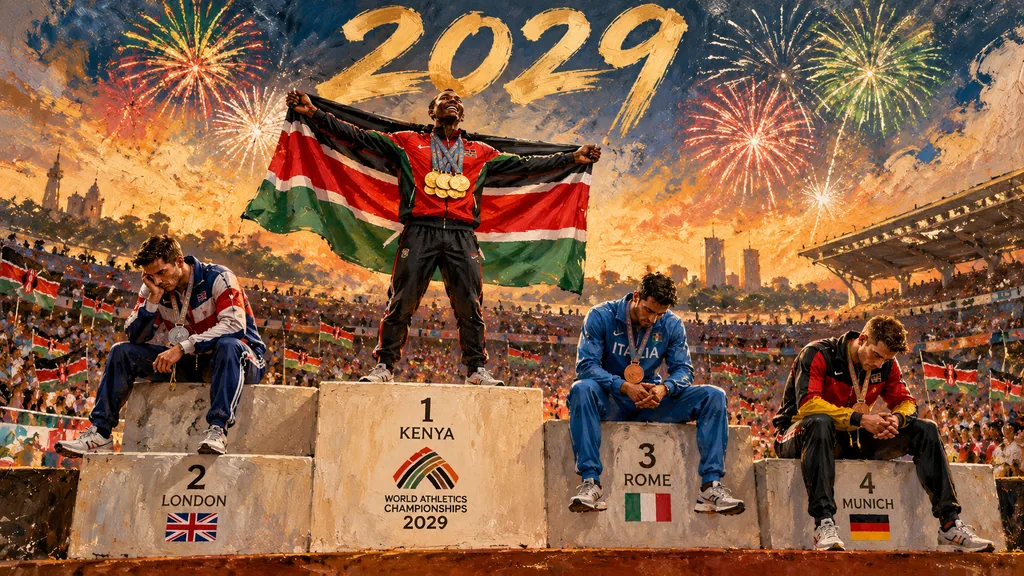
On 15 September 2026, the World Athletics Council selected Nairobi to host the 2029 World Athletics Championships. Kenya beat bids from London, Rome and Munich. Munich was awarded the 2031 edition.
That makes Nairobi the first African city to host the senior outdoor championships.
This is history. It is also business.
Kenya now has AFCON Pamoja 2027 followed by the World Athletics Championships in 2029. Add the general election and you get a wider 2027 attention collision, a wave of infrastructure deadlines and two years in which global sports organisations will be watching closely.
That is not a guaranteed economic boom.
It is a rare concentration of attention.
The countries and companies that benefit from moments like this do not wait for opening week to print banners. They build the search visibility, visitor experience and conversion systems years earlier.
Nairobi has won the event. Now Kenya has to make the attention pay.
Jump to a section
- What Nairobi actually won
- Why Kenya earned this moment
- How AFCON 2027 strengthened the bid
- The 2027 to 2029 sports super-cycle
- What the economic opportunity really is
- How brands can prepare now
- What could still go wrong
- Frequently asked questions
What Nairobi actually won
Let us begin with what is confirmed.
World Athletics announced Nairobi as the 2029 host after its Council meeting in Budapest. The championships will take place in September at the Moi International Sports Centre, Kasarani.
The decision carries three important firsts.
- Nairobi will become the first African city to host the senior World Athletics Championships.
- Kenya will host the sport's flagship event in the country most closely associated with elite distance running.
- Kasarani will move from AFCON 2027 duties into another global event two years later.
That last point matters.
Large venues become expensive monuments when nobody plans what happens after the closing ceremony. Kenya now has the chance to turn a renovation deadline into a repeat-use asset.
The opportunity is real. The automatic riches are not.
No authoritative public forecast currently confirms Nairobi's visitor total, delivery budget or economic impact. Those figures should not be invented before the event plan is published.
A hosting right is not a cheque.
It is the right to build a result.
Why Kenya earned this moment
Kenya did not win because the Council suddenly discovered that we can run.
The evidence has been arriving for decades.
At the 2025 World Athletics Championships in Tokyo, Kenya finished second on the official medal table with 11 medals, including seven golds. Faith Kipyegon, Eliud Kipchoge, David Rudisha, Beatrice Chebet and generations before them have made Kenya central to the sport's biggest stories.
The country had also proved it could host.
Nairobi staged the World U18 Championships in 2017. During the penultimate day, World Athletics reported nearly 88,000 spectators across the morning and evening sessions. The evening crowd alone reached 50,300. It was described as the best-attended session in the history of an age-group athletics event.
That was the crowd proof.
The 2021 World U20 Championships offered a different kind of proof. Kenya delivered the event under pandemic restrictions. It was held behind closed doors because of COVID-19, so it should not be used as another attendance record. It demonstrated operational resilience instead.
Kenya had also bid for the 2025 senior championships and lost to Tokyo.
This time, the proposition was stronger.
World Athletics President Sebastian Coe described Nairobi's 2029 bid as “compelling and emotional.” He said the previous attempt helped the team understand what was required and return with a better offer.
The romance mattered.
So did the concrete.
How AFCON 2027 strengthened the bid
Kenya did not win the 2029 championships simply because it is hosting AFCON.
But the connection is more than a convenient story.
Kasarani is undergoing a major overhaul ahead of AFCON Pamoja 2027. When discussing Nairobi's improved bid, Coe pointed to the renovated stadium and its AFCON preparation.
That gives us a defensible connection:
- AFCON created a hard deadline for renovating Kasarani.
- The upgraded venue strengthened Nairobi's 2029 proposition.
- World Athletics gives the investment a second global use.
This is what an AFCON 2027 legacy should look like.
Not a stadium photographed beautifully for one month, then left to host pigeons and government promises.
A working venue. A second event. A longer commercial runway.
Talanta Sports City is also part of Kenya's wider sports infrastructure programme. However, the confirmed competition venue for the 2029 World Athletics Championships is Kasarani. We should not casually swap the two because both look impressive in a press release.
The same caution applies to airports, highways and hotels. Nairobi will need transport, accommodation, security and visitor services capable of carrying the event. But every city project should not be rebranded as a direct World Athletics investment without evidence.
Good strategy begins where exaggeration ends.
The 2027 to 2029 sports super-cycle
Kenya is entering a sequence of unusually valuable attention moments.
| Year | Attention event | Strategic meaning |
|---|---|---|
| 2027 | AFCON Pamoja and Kenya's General Election | Intense regional, commercial and political attention |
| 2028 | The bridge year | Time to repair gaps, retain visitors and build repeatable offers |
| 2029 | World Athletics Championships in Nairobi | Global sports attention returns to a more mature visitor economy |
This is not three uninterrupted years of tourists pouring through JKIA.
It is better than that.
It is a sequence of public deadlines.
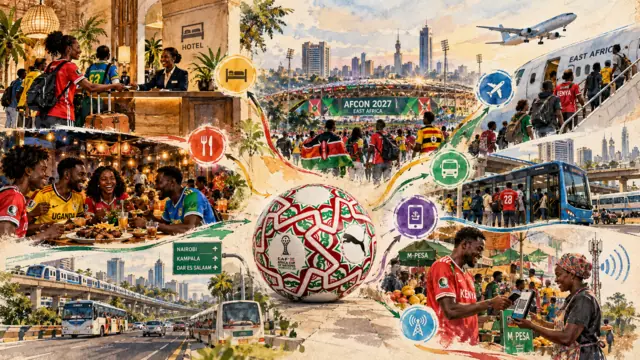
AFCON will test the stadiums, transport routes, payment systems, mobile networks, hotels, restaurants and public information available to visitors. The 2028 bridge year gives businesses time to study what failed. Then 2029 brings a different global audience and another chance to perform.
Football and athletics are not interchangeable products.
AFCON moves supporters between several host cities and three countries. World Athletics concentrates competition in Nairobi, while Kenya's broader running identity creates opportunities beyond the stadium. Eldoret, Iten, Nandi and other training centres can become part of the visitor story if the packages, transport and credible operators exist.
That is where sports tourism Nairobi can become sports tourism Kenya.
What the economic opportunity really is
Major events can generate meaningful economic activity. But impact depends on what gets built, who spends, where the money stays and how costs are counted.
For a grounded comparison, an official impact study found that the 2017 World Athletics Championships generated £79 million in direct economic impact for London. Its estimated total impact ranged from £109 million to £159.6 million.
That does not mean Nairobi will produce the same figure.
London had a different transport system, visitor mix, cost base and stock of accommodation. The useful lesson is not the number. It is the range of businesses touched by the event.
The sports economy reaches:
- Hotels and short-stay accommodation
- Airlines and airport transfer services
- Restaurants and nightlife
- Tour operators and training camps
- Banks, payment companies and foreign exchange providers
- Mobile networks and data services
- Retail, apparel and sporting goods
- Media, production and creator businesses
- Healthcare, recovery and wellness services
- Security, logistics and event suppliers
Sports tourism is also growing globally. UN Tourism cites an estimated 17.5% growth rate for the sector between 2023 and 2030.
Kenya has a natural advantage. We do not need to invent an athletics identity for a campaign. We need to package the identity we already own.
The biggest risk is assuming the story sells itself.
How brands can prepare now
The first commercial deadline is not 2029.
It is the day a traveller starts planning.
That can happen years before the gun goes off.
1. Own the planning questions
Future visitors will search for more than tickets.
They will ask:
- Where should I stay near Kasarani?
- How do I travel from JKIA to the stadium?
- Can I combine the championships with a safari?
- Which running camps accept international visitors?
- How do mobile payments work in Kenya?
- What should I know about Nairobi's altitude and weather?
Our Capture systems map these questions across Google and generative search. Then we build useful pages that deserve to be surfaced.
The goal is not to “train ChatGPT” to love your hotel.
The goal is to publish the clearest, most verifiable answer when the visitor is deciding.
2. Build products, not slogans
“Welcome to Kenya” is not an offer.
A three-night athletics package with airport transfer, breakfast, stadium transport and a clearly stated cancellation policy is an offer.
A verified Iten training extension is an offer.
A roaming bundle with simple activation instructions is an offer.
Brands should use Audience Intelligence to study public questions, reviews and complaints. Then they can build around real friction instead of a boardroom guess about what foreigners probably want.
3. Fix the international conversion journey
A visitor in another time zone should not have to phone a Nairobi landline between 8:00 AM and 5:00 PM.
Make prices clear. Show what is included. Accept appropriate payment methods. Explain refund terms. Connect enquiries to a real booking system.
Our Conversion systems remove the little obstacles that turn a willing buyer into someone else's customer.
4. Prepare operations for demand spikes
Marketing cannot rescue a broken arrival.
Hotels need inventory discipline. Transport companies need dispatch plans. Telecoms need capacity planning. Banks and fintech companies need clear support for international cards, mobile money and foreign exchange.
Automated WhatsApp and email flows can handle common questions around the clock. They should support people, not trap them in a robot maze.
5. Measure what stayed in the business
Do not finish 2029 with a beautiful campaign video and no idea what it sold.
Track:
- Search visibility before and during the event
- Qualified enquiries
- Bookings and revenue by market
- Conversion rate by device and country
- Repeat visits and cross-sells
- Customer questions that exposed operational gaps
Our Attention Analytics connects attention to commercial outcomes.
If the dashboard ends at impressions, the money may have ended there too.
What could still go wrong
Winning hosting rights is the start of the assignment.
Kenya still has to deliver:
- Kasarani on time and to championship standard
- Reliable transport and crowd movement
- Safe, clear and fairly priced visitor experiences
- Strong event operations and public information
- An anti-doping programme worthy of global confidence
- A legacy that reaches athletes and businesses beyond one Nairobi venue
The integrity issue should not be hidden under confetti.
Kenya's doping record remains a serious challenge. World Athletics has described the championships as a catalyst for improvement, alongside the government's anti-doping commitment.
That is the right ambition. It also creates accountability.
The honest position is simple.
Kenya deserves the stage. Kenya must also meet the standard.
Frequently asked questions
Is Nairobi definitely hosting the 2029 World Athletics Championships?
Yes. World Athletics awarded the 2029 senior outdoor championships to Nairobi on 15 September 2026. Munich will host the 2031 edition.
Why is the Nairobi 2029 decision historic?
It will be the first senior World Athletics Championships staged in Africa. Kenya is also one of the sport's leading competitive nations and has previously hosted global cross-country, U18 and U20 events.
Which stadium will host the championships?
The confirmed venue is the Moi International Sports Centre, Kasarani. The stadium is undergoing a major renovation ahead of AFCON Pamoja 2027.
Did AFCON 2027 cause Nairobi to win the bid?
Not by itself. Nairobi's hosting experience, athletics heritage, operational plan, financial guarantees and legacy case all mattered. The Kasarani overhaul strengthened the proposition.
How many visitors will come to Nairobi in 2029?
No authoritative public forecast has confirmed a visitor total yet. Businesses should plan through scenarios instead of presenting an invented number as fact.
How can Kenyan businesses benefit?
Hospitality, transport, tourism, telecoms, finance, retail, wellness and media businesses can build visitor-ready offers early. The advantage comes from being discoverable, easy to buy from and operationally reliable before demand peaks.
The spotlight is booked
Your place inside it is not.
Build the visibility and conversion system before Nairobi 2029 demand peaks.
Keep pulling the thread