
On 13 October 2026, Formula 1 dropped one announcement and several African timelines immediately forgot how to behave.
Rwanda had secured a Grand Prix. South Africans wanted to know what happened to Kyalami. Human-rights groups asked what the deal would help Rwanda hide. Motorsport fans inspected a circuit that had not been built yet and decided which corners they already hated.
I had a more personal crisis.
I do not follow Formula 1 closely enough to explain tyre degradation without first consulting Google. But I do like the jackets. The caps too. F1 merchandise has somehow convinced adults that dressing like a sponsored mechanic is fashion, and I support it.
Now Rwanda is getting a Grand Prix. The universe is clearly telling me to stop pretending I only watch for the clothes.
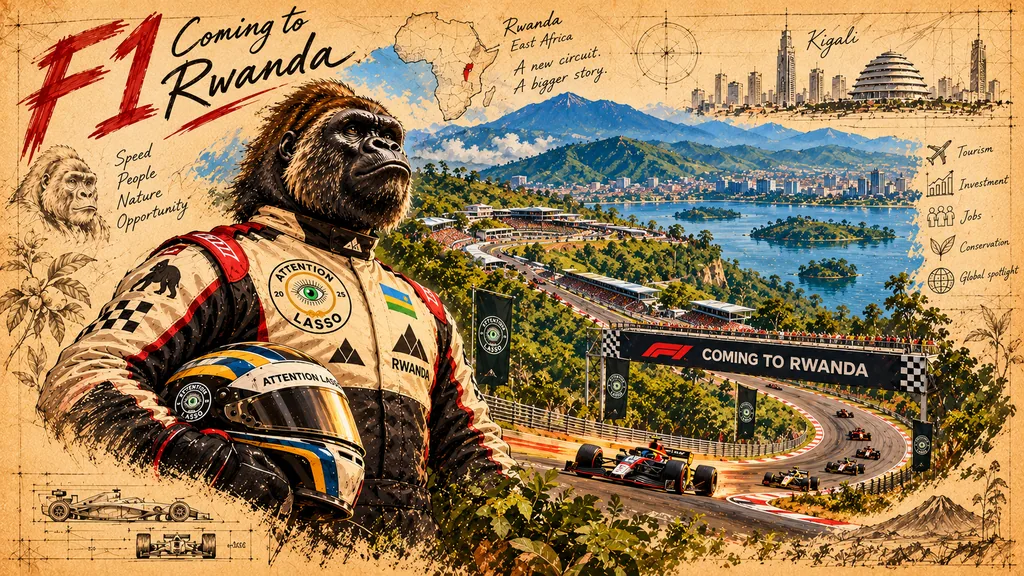
The actual announcement deserves more care than some of the headlines gave it. Formula 1 signed a ten-year agreement to race in Rwanda from the early 2030s. The Formula 1 African Grand Prix, presented by Visit Rwanda, will use a new purpose-built circuit in Bugesera, roughly 40 kilometres south of Kigali and beside the country's new international airport.
It will be Africa's first Formula 1 race since Kyalami hosted the South African Grand Prix in 1993.
That is the confirmed news. Not “Rwanda will host in 2030.” Not yet. The first date has not been announced, and the circuit still has to be built and certified to FIA Grade 1 standards.
Still, the commercial clock has started. Long before the first engine starts, people will search for flights, hotels, tickets, transport, restaurants, clothing and reasons to extend the trip. Brands will compete to be useful. Others will arrive during race week with a boosted post and optimism.
The chequered flag may eventually fall in Bugesera. The attention, visitors and money will not politely remain inside Rwanda. For tourism boards, airlines, hotels, banks, telcos, fashion labels, media companies and experience operators across East Africa, this is a long runway to build relevance before race week becomes expensive.
Jump to
- What Formula 1 actually announced
- Why the announcement has divided X
- What an F1 race can be worth
- Who the modern F1 fan really is
- What the race means for Rwanda
- Why Rwanda's neighbours should care
- The advertising opportunity
- What brands should do now
What Formula 1 Actually Announced
The official Formula 1 announcement confirms five important facts:
- Rwanda has signed a ten-year hosting agreement.
- The race is expected to enter the calendar in the early 2030s.
- The exact inaugural race date has not been confirmed.
- A purpose-built circuit will be constructed in Bugesera.
- The venue is intended to operate throughout the year for motorsport, conferences and entertainment, not only for one Grand Prix weekend.
The proposed circuit will sit roughly 40 kilometres south of Kigali, near the new international airport. Formula 1 says the design will use Rwanda's elevation changes, while circuit designers have described a fast and flowing track with substantial climbs and descents.
The official name matters too. It is not the Rwanda Grand Prix. It is the Formula 1 African Grand Prix, presented by Visit Rwanda.
That choice is already doing marketing work. Rwanda gets the destination branding. Formula 1 gets a continental return. Both get a story much larger than a new track.
Why the Announcement Has Divided X
The reaction on X is not one clean sentiment score. It is several arguments wearing racing helmets.
This section is a rapid qualitative reading of publicly visible and reported reactions published immediately after the announcement. It is not a scientific survey of every post on X. The platform's sign-in restrictions also make a complete independent dataset difficult to audit, so any article claiming “Africa feels X” from a handful of viral posts deserves a yellow flag.
1. The celebration: Africa is finally back
For many fans, the first emotion is relief. Formula 1 says Africa already has more than 100 million F1 fans, yet the continent has been absent from the calendar since 1993.
Rwanda also gives East Africans a reason to celebrate execution. A relatively small country announced its ambition, built relationships with motorsport's governing institutions and secured a ten-year agreement. That has inspired praise from people who see the deal as proof that African countries can compete for premium global events.
The excitement is not only about watching cars. President Paul Kagame framed the agreement around Africans seeing themselves as “engineers, technicians, entrepreneurs and, one day, drivers.” That ambition is part of the event's sales pitch, and it should be measured against the training, contracts and jobs that eventually materialise.
2. The South African frustration: what happened to Kyalami?
South Africa has history, a large motorsport audience and the continent's last F1 host circuit. Many fans therefore assumed Formula 1's return would happen at Kyalami.
Rwanda's announcement reopened frustration over delays in South Africa's bid and political promises that did not produce a race. South African sports minister Gayton McKenzie congratulated Rwanda and argued that Africa should not be treated as if it can host only one Grand Prix. That is a fair point. Formula 1 has staged multiple races inside individual countries. Africa is not one market with one parking space.
The sharper X posts were less diplomatic. Rwanda's win became a comparison of state capacity, leadership and follow-through. Some of that criticism is useful. Some is merely national rivalry discovering Wi-Fi.
3. The human-rights argument: prestige or sportswashing?
This is the part a credible commercial analysis cannot skip.
Amnesty International criticised the agreement, calling it a “sportswashing prize” and pointing to allegations of arbitrary detention, torture and repression of free speech. Critics have also raised Rwanda's alleged support for the M23 rebel group in neighbouring Democratic Republic of Congo. Rwanda has denied supporting M23.
Formula 1 responded that sport can be a positive force and that the agreement can bring the sport closer to African fans. Rwanda presents the project as a long-term investment in jobs, skills, tourism and business.
Brands cannot treat this debate as background noise. Sponsorship puts a logo inside the political meaning of an event. Before buying visibility, companies need a human-rights review, a stakeholder-risk assessment and a clear explanation of the local value they intend to create.
Silence is also messaging. It is simply messaging you did not write.
4. The public-cost question: who pays, and who wins?
Neither the official Formula 1 announcement nor Rwanda's initial announcement disclosed the circuit's construction budget, annual hosting fee, financing structure or expected public contribution.
That information matters. A crowded hotel is not proof that taxpayers received value. A beautiful broadcast shot is not an audited return on investment.
The useful question is not whether F1 creates spending. It clearly can. The question is whether the additional visitor spending, taxes, jobs, skills and year-round use justify the full public and private cost.
Until those figures are published, confidence should not dress up as arithmetic.
5. The internet being the internet: the name and the render
Some fans dislike Rwanda branding its race as the “African Grand Prix” rather than the Rwanda or Kigali Grand Prix. Supporters see the continental name as generous. Critics see one country claiming a very large identity.
Others ignored the geopolitics and attacked the launch visuals. The proposed circuit rendering was mocked as “AI slop”, while some fans debated whether the track would create good racing before a single shovel touched Bugesera.
This may sound trivial. It is not entirely trivial.
Fans now judge an event years before opening day. A concept image becomes a brand asset. A track name becomes a political statement. Every announcement enters a live focus group with no moderator and several people typing in capital letters.
That is why audience intelligence must begin before the campaign. The discourse is already telling organisers and brands what people love, fear and mistrust.
What an F1 Race Can Be Worth
While X argues over national pride, politics and the quality of the rendering, finance teams will eventually have to answer a less glamorous question: does the race make money for Rwanda?
Imagine the weekend properly. A visitor lands on Thursday. They need a flight, a hotel, mobile data, transport, food, a race ticket and something unnecessarily branded to wear. A corporate guest adds hospitality. A creator adds content. A family adds several opinions about where to eat.
That spending moves through airlines, hotels, restaurants, retailers and event suppliers before a car completes one lap. Formula 1 can also deliver global broadcast exposure and year-round destination awareness. Host figures from mature races show the scale, but they also show why every large number needs context.
Singapore's tourism board reported more than 720,000 international visitors and S$2.2 billion in tourism receipts from its night race between its 2008 debut and 2024. The 2025 Singapore Grand Prix recorded more than 300,000 attendances across three days. These are cumulative tourism receipts and multi-day attendance counts, not the race's net profit.
For the inaugural 2023 Las Vegas Grand Prix, an Applied Analysis study reproduced in Clark County's debriefing report reported:
- $501 million in net visitor spending
- $884 million in economic impact from visitor spending
- $1.5 billion in total economic impact after including F1 operations and capital investment
- $77 million in state and local tax revenue
Those figures illustrate scale, but they need a warning label. The Las Vegas totals include one-off capital expenditure, and the analysis was produced for organisations involved in the local event economy. “Economic impact” measures activity moving through an economy. It does not automatically equal government revenue, public profit or money that reached ordinary households.
Recent sports-economics research makes the same distinction. A 2025 peer-reviewed study of economic impact and fiscal loss in sporting events found that fiscal revenue is generally only a small share of headline economic impact, meaning public expenditure can still exceed the additional tax collected.
Here is the sensible way to read future Rwanda projections:
| Number announced | What to ask next |
|---|---|
| Total attendance | How many were unique visitors, international visitors and local repeat attendees? |
| Visitor spending | How much was genuinely additional rather than displaced from other tourism? |
| Economic impact | Does it include construction, F1 operations or money that leaves the country? |
| Jobs created | How many are permanent, skilled and locally held? |
| Tax generated | How does it compare with public construction, hosting, security and transport costs? |
| Media value | Did awareness produce bookings, investment leads or export sales? |
Rwanda enters this project with an existing tourism and events strategy. The Rwanda Development Board says the country welcomed 1.49 million visitors and earned a record $685 million in tourism revenue in 2025, up from $647 million in 2024. Its meetings, incentives, conferences and events sector generated $94.7 million from more than 61,000 delegates in 2025.
F1 therefore does not arrive on a blank sheet. It joins an established effort to attract higher-value visitors and global events.
Whether it becomes good economics will depend on financing, local procurement, skills transfer, airport and transport delivery, visitor length of stay, and whether the Bugesera venue earns money during the other 51 weeks of the year.
Who the Modern F1 Fan Really Is
The lazy stereotype is simple: wealthy older men who know the difference between a diffuser and whatever the rest of us think a diffuser is.
That audience still exists. It is just no longer the whole market.
Formula 1's 2026 half-year review reports more than 830 million followers worldwide. The same report says 43% of the fanbase is under 35 and 42% is female. For key sub-Saharan African markets, Formula 1 says almost 60% of its fans are under 35.
Its 2025 Global F1 Fan Survey drew more than 100,000 responses from self-identified, highly engaged fans in 186 countries. Among those respondents:
- 61% engaged with F1 content every day.
- 76% said sponsors enhance the sport.
- Three out of four new fans in the study were women.
- Gen Z respondents were especially active through streaming and social media.
The methodology matters. This was a survey of engaged fans, not a random sample of the entire public. Still, it tells brands what the commercially active end of the audience looks like.
The modern F1 consumer may be:
- a technical fan who follows race strategy and engineering;
- a young viewer introduced through streaming, TikTok or driver content;
- a corporate guest buying hospitality and networking access;
- an international traveller building a holiday around race weekend;
- a fashion buyer who wants the jacket but cannot yet explain DRS;
- a celebrity-culture follower drawn in by driver appearances and off-track stories.
This mix is why F1 sponsorship stretches far beyond oil, tyres and men shouting about engines. The sport now sits at the intersection of technology, travel, luxury, music, fashion, gaming, food, finance and celebrity.
I may have to learn the sporting regulations after all. It feels irresponsible to own this much racing-inspired clothing without knowing what qualifying is doing.
What the Race Means for Rwanda
Rwanda is not buying one weekend of noise. It is attempting to build a destination platform.
Picture the intended journey. A traveller lands beside the future circuit, spends the weekend in Bugesera and Kigali, adds a conference or business meeting, then stays for one of Rwanda's premium tourism experiences. The airport, race and destination become one commercial story instead of three unrelated projects.
If delivery matches the promise, the project could strengthen five parts of the country's economy:
Tourism
Race visitors can be sold more than a grandstand seat. Rwanda can package Kigali, conferences, conservation tourism and regional itineraries around a premium event. The commercial win is a longer stay, not merely a full hotel for three nights.
Aviation and infrastructure
Placing the circuit beside the new airport creates an obvious transport and destination-marketing corridor. It also creates risk. Airport, road, public transport and event access must work together under peak demand.
Meetings and corporate hospitality
F1 is part sport and part moving business summit. Sponsors, executives, investors, creators and media arrive in the same city. Rwanda already has a growing meetings and events sector. The Grand Prix can extend it if local firms are included in supply chains and corporate programmes.
Skills and enterprise
Motorsport requires event operations, engineering, logistics, broadcasting, security, data, hospitality and content production. The legacy will be more credible if training begins years before the first race and local people hold skilled roles after it.
National positioning
“Visit Rwanda” has already used global sport to market the country through football and basketball partnerships. Formula 1 makes that strategy impossible to miss. It also increases scrutiny. The brighter the global spotlight, the more closely audiences examine governance, public spending and regional politics.
Attention is an asset. It is also an audit.
Why Rwanda's Neighbours Should Care
The race is in Rwanda. The commercial catchment is East Africa.
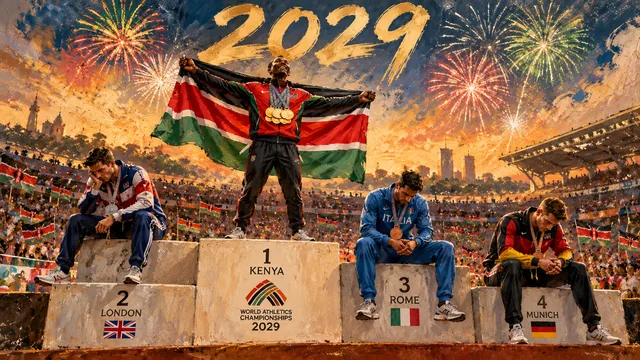
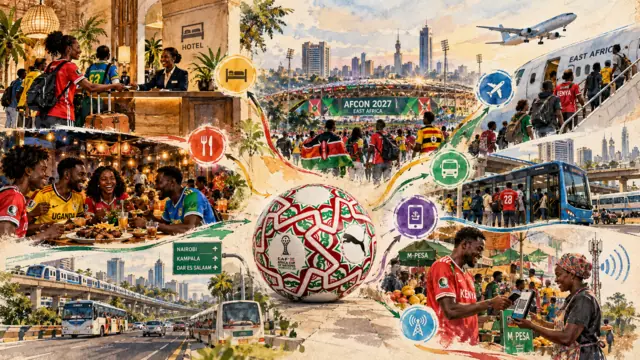
CAF has confirmed that Kenya, Uganda and Tanzania will co-host AFCON PAMOJA 2027, an opportunity we examine in our AFCON guide. World Athletics has selected Nairobi to host its 2029 championships, the first senior edition held in Africa, which we analyse in our Nairobi 2029 article. Rwanda's Grand Prix is the next major marker in a regional calendar that is becoming difficult for global sponsors to ignore.
This is not proof of one coordinated East African sports strategy. It is a pattern of awarded events. The opportunity is to connect them intelligently.
Rwanda's neighbours can benefit through:
- Air connectivity: Regional carriers and airports can sell feeder routes and multi-city journeys.
- Tour extensions: Operators can package the race with Kenyan coast trips, Tanzanian safaris, Ugandan experiences and regional city breaks.
- Overflow demand: Hotels, production crews and event suppliers can serve visitors and brands whose plans extend beyond Rwanda.
- Creative exports: East African agencies, filmmakers, creators, musicians, stylists and production teams can compete for campaign work.
- Payments and connectivity: Banks, fintechs, telcos and eSIM providers can solve the practical problems international visitors meet across borders.
- Business events: Nairobi, Kampala, Dar es Salaam and other regional centres can host satellite conferences, partner meetings and fan events.
None of this happens automatically. Rwanda will understandably try to retain as much value as possible. Neighbouring brands need a useful offer, discoverable pages and booking systems long before travellers begin searching.
A fan flying from London does not have to return home immediately after Sunday. They could continue to Nairobi, Kampala, Zanzibar or the Kenyan coast. But they will only buy that extension if somebody makes it visible, credible and easy to book. Regional opportunity is not a magical mist that drifts across borders. Someone has to package it.
The Advertising Opportunity
A Grand Prix is not one race. It is a three-day global content factory wearing a very expensive watch.
The marketing opportunity begins years earlier and continues between events. In fact, the first race has already started. It is happening in search results, social feeds, news coverage and AI-generated answers while the physical circuit is still a plan.
Search demand will form before race week
Future visitors will search for tickets, visas, flights, hotels, transfers, restaurant bookings, safari extensions, mobile data, payment options and what to wear. Generative AI will answer many of those questions before users visit a website.
Brands that build accurate, useful and well-structured information early have time to earn visibility on Google and inside AI answers. Brands that wait until launch month will discover that somebody else already owns the useful queries.
Our SEO, AEO and GEO systems help brands build that discovery layer before the advertising auction becomes crowded.
Content will move faster than traditional campaigns
The audience will not wait for the approved television commercial. Fans will be watching driver arrivals, team fashion, circuit progress, travel mishaps, celebrity sightings, food, nightlife and behind-the-scenes clips in real time.
The winning content plan needs several lanes:
- authority content for search and AI;
- fast social video for live attention;
- creator partnerships with clear disclosure;
- useful travel content that earns saves and shares;
- premium storytelling for investors and corporate audiences;
- crisis and response protocols for political or operational controversy.
Sponsorship is only valuable if people remember the sponsor
Buying logo space is not the same as owning a commercial association. Brands need a role in the experience.
A payments company can remove transaction friction. A telco can solve connectivity. A fashion brand can interpret racing culture for an African audience. A bank can host business conversations. An airline can make the route easier. A hotel can turn the weekend into a complete itinerary.
The question is not “Where can we place our logo?”
It is “What part of this experience can we make noticeably better?”
Rights discipline will matter
Formula 1's names, logos, footage and event marks are protected commercial assets. Brands should not imply an official relationship they do not have. A smart campaign can participate in the wider travel, fashion or sports conversation without ambush marketing or misleading customers.
Legal review is cheaper than receiving an angry letter written by people who bill by the hour.
What Brands Should Do Now
The first race is years away. That is the advantage.
1. Decide which customer you can genuinely help
Do not begin with a sponsorship package. Begin with a person.
Is your customer a travelling fan, a corporate guest, a regional business, a creator, an event supplier or a local young person seeking work? Their problem should determine the offer.
2. Build a regional search map
Identify the questions that will grow around flights, accommodation, transport, payments, tourism, fashion, hospitality and business events. Publish useful pages before every keyword becomes a bidding war.
3. Monitor the argument, not just the applause
Track how people discuss cost, access, national pride, human rights, Kyalami, the “African Grand Prix” name and local benefits. Sentiment is not a decorative dashboard. It tells you where a campaign can earn trust or walk into a wall.
4. Design a measurable offer
Connect content to reservations, qualified leads, ticketed experiences, app use, sales or partner enquiries. Impressions are pleasant. Revenue pays invoices.
Conversion systems should be ready for international traffic, multiple time zones and people who will not complete a form designed like a tax return.
5. Create value that lasts after the podium
The strongest event strategy leaves behind searchable content, trained staff, customer data, supplier relationships, repeat visitors and products people still want when the engines stop.
That applies to governments too. Rwanda's Grand Prix should eventually be judged through transparent costs, additional tourism revenue, tax receipts, local procurement, permanent employment, skills transfer and year-round venue use.
The announcement is historic. The legacy still has to be engineered.
Africa Is Becoming the Venue, Not Just the Audience
East Africa's near-term sports calendar now includes AFCON PAMOJA 2027, the Nairobi 2029 World Athletics Championships and an African Grand Prix in Rwanda in the early 2030s.
For decades, African fans helped create the global audience while the largest events, hospitality budgets and sponsor activations happened elsewhere. That balance is beginning to shift.
Hosting brings opportunity. It also brings invoices, deadlines and scrutiny. The real victory is not appearing beautifully in a global broadcast. It is converting the spotlight into capable local suppliers, skilled jobs, stronger tourism, exportable creative work and businesses that retain customers after everyone flies home.
Rwanda has won the right to start that race.
There are two ways for an East African brand to experience this moment. It can watch the first race from the sofa and post a flag emoji. Or it can spend the years before lights out building the offer, authority and systems that turn global attention into customers.
The first option is easier. The second one pays.
Frequently asked questions
Is Rwanda hosting a Formula 1 Grand Prix in 2030?
Not in a confirmed calendar year. Formula 1 announced a ten-year agreement for the African Grand Prix to join the calendar in the early 2030s. The first date will follow completion and approval of the Bugesera circuit.
Where will the Rwanda F1 circuit be located?
The planned circuit will be in Bugesera, about 40 kilometres south of Kigali and next to Rwanda's new international airport.
Why is it called the African Grand Prix?
Formula 1 and Rwanda announced it as the Formula 1 African Grand Prix, presented by Visit Rwanda, positioning the event as the continent's return to the calendar after 1993.
What could the Grand Prix mean for Rwanda's economy?
It could increase tourism, hospitality demand, aviation traffic, conferences, sponsorship and event-related employment. The net benefit cannot yet be calculated because major cost and financing details are not public.
Which East African brands could benefit?
Airlines, airports, hotels, tour operators, restaurants, payment providers, banks, telcos, fashion labels, media companies, event suppliers and professional services firms could benefit.
Lights out is years away
The commercial starting grid is already forming.
Build the authority and conversion system that turns regional attention into customers.
Keep pulling the thread